
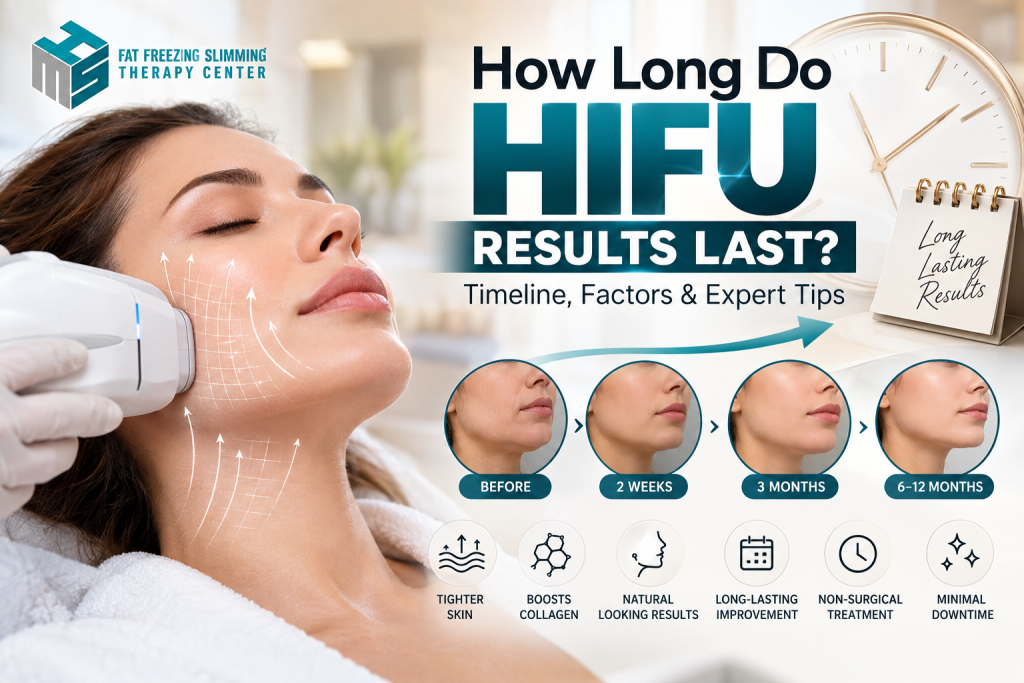
How Long Do HIFU Results Last?
If you are considering HIFU, one of the most practical questions to ask is not simply, “Does it work?” but “How long will the results actually last?”
The answer is more nuanced than a fixed number of months.
HIFU, particularly microfocused ultrasound used for aesthetic skin tightening, works by delivering focused ultrasound energy into selected deeper tissue layers. The treatment creates controlled thermal effects that trigger tissue contraction and a longer remodeling process involving collagen. Because collagen remodeling takes time, the final appearance does not necessarily arrive immediately after the appointment.
For many suitable patients, visible improvement develops over the following weeks and months. Clinical research has documented meaningful facial and neck improvement for up to around a year after a single treatment, while newer research has found measurable benefits continuing through 9–12 months. However, HIFU results are not permanent, because the natural aging process continues after treatment.
So, if you are planning HIFU in Dubai, the better question is:
How long can my individual result remain noticeable, and what can I realistically do to maintain it?
This guide explains the timeline, factors affecting longevity, maintenance strategy, common mistakes and what the evidence actually tells us.
What Is HIFU and How Does It Work?
HIFU stands for High-Intensity Focused Ultrasound.
In aesthetic medicine, focused ultrasound can be used to deliver energy beneath the skin without creating an incision. Depending on the device and indication, energy can be directed to particular tissue depths, producing controlled thermal coagulation points that encourage tissue contraction and remodeling.
The FDA’s current documentation for the Ulthera System, for example, describes focused ultrasound energy being delivered below the skin surface to produce discrete thermal coagulation points and temporary changes in the appearance of lax skin. Indications include lifting lax submental and neck tissue and improving the appearance of lines and wrinkles in specified areas.
This distinction matters because HIFU is not simply “heating the skin.”
Treatment depth, energy delivery, treatment area, device technology, patient anatomy and practitioner technique all influence the outcome.
Why Doesn’t HIFU Show Its Full Result Immediately?
Your skin needs time to respond to the controlled energy delivered during treatment.
The process can involve:
- Initial tissue contraction
- Collagen remodeling
- Gradual changes in skin firmness
- Improvement in the appearance of lax tissue
- Progressive refinement of the treated area
The American Academy of Dermatology notes that ultrasound-based non-invasive skin tightening generally produces gradual results, with modest lifting and tightening often becoming apparent over approximately 2–6 months.
That is why judging the treatment solely from the mirror a few days after the appointment can be misleading.
So, How Long Do HIFU Results Last?
For facial and neck skin tightening, around 6–12 months is a reasonable evidence-based timeframe to discuss, although individual results can vary considerably.
Some clinical studies have documented improvement at six months and maintained results at one year. A study involving 50 adults treated for mid- and lower-face sagging reported that improvements observed at six months were maintained at one year.
Another prospective study following patients after microfocused ultrasound treatment reported appreciable lifting and tightening with improvements maintained for up to one year.
More recent research published in 2026 followed 28 women for 12 months after one microfocused ultrasound treatment. The researchers found that several objective measures of improvement remained statistically significant at 12 months, with collagen-related measurements peaking later in the follow-up period and remaining elevated at 12 months.
This does not mean every person will have the same result for exactly 12 months.
Think of HIFU longevity as a range rather than an expiration date.
A patient with mild-to-moderate laxity, stable weight and good skin quality may experience a different duration of visible improvement from someone with significant laxity, substantial sun exposure or major weight fluctuations.
HIFU Results Timeline: What to Expect
Understanding the timeline can prevent unrealistic expectations.
Immediately After Treatment
Some people notice a subtle tightening effect shortly after treatment, while others notice little visible change.
Temporary redness, sensitivity, tenderness or swelling can occur depending on the treatment and individual response.
An immediate appearance should not be considered the final result.
First 2–6 Weeks
The skin begins its remodeling response.
You may notice:
- Slightly firmer skin
- A more defined jawline
- Subtle improvement in laxity
- Changes that are more noticeable in photographs than in the mirror
However, results can still be developing.
Around 2–3 Months
This is an important assessment period.
Research has found clinically meaningful improvement around the three-month point in several microfocused ultrasound studies. A 2026 prospective study reported peak overall aesthetic improvement around three months.
For some patients, this is when the difference becomes easier to appreciate.
Around 3–6 Months
Collagen remodeling continues.
The American Academy of Dermatology describes ultrasound skin tightening results as developing gradually, commonly within approximately two to six months.
This is also a useful time to compare standardized photographs rather than relying entirely on day-to-day visual impressions.
Around 6–12 Months
The result may remain visible, but the exact degree of improvement varies.
Clinical evidence has demonstrated continued improvement at six months and maintained benefits at one year in some patient groups.
The newer 12-month study also found continued measurable effects in facial and submental regions.
What Determines How Long HIFU Results Last?
There is no universal “HIFU lasts X months” rule because several variables influence the outcome.
1. Your Age and Natural Collagen Production
Collagen production and skin elasticity change with age.
Two people receiving the same treatment may therefore experience different degrees and durations of improvement.
Age itself is not necessarily a reason to avoid HIFU. Instead, the quality of the skin and degree of laxity should be considered during assessment.
2. Degree of Skin Laxity
HIFU is generally more suitable for mild-to-moderate laxity than for very large amounts of loose skin.
If there is significant excess skin, a non-surgical treatment may not create the degree of lifting someone expects.
The AAD similarly notes that people with extensive sagging may not obtain the desired benefit from non-invasive skin tightening.
3. Treatment Area
The longevity of results can differ depending on the anatomical area.
Interestingly, the 2026 study found that submental improvement demonstrated greater durability than some facial measurements during the 12-month follow-up.
This highlights an important point: HIFU results should be assessed by treatment area rather than assuming the whole face will respond identically.
4. Treatment Parameters and Technique
HIFU is not simply about selecting the highest possible energy.
The treatment must be matched to:
- Tissue depth
- Anatomy
- Skin condition
- Treatment objective
- Device specifications
- Appropriate energy settings
- Treatment pattern
A recent 2026 study examined how energy level, exposure duration and focal depth influence thermal accumulation, reinforcing the importance of parameter selection.
5. Weight Changes
Significant weight gain or weight loss can change facial and body contours.
Even if HIFU successfully improves skin laxity, subsequent changes in underlying tissue volume can alter the appearance of the treated area.
Maintaining a relatively stable weight can therefore help preserve the overall aesthetic result.
6. Sun Exposure and Skin Aging
Ultraviolet exposure contributes to collagen breakdown and visible skin aging.
This means someone who consistently protects their skin from UV exposure may be working against fewer ongoing environmental factors than someone with frequent unprotected sun exposure.
The AAD recommends sun protection as part of maintaining healthier-looking skin and advises people considering skin-tightening procedures to protect their skin from the sun.
7. Your Overall Skin Health
Skin quality matters.
Hydration, smoking, sun exposure, lifestyle factors and the underlying condition of the skin can influence how the face ages after treatment.
Can HIFU Results Be Permanent?
No.
HIFU can create a period of visible tightening and remodeling, but it does not stop biological aging.
Your skin continues to experience:
- Collagen degradation
- Changes in elasticity
- Sun exposure
- Environmental stress
- Changes in facial volume
- Natural tissue movement
Therefore, HIFU should be viewed as a maintenance-oriented aesthetic treatment, rather than a permanent replacement for aging.
This is one reason why promising “permanent facelift without surgery” claims should be approached carefully.
The FDA documentation for the Ulthera System specifically describes its aesthetic effects as temporary changes in the physical appearance of skin.
HIFU vs Other Skin Tightening Options
| Treatment | Main Approach | Result Development | Typical Longevity Consideration | Downtime |
|---|---|---|---|---|
| HIFU / Microfocused Ultrasound | Focused ultrasound energy | Gradual, often 2–6 months | Often discussed around 6–12 months depending on patient and treatment | Little to none |
| Radiofrequency | Controlled heat in tissue | Gradual | Variable; depends on technology and treatment plan | Usually minimal |
| Laser Skin Resurfacing | Laser energy and controlled skin remodeling | Gradual after healing | Variable | Can be several days or more |
| Surgical Facelift | Surgical repositioning of tissue | More immediate after recovery | Generally longer-lasting than non-surgical options | Significant |
| Skincare | Topical support for skin quality | Slow and subtle | Requires continued use | None |
The American Academy of Dermatology emphasizes that non-invasive skin tightening produces more modest effects than surgical lifting, while offering advantages such as little downtime.
The right choice depends on the problem being treated rather than simply selecting the treatment with the longest advertised duration.
Pros and Cons of HIFU
Pros
- Non-invasive approach
- No surgical incision
- Usually little or no downtime
- Gradual, natural-looking improvement
- Can target areas such as the jawline, under-chin region and neck depending on the device and indication
- Stimulates a biological remodeling response
- Useful for selected patients with mild-to-moderate skin laxity
- Can be incorporated into a longer-term skin-maintenance strategy
Cons
- Results are not permanent
- Improvement is gradual
- Results vary significantly between individuals
- It cannot reproduce the degree of lifting achieved by surgery
- Treatment can cause discomfort
- Temporary redness, swelling or tenderness may occur
- Incorrect treatment parameters can affect safety and results
- Not every person with loose skin is an appropriate candidate
A key advantage of HIFU is therefore not “maximum lifting.” It is the combination of non-invasive treatment, gradual improvement and limited downtime for appropriately selected patients.
Does More HIFU Mean Better Results?
Not necessarily.
This is one of the most important points for anyone considering treatment.
More energy, more treatment lines or more frequent sessions do not automatically mean a better aesthetic outcome.
HIFU works through controlled energy delivery. Treatment parameters should be selected according to anatomy and the intended treatment area.
Over-treatment is not the same as optimization.
The 2026 research examining treatment parameters found that focal temperatures increased with higher energy levels and longer exposure durations, illustrating why energy delivery needs to be controlled rather than simply maximized.
At HMS Fat Freezing, the practical approach should be to assess the patient’s concerns and tissue characteristics before recommending a treatment plan rather than promising the same protocol to everyone.
When Should You Consider a HIFU Maintenance Treatment?
There is no universal calendar that says every patient needs another session after exactly six or twelve months.
A maintenance decision should consider:
- How much improvement you achieved
- Whether the result is still visible
- Your current degree of skin laxity
- Your age and skin quality
- Whether your weight has changed
- Whether new concerns have appeared
- Your previous treatment response
- The specific device and treatment area
Rather than automatically repeating treatment because a certain number of months has passed, a professional reassessment can help determine whether another session is actually appropriate.
A Practical Way to Track Your Result
One useful strategy is to take standardized photographs:
Before treatment → 3 months → 6 months → 12 months
Use similar:
- Lighting
- Camera distance
- Facial expression
- Head position
- Clothing
- Background
This makes subtle changes much easier to evaluate than memory alone.
It is also useful when discussing maintenance with an aesthetic professional.
Expert Recommendations from HMS Fat Freezing
At HMS Fat Freezing, we recommend approaching HIFU as part of a personalized aesthetic plan rather than treating it as a one-size-fits-all procedure.
Our practical recommendations include:
Start with the right indication.
HIFU is most useful when the primary concern is appropriate for ultrasound-based tightening. Significant excess skin may require discussion of other treatment options.
Don’t judge the result too early.
Give the collagen-remodeling process time to develop. A photograph taken immediately after treatment cannot represent the final outcome.
Don’t chase an unrealistic facelift effect.
Non-invasive tightening and surgery are different procedures with different levels of tissue change. Setting realistic expectations is part of responsible aesthetic care.
Prioritize technique over marketing claims.
Ask what device is being used, what area is being treated, what depth is appropriate and why the proposed treatment plan suits your anatomy.
Protect your investment.
Sun protection, stable weight and a consistent skincare routine can support overall skin quality while the natural aging process continues.
Reassess instead of automatically repeating.
Maintenance should be based on your response and current skin condition, not simply an arbitrary date on the calendar.
Most importantly, a consultation should focus on what you want to change, what HIFU can realistically accomplish and whether another treatment may be more appropriate.
HIFU for Jawline and Double-Chin Concerns
One of the reasons people search for HIFU is the desire for a sharper jawline.
When the appearance of a soft jawline is primarily related to skin laxity, ultrasound-based tightening may be considered as part of a treatment plan.
However, a less-defined jawline can have several causes:
- Skin laxity
- Submental fat
- Facial structure
- Aging-related volume changes
- Genetics
- Weight changes
HIFU does not address every cause in the same way.
This is why “HIFU for double chin” should not automatically mean that HIFU is the correct treatment for every double chin.
A consultation should first identify what is creating the appearance of fullness or laxity.
What Makes HIFU Results Look Natural?
The gradual nature of collagen remodeling can be an advantage.
Instead of producing an abrupt surgical change, non-invasive tightening can produce a progressive change in the appearance of the treated tissue.
The AAD notes that results from non-invasive skin-tightening procedures tend to appear gradually, which can make them look natural.
This is particularly relevant for people who want to look refreshed rather than dramatically different.
Safety and Choosing a Qualified Provider
HIFU should not be treated like an ordinary beauty service simply because it does not involve surgery.
Focused ultrasound delivers energy into tissue, so proper patient assessment, anatomical knowledge and device handling matter.
Published research generally reports favorable safety profiles for appropriately performed microfocused ultrasound, with commonly reported effects such as temporary redness, swelling, tenderness or discomfort.
The AAD recommends consulting a board-certified dermatologist for skin-tightening assessment and notes that provider expertise is important when selecting these procedures.
When considering a clinic, ask:
- What device will be used?
- What is the intended treatment depth?
- What specific concern is being treated?
- Am I a suitable candidate?
- What improvement is realistic for my skin?
- When should I expect the peak result?
- When should my result be reassessed?
- What alternatives would make sense for my particular concern?
Those questions are often more useful than asking simply, “How many months does HIFU last?”
Frequently Asked Questions About HIFU Results
1. How long do HIFU results usually last?
For facial and neck tightening, research has documented improvement lasting approximately six months to one year in many study settings. Some newer research has demonstrated measurable benefits at 12 months. Individual longevity varies according to anatomy, skin laxity, age, treatment parameters and lifestyle.
2. When will I see HIFU results?
Some people notice an early tightening effect, but the main improvement develops gradually. The AAD reports that ultrasound skin-tightening results commonly become apparent over approximately 2–6 months.
3. Are HIFU results permanent?
No. HIFU can stimulate tissue remodeling and improve the appearance of skin laxity, but it does not stop natural aging. The FDA’s documentation describes the aesthetic changes produced by the Ulthera System as temporary.
4. Does HIFU tighten skin immediately?
Some patients may notice subtle immediate changes, but this should not be confused with the final result. Much of the improvement develops as the tissue undergoes remodeling over subsequent weeks and months.
5. How often should I repeat HIFU?
There is no single schedule that applies to everyone. A repeat treatment should be considered after assessing the original response, current skin laxity, treatment area and individual goals. Automatic retreatment at a fixed interval is not necessarily appropriate.
6. Does HIFU work better on younger skin?
Age alone does not determine the outcome. The degree of skin laxity, skin quality, anatomy and treatment goals are important. A proper assessment is more useful than using age as the only deciding factor.
7. Can HIFU remove a double chin?
HIFU may be useful for selected patients when skin laxity contributes to the appearance of a double chin. However, a double chin can also involve submental fat or anatomical factors. The appropriate treatment therefore depends on the underlying cause.
8. Is HIFU better than a facelift?
They are not equivalent procedures. A facelift involves surgery and can produce substantially more dramatic lifting, while HIFU is non-invasive and generally provides more modest tightening with little downtime. The AAD specifically distinguishes non-invasive skin tightening from surgical lifting.
9. Can I make my HIFU results last longer?
You cannot stop the aging process, but you can support your overall skin health. Protecting your skin from UV exposure, maintaining a stable weight, avoiding smoking and following a sensible skincare routine can help preserve healthy-looking skin. The AAD specifically recommends sun protection, healthy weight maintenance and avoiding smoking for people considering skin tightening.
10. Why did my HIFU results not last as long as someone else’s?
Treatment response is individual. Differences in skin laxity, anatomy, age, collagen response, weight changes, sun exposure, treatment parameters and expectations can all contribute. Clinical studies themselves demonstrate variability between patients and anatomical regions.
Related Treatment Guides
If you are researching non-surgical body and facial treatments, you may also find these HMS Fat Freezing resources useful:
- HIFU Treatment in Dubai – Understand how ultrasound-based aesthetic treatments can be incorporated into a personalized treatment plan.
- Non-Surgical Fat Reduction in Dubai – Learn how non-invasive body-contouring approaches differ from skin-tightening procedures.
- Body Sculpting in Dubai – Explore treatment considerations when the concern involves body contour rather than skin laxity alone.
- Weight Loss in Dubai – Understand why weight management and aesthetic body contouring address different goals.
These distinctions matter because skin tightening, fat reduction and weight loss are not interchangeable treatments. Choosing the right approach begins with identifying the actual cause of the concern.
What the Evidence Tells Us
The evidence surrounding ultrasound-based skin tightening is encouraging, but it should be interpreted realistically.
Earlier clinical studies demonstrated facial and neck improvement at 6–12 months in selected patients.
More recent research has added objective measurements and suggests that collagen-related changes may continue developing well after the initial treatment, with measurable improvements still present at 12 months in a small prospective study.
At the same time, not every study reports identical results. For example, a retrospective study of 24 patients found that investigator-assessed improvement was more limited than patient-reported improvement after a single treatment, highlighting why subjective satisfaction and objective assessment do not always tell exactly the same story.
That is an important EEAT point: HIFU should be discussed using evidence ranges and individual assessment, not guaranteed results.
Final Thoughts: Think in Terms of Skin Maintenance, Not a Countdown
So, how long do HIFU results last?
For suitable patients undergoing ultrasound-based facial or neck tightening, a practical expectation is that improvements may develop over several months and can remain noticeable for approximately 6–12 months, with some research demonstrating measurable benefits at the one-year mark.
But the calendar is only one part of the answer.
Your starting level of laxity, anatomy, treatment parameters, age, lifestyle, weight stability and ongoing skin aging all influence what happens after treatment.
The most useful mindset is therefore not:
“HIFU will last exactly 12 months.”
It is:
“HIFU can provide a period of gradual improvement, and my result should be reassessed as my skin changes.”
That approach allows treatment decisions to remain individualized rather than driven by marketing promises.
For anyone considering HIFU in Dubai, the goal should be a treatment plan based on appropriate candidacy, realistic expectations, qualified assessment and long-term skin health.
Authoritative Resources
- American Academy of Dermatology – Skin Tightening
- FDA – Ulthera System 510(k) Information
- PubMed – 2026 Long-Term Microfocused Ultrasound Study
- PubMed – Microfocused Ultrasound for Facial and Neck Lifting
- Cleveland Clinic – HIFU Overview
Visit HMS Fat Freezing in Dubai
If you are considering HIFU or another non-surgical aesthetic treatment, HMS Fat Freezing can assess your concerns and help determine which approach is appropriate for your goals.
HMS Fat Freezing
HAMSAH BUILDING, OFFICE 407 & 408,
BLOCK-A, Business Center – Beside Ansar Gallery – Dubai
Phone: +971 4 583 2989
Email: info@hmsfatfreezing.com
Website: hmsfatfreezing.com