
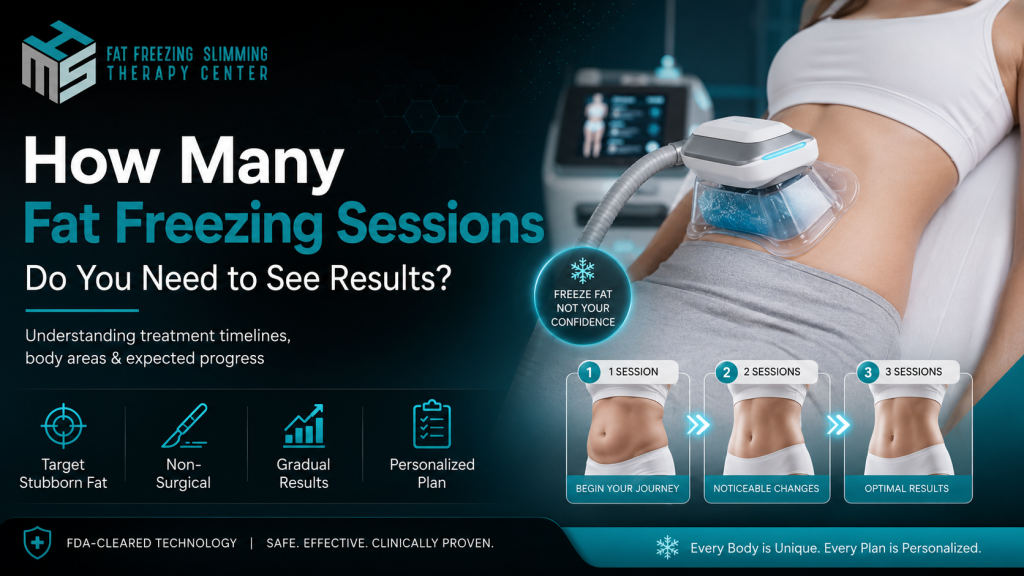
How Many Fat Freezing Sessions Do You Need to See Results?
One of the first questions people ask before booking Fat Freezing is simple:
“How many sessions will I need before I can actually see a difference?”
The answer is not the same for everyone.
Some people may be satisfied after treating a small localized fat pocket once. Others may require two or more treatment cycles in the same area to achieve the contour they want. Larger areas, thicker fat layers, multiple treatment zones and more ambitious aesthetic goals can all change the treatment plan.
There is another important point that is often overlooked: Fat Freezing is gradual.
You do not normally leave the clinic looking dramatically slimmer that afternoon. Cryolipolysis works by controlled cooling of targeted subcutaneous fat cells. The body then gradually processes the affected cells over the following weeks and months. The FDA describes cryolipolysis as a non-invasive body-contouring technology intended to reduce visible fat bulges rather than a treatment for general weight loss.
Clinical sources also report that changes may begin appearing within a few weeks, while fuller results can require several months. Cleveland Clinic notes that some patients begin noticing changes around three weeks, with more substantial improvement around two months and optimal results potentially taking three to six months.
So, rather than asking only, “How many sessions do I need?” a better question is:
How many treatment cycles does my specific area need, and when should I reassess it?
This guide from HMS Fat Freezing explains that distinction in detail.
The Short Answer: How Many Fat Freezing Sessions Are Usually Needed?
For many suitable candidates, one treatment session per targeted area may produce a measurable improvement, but some people choose additional sessions to achieve further contour reduction.
A practical planning range may look like this:
| Goal / Situation | Possible Treatment Approach | When to Reassess |
|---|---|---|
| Small localized fat pocket | Often 1 session may be enough to judge response | Around 8–12 weeks |
| Moderate abdominal or flank fullness | 1–2 sessions may be considered | Reassess after each treatment cycle |
| Larger localized fat layer | Multiple sessions may be discussed | Depends on response and applicator plan |
| Several body areas | Separate cycles for each zone | Staged according to treatment plan |
| Subtle contour refinement | Sometimes 1 session | Wait for full result before repeating |
| More noticeable contour goal | 2 or more sessions may be needed | Only after professional reassessment |
These are not guaranteed prescriptions.
A qualified practitioner needs to assess fat thickness, anatomy, skin quality, treatment area and expectations before recommending the number of Fat Freezing sessions.
Research supports this individualized approach. Clinical reviews have found meaningful reductions in localized fat thickness after cryolipolysis, but the magnitude of improvement varies significantly between people and body areas.
How Fat Freezing Works Before Results Appear
Understanding the timeline becomes easier when you understand what happens after treatment.
Fat Freezing, also known as cryolipolysis, uses controlled cooling to target subcutaneous fat tissue.
During treatment, an applicator is positioned over a suitable fat bulge. Depending on the technology, tissue may be drawn into an applicator using vacuum while controlled cooling is applied.
Fat cells are more susceptible to cold injury than surrounding tissues under controlled treatment conditions. After treatment, affected fat cells undergo biological changes and are gradually cleared by the body’s inflammatory and metabolic processes.
This explains why results are progressive rather than instant.
What Happens After a Session?
The typical sequence is:
Immediately after treatment:
The area may feel cold, numb, sensitive or firm. Temporary redness, tenderness, tingling or swelling can occur.
Weeks 2–4:
The body’s clearance process continues. Some patients may begin noticing early changes, although others may not see a visible difference yet.
Weeks 6–8:
The treated area may begin looking more refined.
Weeks 8–12:
This is often a more useful period for comparing photographs and measurements.
Months 3–6:
Further gradual improvement may occur in some patients.
Cleveland Clinic states that optimal results can take three to six months because treated fat is removed gradually.
Why One Session May Be Enough for One Person but Not Another
There is no universal “three-session rule” for Fat Freezing.
Several variables determine whether you may be satisfied after one treatment or choose another.
1. Thickness of the Fat Layer
A small, pinchable fat pocket may require less treatment than a thicker abdominal or flank area.
Cryolipolysis is designed for localized subcutaneous fat—not for treating obesity or large amounts of visceral fat around internal organs.
If the majority of abdominal prominence comes from visceral fat rather than pinchable subcutaneous fat, Fat Freezing may not deliver the type of change the person expects.
This is why physical assessment is important.
2. The Treatment Area
Different body areas can respond differently.
Common areas include:
- Abdomen
- Love handles
- Flanks
- Inner thighs
- Outer thighs
- Upper arms
- Back or bra-line area
- Under-chin area, depending on the device and indication
Research reviews have shown variations in measured fat reduction depending on anatomical area and study method. One clinical best-practice review reported reductions across areas including the abdomen, flanks, thighs, bra area and upper arms, while also emphasizing substantial individual variation.
3. Your Starting Point
Someone close to their desired body shape with a single stubborn bulge is different from someone hoping to reduce a large amount of overall body fat.
Fat Freezing is primarily a body-contouring treatment, not a replacement for diet, exercise or medically supervised weight management.
A recent systematic review found reductions in localized circumference and fat thickness after cryolipolysis but did not find a statistically significant effect on overall body weight.
That distinction is extremely important.
4. Your Desired Result
Consider two clients with the same amount of abdominal fat.
Client A wants:
“A small improvement so my clothes fit a little more smoothly.”
Client B wants:
“I want a visibly flatter abdomen and significant contour change.”
Their starting anatomy may be identical, but their treatment goals are not.
Client B may require additional treatment—or may need a different body-contouring or surgical approach altogether.
5. Applicator Placement
The number of sessions is only one part of treatment planning.
Placement matters.
For example, abdominal fullness may require different applicator positions depending on whether the fat is concentrated centrally, horizontally, vertically or across the lower abdomen.
Treating one small zone does not automatically reshape an entire waistline.
An experienced Fat Freezing practitioner therefore plans the contour rather than simply counting applications.
What Does Research Say About Fat Freezing Results?
Scientific studies generally support cryolipolysis as a treatment for localized fat reduction, but results vary.
A systematic review examining 19 clinical studies reported average reductions of approximately 14.7% to 28.5% using caliper measurements and approximately 10.3% to 25.5% using ultrasound measurements.
A newer 2025 systematic review and meta-analysis similarly found reductions in circumference and localized fat thickness, while noting that results differ according to body region and study methodology.
Another 2025 meta-analysis involving more than 3,000 participants found improvements in several body-composition measurements after cryolipolysis, including abdominal circumference and localized fat thickness.
These findings support one important conclusion:
Fat Freezing can reduce localized fat, but it should not be marketed as guaranteed dramatic weight loss.
One Session vs Two vs Three Sessions
One Fat Freezing Session
One session may be appropriate when:
- The fat pocket is relatively small
- The client wants modest contour refinement
- It is their first experience with cryolipolysis
- The practitioner wants to evaluate individual response before additional treatment
A sensible approach is often to perform the planned treatment and allow enough time for the biological response before deciding whether another session is necessary.
Two Fat Freezing Sessions
A second session may be considered when:
- There is visible improvement but more contour reduction is desired
- The original fat layer was moderately thick
- The treatment area still has suitable pinchable fat
- The first session was well tolerated
- The practitioner believes another cycle is appropriate
Cleveland Clinic advises that when another treatment is needed, it should generally not be performed until the treated cells have had time to clear; it cites a period of roughly six to eight weeks between sessions.
Three or More Sessions
Three or more Fat Freezing sessions may occasionally form part of a larger contouring strategy, but repeating treatment indefinitely is not automatically the best approach.
If there is little meaningful response after correctly performed sessions, the practitioner should reassess:
- Whether the fat is actually subcutaneous
- Whether the applicator fits the area correctly
- Whether expectations are realistic
- Whether another treatment modality is more appropriate
- Whether weight changes have affected the outcome
More sessions should not replace proper reassessment.
Fat Freezing Session Planning by Body Area
The following table is for general education—not an individual treatment prescription.
| Body Area | Typical Concern | Why Session Needs Differ |
| Abdomen | Lower-belly or central bulge | Thickness and width vary greatly |
| Flanks | Love handles | May require treatment on both sides |
| Inner thighs | Localized inner-thigh fullness | Applicator fit and anatomy matter |
| Outer thighs | Saddlebag-type fat | Wider contour may require careful placement |
| Upper arms | Localized soft fat | Smaller treatment area but individual response varies |
| Back fat | Bra-line or lower-back bulges | Multiple pockets may need separate positioning |
| Under chin | Small localized fullness | Device indication and anatomy must be evaluated |
How Long Should You Wait Between Fat Freezing Sessions?
Repeating treatment too quickly can make it difficult to judge the actual outcome of the previous cycle.
The body needs time to process the treated fat cells.
Cleveland Clinic notes that when additional cryolipolysis treatment is required, another session generally should not occur until approximately six to eight weeks after the first.
In practice, the ideal interval depends on:
- Device protocol
- Treatment area
- Clinical response
- Temporary swelling
- Skin condition
- Individual treatment plan
At HMS Fat Freezing, the more useful approach is to evaluate the treatment area after sufficient time rather than selling an arbitrary package of repeated sessions without reassessment.
How Soon Will You See Fat Freezing Results?
A realistic timeline may be:
Around 3 Weeks
Some people may notice subtle early changes.
Do not worry if nothing dramatic is visible yet.
Around 6 Weeks
Contour changes may become easier to notice, particularly when comparing standardized photographs.
Around 8–12 Weeks
This is often a useful period for evaluating progress.
Around 3–6 Months
Some results may continue developing.
Research and clinical guidance consistently emphasize that cryolipolysis produces gradual changes rather than immediate removal of fat.
How to Measure Results Properly
Relying only on the bathroom scale is one of the biggest mistakes after Fat Freezing.
Because the treatment targets localized fat rather than overall body weight, scale changes may be minimal or nonexistent.
Better ways of assessing progress include:
Standardized Photographs
Take photographs:
- At the same angle
- In similar lighting
- At the same distance
- In the same clothing
- With similar posture
Circumference Measurements
Measure the same anatomical landmark each time.
Randomly measuring higher or lower on the abdomen can create misleading comparisons.
Clothing Fit
Changes in how trousers, dresses or fitted clothing sit around a treated area may be noticeable even when body weight remains unchanged.
Clinical Assessment
A practitioner can evaluate fat thickness, contour symmetry and whether another treatment cycle is appropriate.
HMS Fat Freezing also explains its approach to personalized assessment and treatment planning in its guide to Fat Freezing in Dubai.
Who Is Most Likely to Be a Good Candidate?
A good Fat Freezing candidate is generally someone who:
- Has localized pinchable fat
- Is reasonably close to a stable body weight
- Understands that it is body contouring, not major weight loss
- Has realistic expectations
- Prefers a non-surgical treatment
- Can wait several weeks for gradual improvement
HMS Fat Freezing discusses similar candidate considerations in its guide to Non-Surgical Body Contouring in Dubai.
For people trying to understand the wider difference between weight reduction and localized contouring, the clinic’s guide on How to Lose Belly Fat explains why nutrition, exercise and body contouring serve different roles.
Those researching treatment options can also read HMS’s overview of Fast Fat Freezing in Dubai.
Pros and Cons of Fat Freezing
Advantages
- Non-surgical treatment
- No surgical incision
- No general anaesthesia
- Usually minimal disruption to routine
- Targets localized fat deposits
- Results develop gradually
- Can treat selected body areas
- May be suitable for clients who do not want liposuction
Limitations
- Results are not immediate
- More than one session may be needed
- It is not a treatment for obesity
- It does not guarantee weight loss
- Response varies between individuals
- Temporary redness, tenderness, swelling or numbness may occur
- Some people may be better candidates for another body-contouring method
- Rare complications are possible
The FDA lists potential adverse effects of non-invasive body contouring and advises that treatment suitability should be considered carefully.
One uncommon but important risk associated with cryolipolysis is paradoxical adipose hyperplasia, where the treated area enlarges instead of shrinking. Cleveland Clinic describes this as rare but recognized.
Expert Recommendations from HMS Fat Freezing
1. Do Not Buy Sessions Before Assessing the Area
The number of sessions should follow a body assessment—not the other way around.
Two people asking for abdominal Fat Freezing may require completely different applicator plans.
2. Wait Before Judging the First Session
Taking photos every morning will not speed up the body’s response.
Allow enough time for the treated area to settle and for gradual fat clearance before deciding the treatment “didn’t work.”
3. Keep Your Weight Relatively Stable
The treated fat cells are targeted, but remaining fat cells elsewhere can still enlarge with significant weight gain.
Maintaining stable nutrition and activity habits makes contour changes easier to evaluate.
4. Think in Terms of Shape, Not Kilograms
A good body-contouring result is often visible in:
- Waistline shape
- Reduced bulging
- Clothing fit
- Symmetry
- Silhouette
not necessarily on the scale.
5. Do Not Assume More Sessions Always Mean Better Results
If another treatment is appropriate, it should have a clear reason.
Repeated treatment without reassessing anatomy, fat thickness and response is not good treatment planning.
6. Ask What Device and Applicator Will Be Used
Good treatment depends not only on the technology category but also on:
- Correct applicator
- Proper placement
- Treatment parameters
- Practitioner experience
- Appropriate candidate selection
7. Set a Specific Goal Before Treatment
“Lose fat” is vague.
Better goals might be:
“Reduce the lower-abdominal bulge visible in fitted clothing.”
or
“Improve the contour of both love handles.”
Specific goals make it easier to evaluate whether Fat Freezing has achieved what you wanted.
Evidence-Based Resources for Understanding Cryolipolysis
For readers who want to explore the science behind Fat Freezing, these sources are useful:
U.S. Food and Drug Administration – Non-Invasive Body Contouring Technologies
The FDA explains cryolipolysis, how cooling-based devices work and key safety considerations.
Read FDA Guidance
Cleveland Clinic – Fat Freezing (Cryolipolysis)
Provides practical information on treatment, expected timing, repeat sessions and potential side effects.
Read Cleveland Clinic’s Guide
PubMed – Cryolipolysis Safety and Efficacy Review
A systematic review of clinical evidence on localized fat reduction, safety and treatment outcomes.
Read the PubMed Review
2025 Systematic Review and Meta-Analysis
Recent research evaluating cryolipolysis effects on body circumference, localized fat thickness and body composition.
Read the Research
Frequently Asked Questions
1. Is one Fat Freezing session enough?
For some people with a small localized fat pocket and modest goals, one session may provide satisfactory improvement. Others may require additional treatment. The correct number depends on fat thickness, anatomy, treatment area and desired contour.
2. How many Fat Freezing sessions do you need for belly fat?
There is no fixed number for abdominal treatment. Some people begin with one treatment cycle and reassess after results develop, while thicker abdominal fat or larger contour goals may require further sessions. A consultation is needed to determine whether the abdominal fullness is suitable subcutaneous fat.
3. How soon can I see Fat Freezing results?
Some people notice early changes approximately three weeks after treatment, while clearer improvement often develops over six to twelve weeks. Full improvement may continue for several months.
4. Can I have Fat Freezing every week?
That is generally not how cryolipolysis is planned for the same treatment area. The body needs time to process the affected cells. Cleveland Clinic notes that repeat sessions, when necessary, may be spaced around six to eight weeks apart.
5. Does Fat Freezing permanently remove fat cells?
Cryolipolysis damages targeted fat cells, which are then gradually cleared from the treated area. However, remaining fat cells can still enlarge if body weight increases substantially. Maintaining a stable lifestyle therefore remains important.
6. How much fat can one Fat Freezing session remove?
Studies report variable localized reductions depending on measurement method, body area, device and patient. A systematic review found average reductions ranging roughly from 10% to 28% across ultrasound and caliper measurements. These are research averages, not guaranteed outcomes for an individual.
7. Will I lose weight after Fat Freezing?
Not necessarily. Fat Freezing is designed for localized body contouring rather than significant weight loss. A recent meta-analysis found improvement in localized measurements but no statistically significant overall weight reduction.
8. What happens if I do not see results after one session?
First, consider timing. If only a few weeks have passed, the result may still be developing. Once sufficient time has passed, the practitioner should reassess the area, compare measurements and photographs, confirm whether the tissue remains suitable for another treatment and discuss alternatives if needed.
9. Can Fat Freezing replace liposuction?
No. They serve different purposes. Liposuction is a surgical procedure capable of removing larger volumes of fat more directly. Cryolipolysis is non-surgical and produces gradual, generally more modest localized reduction. The right option depends on the patient’s anatomy, expectations and willingness to undergo surgery.
10. How do I know how many sessions I personally need?
The most reliable way is through an in-person consultation. A practitioner should assess the amount and distribution of pinchable fat, skin quality, body proportions, previous treatments and desired outcome before recommending a Fat Freezing plan.
Conclusion
So, how many Fat Freezing sessions do you need?
For some people, one well-planned session may be enough to create a noticeable improvement.
For others, a second or additional treatment may be appropriate after the first result has had enough time to develop.
The key is not chasing a predetermined session number.
Effective cryolipolysis depends on:
- Correct candidate selection
- Treating the right type of fat
- Accurate applicator positioning
- Realistic expectations
- Enough time between treatments
- Consistent before-and-after assessment
- Reassessment before repeating treatment
The biggest misconception is expecting Fat Freezing to behave like instant surgical fat removal.
It does not.
It is a gradual body-contouring process designed to improve localized fat bulges without surgery. Evidence supports meaningful reductions in localized fat thickness and circumference, while also showing that individual response varies and overall body weight may change very little.
At HMS Fat Freezing in Dubai, the appropriate number of sessions should therefore be based on the client’s anatomy and goal—not a generic package promising the same result to everyone.
The most useful first step is a professional assessment followed by a realistic treatment plan and enough time to evaluate how your body responds.
Contact HMS Fat Freezing
HMS Fat Freezing
Location: HAMSAH BUILDING, OFFICE 407 & 408, BLOCK-A, Business Center – beside ANSAR GALLERY – Dubai
Phone: +971 4 583 2989
Email: info@hmsfatfreezing.com
Website: https://hmsfatfreezing.com/
HMS Fat Freezing provides non-surgical body-contouring and slimming treatments in Dubai with individualized assessment and treatment planning.
Medical note: This article is educational and does not replace an individual medical assessment. Suitability, risks and treatment frequency should be discussed with an appropriately qualified healthcare or aesthetic professional before undergoing cryolipolysis.