
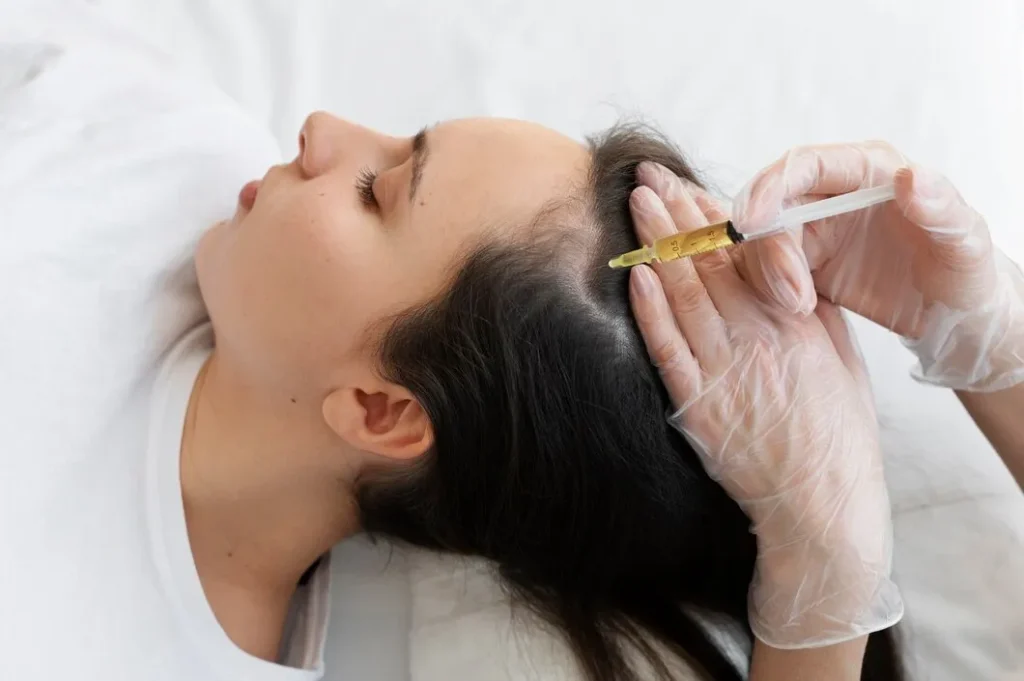
Best Hair Treatments for Hair Loss and Thinning Hair
Watching your hair become progressively thinner can be frustrating, particularly when every shampoo, serum and supplement promises to solve the problem. The reality is that choosing the Best Hair Treatment is rarely about finding one miracle product. Successful hair restoration begins by identifying why the hair is thinning and then selecting a treatment that addresses that specific cause.
Contact HMS Fat Freezing for Best Hair Treatment
Hair loss can develop because of genetics, hormonal changes, nutritional deficiencies, stress, illness, scalp conditions, medications or changes in the normal hair-growth cycle. This is why two people with apparently similar thinning hair may require very different treatment plans.
At HMS Fat Freezing in Dubai, hair-restoration options include regenerative treatments such as PRP and GFC therapy along with professional scalp assessment and supportive scalp treatments. The clinic’s current hair services specifically describe both PRP and GFC approaches for people experiencing thinning and early-stage hair loss.
Contact HMS Fat Freezing for Best Hair Treatment
This guide examines the leading options available today, where each approach fits, what results can realistically be expected and how to choose the Best Hair Treatment for your particular pattern of hair loss.
Medical note: Hair loss may occasionally signal an underlying medical condition. Sudden, patchy, rapidly worsening or unexplained hair loss should be assessed by a qualified healthcare professional or dermatologist before cosmetic treatment begins.
Contact HMS Fat Freezing for Best Hair Treatment
Why Hair Loss Happens Before Choosing a Treatment
One of the biggest mistakes people make is choosing a treatment before identifying the type of hair loss.
The Best Hair Treatment for hereditary thinning is not necessarily the right treatment for stress-related shedding, inflammatory scalp disease or patchy autoimmune hair loss.
Androgenetic Alopecia
Androgenetic alopecia is commonly known as male-pattern or female-pattern hair loss. Genetics and sensitivity to androgens contribute to progressive miniaturisation of the hair follicles.
Men may notice recession at the temples, thinning at the crown or a gradually receding hairline. Women more commonly experience widening of the parting and diffuse thinning across the top of the scalp.
This type of hair loss usually progresses slowly, making early treatment important.
Contact HMS Fat Freezing for Best Hair Treatment
Telogen Effluvium
Telogen effluvium causes increased shedding after the normal hair-growth cycle is disrupted.
Potential triggers include severe stress, illness, surgery, rapid weight changes, nutritional deficiencies, childbirth and certain medications.
Treatment therefore depends heavily on finding and correcting the trigger rather than simply stimulating the scalp.
Alopecia Areata
Alopecia areata is an autoimmune condition that commonly produces clearly defined patches of hair loss.
According to the American Academy of Dermatology, corticosteroid injections are among the treatments dermatologists may use for limited patchy alopecia areata.
This is an important example of why a cosmetic hair-growth treatment should never replace an appropriate medical diagnosis.
Scalp Conditions
Dandruff, inflammation, excessive oiliness and other scalp problems may contribute to itching, scratching, breakage and an unhealthy scalp environment.
HMS Fat Freezing also offers a professional anti-dandruff treatment involving scalp assessment, cleansing and targeted scalp care.
A healthier scalp does not automatically reverse genetic baldness, but addressing scalp disease can be an important component of a broader treatment strategy.
Contact HMS Fat Freezing for Best Hair Treatment
What Is the Best Hair Treatment for Hair Loss?
There is no single treatment that deserves the title of Best Hair Treatment for every person.
A better question is:
Which treatment offers the strongest balance of evidence, suitability, safety and practicality for your specific form of hair loss?
Common options include:
- PRP hair restoration
- GFC hair treatment
- Topical minoxidil
- Prescription hair-loss medications
- Low-level laser therapy
- Hair transplantation
- Professional scalp treatment
- Nutritional or medical correction when deficiency or disease is involved
The strongest plans often combine treatments that address different parts of the hair-loss process.
Contact HMS Fat Freezing for Best Hair Treatment
Comparison of Leading Hair Loss Treatments
| Treatment | Best Suited For | Invasiveness | Downtime | Main Advantage | Key Limitation |
|---|---|---|---|---|---|
| PRP Hair Treatment | Early thinning, pattern hair loss | Minimally invasive | Minimal | Uses platelet-rich plasma from your own blood | Usually requires several sessions |
| GFC Hair Treatment | Hair thinning and weakened follicles | Minimally invasive | Minimal | Concentrated growth-factor approach | Evidence base is newer than established medications |
| Topical Minoxidil | Male and female pattern hair loss | Non-invasive | None | Widely used medical option | Benefits generally require continued use |
| Finasteride | Appropriate men with pattern hair loss | Non-invasive | None | Can slow hereditary hair loss | Prescription treatment with potential side effects |
| Low-Level Laser Therapy | Selected hereditary hair-loss cases | Non-invasive | None | Painless and drug-free | Frequent long-term treatment may be needed |
| Scalp Treatment | Dandruff, buildup, oily or irritated scalp | Non-invasive | Minimal | Improves scalp environment | Does not directly reverse advanced genetic baldness |
| Hair Transplant | Established permanent pattern hair loss | Surgical | Moderate | Redistributes permanent donor hair | Cost, surgery and donor supply |
| Nutritional/Medical Correction | Deficiency or illness-related loss | Depends on cause | None | Treats the underlying trigger | Requires accurate diagnosis |
The American Academy of Dermatology lists options including minoxidil, prescription medication, laser therapy, PRP and hair transplantation depending on the diagnosis.
Contact HMS Fat Freezing for Best Hair Treatment
1. PRP Hair Treatment
PRP, or platelet-rich plasma therapy, has become one of the most recognised regenerative treatments for thinning hair.
At HMS Fat Freezing, PRP Hair Restoration involves drawing a small quantity of the patient’s blood, processing it to concentrate platelet-rich plasma and applying or injecting the PRP into targeted scalp areas.
Platelets contain signalling proteins and growth factors involved in tissue repair. In hair restoration, the aim is to support follicular activity and improve hair density in appropriate candidates.
The American Academy of Dermatology describes PRP as a treatment that studies suggest can be safe and effective for hair loss and notes that repeat sessions are typically required.
Who May Benefit from PRP?
PRP may be considered for people experiencing:
- Early-stage pattern hair loss
- Generalised thinning
- Reduced hair density
- Increased shedding with viable follicles
- Weak or miniaturising hair
PRP is generally more logical when follicles are still present. A completely smooth area of long-standing baldness is less likely to respond meaningfully because regenerative injections cannot recreate follicles that no longer exist.
Practical Example
Consider a 35-year-old man noticing gradual crown thinning over the last three years. His follicles are miniaturising but still visible.
Rather than waiting until the crown becomes completely bald, early assessment followed by an appropriate combination of evidence-based treatments may preserve more existing hair.
In this context, PRP could be included as part of the Best Hair Treatment strategy rather than treated as a standalone miracle procedure.
PRP Pros and Cons
Pros
- Non-surgical
- Uses the patient’s own plasma
- Minimal downtime
- Can support hair density in appropriate candidates
- Can be incorporated into a combination programme
Cons
- Requires injections
- Multiple sessions are usually needed
- Individual responses differ
- Maintenance may be recommended
- It is not a cure for every type of alopecia
2. GFC Hair Treatment
GFC stands for Growth Factor Concentrate. It is a regenerative treatment derived from components of the patient’s blood.
HMS Fat Freezing currently provides GFC Hair Restoration, describing it as a concentrated growth-factor approach aimed at reducing hair fall, strengthening follicles and improving hair density.
The practical distinction promoted for GFC is that the preparation aims to deliver selected concentrated growth factors rather than the broader platelet-rich preparation traditionally associated with PRP.
GFC vs PRP: Which Is Better?
People often search for the Best Hair Treatment by comparing PRP with GFC.
Both are blood-derived regenerative treatments, but they are prepared differently.
PRP has a broader and more established clinical literature. GFC preparations are newer and protocols can vary between providers. Therefore, claims that one method is universally superior to the other should be treated cautiously.
The more useful comparison considers:
- Type of hair loss
- Degree of follicle miniaturisation
- Scalp condition
- Treatment protocol
- Practitioner experience
- Number of sessions
- Previous treatment response
A consultation is therefore more valuable than simply choosing whichever treatment is described as “newer.”
3. Minoxidil
Minoxidil remains one of the most established options for pattern hair loss.
The NHS identifies minoxidil as one of the main treatments for male-pattern baldness and notes that it can also be used for female-pattern baldness. It also makes an important point: treatments such as minoxidil do not work for everyone and generally only continue working while they are being used.
Minoxidil is commonly applied directly to the scalp.
Contact HMS Fat Freezing for Best Hair Treatment
Why It Is Frequently Used
The advantage of minoxidil is that it can be used at home and has decades of clinical use behind it.
However, consistency matters.
Someone who applies treatment irregularly for two weeks and stops because nothing dramatic happened has not completed a realistic trial. Hair biology works on a scale of months, not days.
Initial Shedding
Some people notice temporary increased shedding after starting treatment. This can be alarming and should be discussed with a qualified provider rather than automatically assuming that treatment has permanently damaged the hair.
Minoxidil may form part of the Best Hair Treatment plan for some patients, particularly where pattern hair loss has been appropriately diagnosed.
4. Finasteride and Prescription Hair-Loss Medication
Finasteride is a prescription medication used for male-pattern hair loss.
It works by reducing the conversion of testosterone to dihydrotestosterone, or DHT, which plays a major role in susceptible hair follicles.
The NHS confirms that finasteride can be used for male-pattern baldness and notes that it is generally not recommended for women. It can also cause adverse effects, including sexual side effects, while rare mood-related effects are listed as important potential risks.
The American Academy of Dermatology likewise notes that finasteride is FDA-approved for male pattern hair loss and may slow loss or stimulate regrowth in some patients.
Finasteride should therefore be discussed with a prescribing healthcare professional rather than purchased casually based on social-media recommendations.
The Best Hair Treatment should improve the hair without ignoring the patient’s wider health profile.
5. Low-Level Laser Therapy
Low-level laser therapy, sometimes called red-light hair therapy, uses specific wavelengths of light directed at the scalp.
The American Academy of Dermatology states that studies suggest laser therapy may help certain people with hereditary hair loss and notes that treatment usually requires repeated sessions over many months.
Its advantages include:
- No injections
- No surgery
- Painless sessions
- Potential use alongside other treatments
The disadvantage is commitment.
A device that is used consistently according to an appropriate protocol is very different from one purchased, used three times and left in a cupboard.
6. Professional Scalp Treatments
Hair follicles grow within the scalp, yet scalp health is frequently ignored.
Persistent dandruff, scaling, inflammation and heavy product buildup can make the scalp uncomfortable and potentially worsen breakage or shedding behaviour.
HMS Fat Freezing’s professional anti-dandruff treatment includes scalp evaluation, deep cleansing and targeted scalp care designed to manage flakes, itching and excess oil.
Scalp treatment should be viewed realistically.
It may improve scalp condition, but it should not be marketed as a replacement for medically indicated treatment of androgenetic alopecia, alopecia areata, thyroid-related hair loss or iron deficiency.
For someone whose hair loss is complicated by severe dandruff, however, scalp care can be a useful part of the Best Hair Treatment programme.
7. Hair Transplant Surgery
Hair transplantation can provide a more permanent structural solution for suitable people with established pattern baldness.
Modern procedures move follicles from donor areas—typically the back or sides of the scalp—to thinning or bald regions.
The American Academy of Dermatology notes that hair transplantation may provide permanent, natural-looking results in appropriate cases of pattern hair loss.
A transplant does not stop untreated native hair from continuing to thin.
This is why experienced hair-restoration practitioners often think in terms of a long-term plan rather than simply filling today’s bald area.
For advanced permanent thinning, surgery may ultimately be the Best Hair Treatment, whereas regenerative treatments may be more useful earlier in the process.
Choosing the Best Hair Treatment by Hair-Loss Pattern
Early Diffuse Thinning
When the scalp is becoming more visible but substantial hair remains, the priority is often preserving and strengthening viable follicles.
Potential strategies may include:
PRP or GFC therapy, evidence-based topical treatment, scalp management and investigation of nutritional or hormonal triggers.
Receding Hairline
A receding hairline can represent androgenetic alopecia.
Medical therapy may help stabilise progression, while PRP may support remaining follicles in appropriate candidates.
Severe recession may eventually require transplantation if a structural restoration of the hairline is desired.
Female Hair Thinning
Women can experience pattern hair loss, postpartum shedding, iron deficiency, thyroid-related hair loss and several other conditions.
Because the causes overlap, the Best Hair Treatment should follow diagnosis rather than assumptions.
Minoxidil can be used for female-pattern hair loss according to NHS guidance, while prescription options require individual medical evaluation.
Sudden Hair Shedding
Sudden widespread shedding may follow illness, emotional stress, surgery, major dieting or childbirth.
In these cases, diagnosing and correcting the trigger may matter more than immediately booking an aesthetic procedure.
Patchy Bald Spots
Patchy hair loss should be assessed medically.
It can indicate alopecia areata, fungal infection, inflammatory disease or other conditions requiring specific management.
Contact HMS Fat Freezing for Best Hair Treatment
Why Combination Treatment Often Makes More Sense
Hair loss usually involves more than one biological mechanism.
Imagine a patient with hereditary follicle miniaturisation, scalp inflammation and poor nutritional status.
Using only PRP while ignoring the other issues is unlikely to be the strongest strategy.
A better approach may involve:
- Diagnosing the type of hair loss.
- Controlling active scalp problems.
- Addressing nutritional or medical contributors.
- Using evidence-based medical therapy where appropriate.
- Adding regenerative treatments such as PRP or GFC for selected candidates.
- Monitoring progress with consistent photographs and scalp assessment.
This approach is often closer to a genuine Best Hair Treatment plan than repeatedly switching from one fashionable treatment to another.
Pros and Cons of Modern Hair Restoration
Advantages
Modern treatments provide more options than previous generations had.
Many people can now begin treatment before significant baldness develops. PRP and GFC provide minimally invasive choices, minoxidil offers convenient home treatment, laser devices offer a non-drug option and hair transplantation can restore permanently bald areas in appropriate candidates.
Combining therapies also allows treatment to address several mechanisms simultaneously.
Limitations
No ethical provider should promise that every patient will regrow a full head of hair.
Hair restoration is influenced by:
- Diagnosis
- Genetics
- Duration of hair loss
- Follicle viability
- Age
- Health status
- Consistency with treatment
- Individual biological response
A treatment can be scientifically reasonable yet produce different results in two people.
That variability is one reason why the Best Hair Treatment is a personalised plan rather than a universal package.
Contact HMS Fat Freezing for Best Hair Treatment
Expert Recommendations from HMS Fat Freezing
At HMS Fat Freezing, the practical starting point should be a detailed assessment rather than automatically selecting the most aggressive treatment.
The clinic’s published PRP and GFC information emphasises personalised treatment planning and evaluation of hair-loss patterns before proceeding.
For someone considering hair restoration in Dubai, the following principles are particularly useful.
Start Treatment Before Advanced Follicle Loss
Regenerative treatment generally makes more biological sense when viable follicles are still present.
Waiting until an area has been smooth and completely bald for years can significantly narrow non-surgical treatment options.
Photograph Progress Properly
Hair results are difficult to judge from memory.
Take photographs under the same lighting, angle, hairstyle and camera distance every month. Otherwise, changes in lighting alone can make density appear dramatically better or worse.
Evaluate the Scalp Too
Visible dandruff, inflammation or irritation deserves attention.
HMS Fat Freezing offers both hair-restoration treatments and dedicated scalp care, allowing treatment to consider the environment in which the hair follicles are growing.
Be Patient with the Hair Cycle
Hair growth occurs slowly.
A treatment should not be judged solely after a few days or weeks. Depending on the therapy and diagnosis, meaningful evaluation may require several months.
Avoid “Guaranteed Regrowth” Claims
Hair-loss treatment is biological medicine and aesthetic care—not mathematics.
Results vary.
A trustworthy Best Hair Treatment recommendation should explain what treatment can realistically achieve, where its limitations lie and what alternatives exist.
What Makes Hair Restoration in Dubai Different?
Dubai residents face several practical challenges that can affect how hair and scalp are managed.
Frequent air conditioning, high outdoor temperatures, sun exposure, exercise, styling products, hard-water concerns and regular washing can influence scalp comfort and hair quality.
These factors do not automatically cause hereditary baldness, but they may influence dryness, breakage and scalp condition.
A useful Dubai hair-restoration plan therefore separates three different goals:
Stopping or slowing true follicular hair loss
Improving scalp health
Improving cosmetic hair quality and breakage
Confusing these goals is one reason many people spend heavily on shampoos while progressive androgenetic alopecia continues untreated.
You can explore HMS Fat Freezing’s wider hair-treatment information and its guide to scalp treatments in Dubai for additional treatment context.
Contact HMS Fat Freezing for Best Hair Treatment
How Long Does Hair Treatment Take to Work?
The timeline depends completely on the treatment.
PRP and similar regenerative procedures usually require a series of treatments and gradual evaluation. HMS Fat Freezing’s PRP information also notes that results develop over time and treatment schedules vary according to the extent of hair loss and individual response.
The AAD notes that patients undergoing PRP commonly receive repeat injections, while laser therapy can require multiple weekly treatments for months.
Medical treatments such as minoxidil also require consistency.
This is why switching products every few weeks usually makes it difficult to determine which treatment is actually working.
Contact HMS Fat Freezing for Best Hair Treatment
Frequently Asked Questions
1. What is the Best Hair Treatment for thinning hair?
The Best Hair Treatment depends on why your hair is thinning. People with early pattern hair loss may benefit from options such as minoxidil, PRP, GFC or combination treatment. Nutritional, hormonal, autoimmune and scalp-related hair loss may require different management. A professional assessment should come first.
2. Is PRP effective for hair loss?
PRP may help selected patients with thinning hair and pattern hair loss. The American Academy of Dermatology describes PRP as a procedure that studies suggest can be safe and effective for hair loss, although repeat treatments are normally required.
3. Is GFC better than PRP for hair?
GFC uses concentrated growth factors derived from the patient’s blood, while PRP uses platelet-rich plasma. GFC is a newer variation and protocols differ between providers. Rather than assuming one is universally better, suitability should be determined according to your diagnosis, follicle condition and treatment history.
4. Can thinning hair become thick again?
Sometimes. If follicles are miniaturised but still functioning, treatment may improve thickness or density. When follicles have been permanently lost in a long-standing bald area, non-surgical treatments are less likely to recreate them, and transplantation may be considered.
5. Which treatment is best for male-pattern baldness?
Evidence-based medical options commonly include minoxidil and, for appropriate men, prescription finasteride. PRP or laser therapy may be added in selected cases, while hair transplantation can address permanent areas of baldness.
6. What is the Best Hair Treatment for female hair loss?
Treatment depends on the cause. Female-pattern hair loss may be treated differently from postpartum shedding, iron deficiency, thyroid-related hair loss or alopecia areata. Minoxidil is one recognised treatment for female-pattern hair loss, but sudden or unexplained thinning should be medically assessed.
7. How many PRP hair sessions are required?
The schedule varies. The AAD notes that PRP programmes frequently involve an initial series of monthly sessions followed by maintenance at wider intervals. HMS Fat Freezing similarly states that treatment plans depend on the degree of hair loss and individual response.
8. Can dandruff cause hair loss?
Dandruff itself is not the same as genetic baldness, but significant inflammation, itching and scratching can contribute to scalp discomfort and hair breakage. Treating the scalp condition may therefore be an important part of a wider hair-care programme.
9. When should I see a dermatologist for hair loss?
Seek medical assessment when hair loss is sudden, severe, patchy, accompanied by scalp pain or inflammation, associated with other symptoms, or progressing without an obvious explanation. A dermatologist can help determine whether the cause is genetic, autoimmune, nutritional, hormonal, inflammatory or medication-related.
10. How do I choose the Best Hair Treatment clinic in Dubai?
Look beyond price. Ask who performs the treatment, how your type of hair loss will be diagnosed, what evidence supports the recommended procedure, how progress will be measured, what side effects are possible and what happens if you do not respond. Personalised assessment is more valuable than a standard treatment package.
Contact HMS Fat Freezing for Best Hair Treatment
Authoritative Skincare Resources
For readers who want to research facial treatments and exfoliation further, useful independent resources include:
- American Academy of Dermatology – Safe Exfoliation — dermatologist-backed guidance on exfoliation and skin type.
- U.S. FDA – Alpha Hydroxy Acids — information about how AHAs exfoliate skin and sun-sensitivity considerations.
- Cleveland Clinic – Facials and HydraFacial — overview of facial procedures and HydraFacial.
- Hydrafacial Official Website — information about Hydrafacial technology and treatment objectives.
- NCBI – Chemical Peels for Skin Resurfacing — clinical background on chemical exfoliation and skin resurfacing.
Conclusion
The search for the Best Hair Treatment becomes much easier once the focus changes from “Which procedure is most popular?” to “What is causing my hair loss?”
PRP, GFC, minoxidil, prescription medication, laser therapy, scalp care and hair transplantation all have legitimate roles—but they solve different problems.
Someone with early genetic thinning may benefit from preserving follicles before major hair loss develops. Someone experiencing sudden shedding may need medical investigation instead. A person with severe dandruff may first need to restore scalp health, while long-standing baldness may require surgical restoration.
Contact HMS Fat Freezing for Best Hair Treatment
The most effective hair-restoration plans are therefore diagnostic, personalised and realistic.
At HMS Fat Freezing Dubai, PRP, GFC and professional scalp treatments provide non-surgical options for people concerned about hair fall, reduced density and thinning hair. The clinic’s published treatment information emphasises individual evaluation and customised treatment planning rather than a one-size-fits-all protocol.
If your goal is fuller, healthier-looking hair, early evaluation can be particularly valuable. The sooner you understand what is happening at follicle level, the easier it becomes to select the Best Hair Treatment for your needs rather than wasting months moving between products that were never designed for your type of hair loss.
Contact HMS Fat Freezing for Best Hair Treatment
Contact HMS Fat Freezing
HMS Fat Freezing Slimming Therapy Center
Address: HAMSAH BUILDING, OFFICE 407&408, BLOCK-A, Business Center – beside ANSAR GALLERY – Dubai
Phone: +971 4 583 2989
Email: info@hmsfatfreezing.com
Website: https://hmsfatfreezing.com/
The address, telephone number and email above match the clinic’s current contact information.
Contact HMS Fat Freezing for Best Hair Treatment