
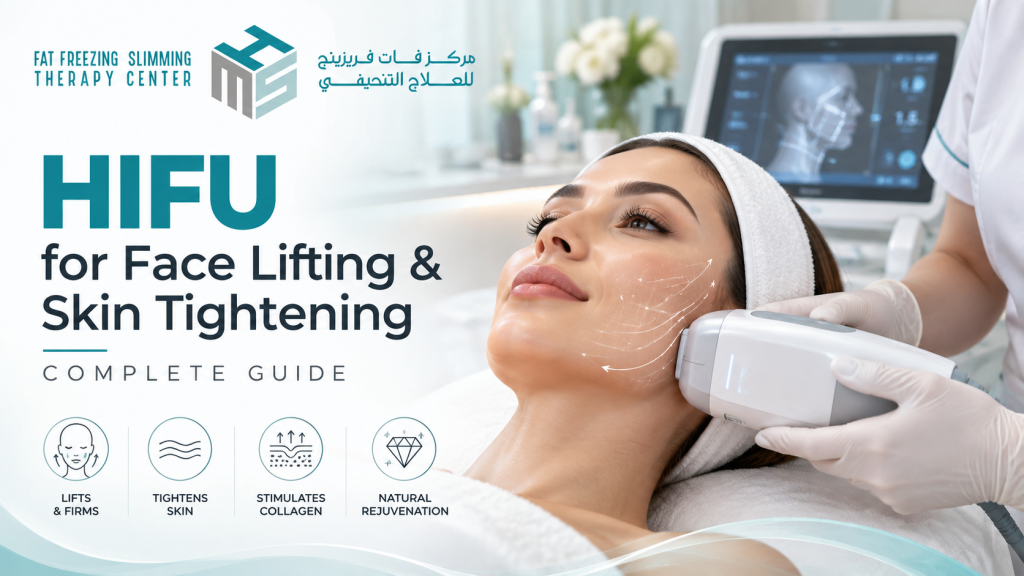
HIFU for Face Lifting and Skin Tightening: Complete Guide
Facial ageing rarely happens overnight. You may first notice that your jawline looks slightly softer in photographs, your cheeks no longer feel as firm, or the skin beneath your chin appears looser than before. These changes are natural, but not everyone wants surgery, injectable treatments, or a lengthy recovery period to address them.
This is where HIFU has attracted attention as a non-surgical facial rejuvenation treatment. By using focused ultrasound energy beneath the skin, it aims to stimulate collagen remodeling and improve the appearance of mild to moderate skin laxity.
Unlike surgical facelifts, which physically reposition tissues and remove excess skin, this technology works with the body’s gradual repair response. Results are generally subtle and develop over time rather than appearing as a dramatic transformation immediately after treatment.
At HMS Fat Freezing in Dubai, clients can explore ultrasound-based skin tightening as part of a personalized aesthetic consultation.
This guide explains how the treatment works, which facial areas may benefit, what scientific research reveals, possible side effects, expected costs, and how to decide whether the procedure suits your skin.
What Is HIFU Treatment?
HIFU stands for High-Intensity Focused Ultrasound, a technology that concentrates ultrasound energy within carefully selected tissue layers.
In aesthetic medicine, certain focused ultrasound devices are used to create controlled thermal treatment points beneath the skin. These points trigger a tissue-remodeling response that may improve skin firmness and provide a modest lifting effect.
One major advantage is that the procedure does not require surgical incisions or stitches. The skin surface generally remains intact while ultrasound energy reaches deeper target areas.
Facial applications may include:
- Improving the appearance of mild jawline sagging.
- Tightening loose skin beneath the chin.
- Addressing selected areas of facial laxity.
- Providing subtle eyebrow lifting in suitable patients.
- Supporting collagen remodeling in the face and neck.
- Softening the appearance of certain fine lines.
An important distinction is that not every ultrasound device performs identically. Treatment depths, energy delivery, safety features, clinical evidence, and authorized uses differ between manufacturers.
Therefore, a consultation should identify the exact device being used rather than treating all ultrasound-based procedures as interchangeable.
How Does HIFU Work for Face Lifting?
The treatment uses concentrated acoustic energy, delivered through a handheld device positioned against the skin.
When appropriately directed, ultrasound energy creates tiny zones of controlled heating at predetermined depths. Surrounding tissues respond through natural healing and collagen remodeling.
1. Targeting Specific Skin Layers
Different facial areas contain different amounts of skin, connective tissue, and underlying fat.
Depending on the equipment and clinical indication, commonly studied treatment depths include approximately 1.5 mm, 3 mm, and 4.5 mm.
These depths may allow practitioners to target the dermis, deeper supporting tissue, or selected fibromuscular layers.
However, deeper treatment is not automatically better. Incorrect targeting can increase the risk of unwanted effects, including injury to nerves or fat.
2. Stimulating Collagen Remodeling
Collagen is a structural protein that contributes to skin firmness, strength, and elasticity.
As people age, collagen production and organization change, contributing to wrinkles and reduced skin support.
Controlled thermal stimulation may initiate remodeling of existing collagen and the production of new collagen over time.
This process explains why results usually become more noticeable gradually rather than immediately.
3. Supporting a Firmer Facial Appearance
As remodeling progresses, some patients experience improved skin tightness along the jawline, cheeks, or neck.
The improvement depends on several factors, including initial skin laxity, age, tissue thickness, device settings, and individual healing responses.
A well-planned treatment seeks natural-looking improvement without promising the same degree of lifting achievable through surgery.
A 2023 systematic review found evidence of improvement in patients with mild to moderate facial laxity, while also highlighting differences in study methods and the need for stronger long-term evidence.
PubMed
+1
Which Areas of the Face Can Be Treated?
One reason focused ultrasound has become popular is its ability to address several facial concerns without surgical incisions.
Suitability and the exact areas treated depend on the device’s approved indications and a professional anatomical assessment.
Jawline and Lower Face
The lower face is one of the most common areas of concern.
As skin loses elasticity, the once-defined transition between the cheeks and jaw may appear less distinct. Early jowling can also become noticeable.
HIFU may help improve mild laxity around the lower face, creating a firmer appearance.
However, pronounced jowls caused by significant tissue descent will generally require more than collagen stimulation to achieve a dramatic correction.
Cheeks and Mid-Face
Mild cheek laxity may contribute to a tired or less defined appearance.
Focused ultrasound can sometimes improve firmness in selected cheek areas, but careful patient selection is particularly important.
People with naturally slim faces or existing cheek volume loss need a cautious assessment because inappropriate energy delivery may contribute to undesirable facial fat reduction.
Under-Chin and Neck Area
The submental region, located beneath the chin, commonly develops skin laxity as people age.
Some ultrasound devices have evidence supporting improvements in this area.
The practitioner must distinguish loose skin from excess fat, muscular changes, and anatomical factors because each concern may require a different treatment.
Brow and Upper-Face Region
Certain devices are authorized for non-invasive brow lifting.
The objective is usually a modest lift rather than a dramatic change in eyebrow position.
Treatment around the eyes requires particular expertise and adherence to device-specific safety guidance. Ultrasound energy should never be directed toward the eyeball.
Who Is a Good Candidate for HIFU?
The most suitable candidate is generally someone with mild to moderate skin laxity who wants gradual improvement without surgery.
People seeking a noticeable but understated change may find the treatment more appealing than those expecting a completely transformed facial contour.
Potential candidates include adults who:
- Have early signs of lower-face sagging.
- Notice reduced firmness around the jawline.
- Want to improve mild neck laxity.
- Prefer a non-surgical approach.
- Understand that outcomes are gradual and variable.
- Have realistic expectations about the treatment’s limitations.
Does Age Determine Treatment Success?
Age alone does not determine whether someone will respond well.
A person in their late 30s with significant facial volume loss may be a less suitable candidate than someone in their 50s who has relatively good skin quality and only mild laxity.
Skin condition, anatomy, medical history, and the nature of the concern matter more than choosing a procedure based on a particular birthday.
Who Should Avoid or Postpone Treatment?
Focused ultrasound is not suitable for everyone.
Treatment should be avoided over active infections, open wounds, or significant skin lesions. Certain implanted medical devices and metal implants may also represent contraindications depending on location and device guidance.
Pregnancy, recent aesthetic procedures, impaired healing, certain neurological conditions, and relevant medications require additional assessment.
The US Food and Drug Administration’s safety guidance identifies risks including thermal injury and cautions concerning implants, open wounds, and eye exposure.
FDA
+1
What Happens During a HIFU Treatment Session?
Knowing what happens during the appointment can help patients feel better prepared.
A carefully performed procedure involves more than moving a machine across the face. It requires assessing facial anatomy, selecting appropriate treatment zones, and following the manufacturer’s clinical guidance.
Step 1: Skin Consultation and Assessment
Your practitioner should begin by discussing your treatment goals, medical history, previous aesthetic procedures, and areas of concern.
Facial symmetry, skin thickness, existing volume loss, and the degree of laxity are particularly important.
Baseline photographs may be taken under consistent lighting to help evaluate subsequent changes.
Step 2: Cleansing and Treatment Planning
The skin is cleansed, and the proposed treatment areas are identified.
The practitioner chooses device settings and treatment depths according to the equipment instructions and individual anatomy.
Sensitive regions, major nerves, and other areas identified in the device’s safety guidance must be avoided.
Step 3: Application of Ultrasound Gel
A coupling gel is applied to help transmit ultrasound energy efficiently between the treatment handpiece and skin.
Proper handpiece contact is important for consistent energy delivery and reducing avoidable risks.
Step 4: Delivery of Focused Ultrasound Energy
The practitioner delivers controlled pulses across the selected treatment areas.
Patients may notice brief sensations of warmth, pressure, tingling, or discomfort.
The intensity varies according to the area being treated, device settings, and individual sensitivity.
Step 5: Post-Treatment Assessment
Once the session is complete, the practitioner checks the skin for unusual reactions and provides aftercare instructions.
Appointment length varies by device, number of treatment lines, and facial areas selected. A focused procedure may take less time than comprehensive face-and-neck treatment.
Patients should not assume that faster treatment is necessarily better, or that a greater number of ultrasound pulses guarantees stronger results.
HIFU Before and After: What Results Can You Expect?
This is one of the most important questions to address before booking a session.
Marketing photographs can make non-surgical procedures look more dramatic than their typical clinical results.
A realistic outcome is usually a subtle to moderate improvement in firmness, not the removal of substantial loose skin.
Immediately After Treatment
Some people notice temporary tightness soon after the procedure.
This should not be confused with the final result. Early changes can reflect transient tissue responses or swelling.
Mild tenderness or redness may also occur.
After Four to Eight Weeks
Collagen remodeling may begin to produce visible changes over the following weeks.
Patients might notice the jawline appearing slightly firmer or the skin beneath the chin looking smoother.
However, others will see little visible difference at this stage.
After Two to Three Months
This is a common period for reassessing the treatment response.
Improvements may become more evident as the remodeling process progresses.
One systematic review reported measurable tightening in studied facial areas, but its findings should not be interpreted as guaranteed outcomes for every device or patient.
PubMed
After Six Months and Beyond
Some improvements may continue, while natural skin ageing also continues.
Results are not permanent, and the duration differs considerably between individuals.
A useful approach is to compare photographs taken with the same camera angle, expression, lighting, and head position.
Even a slight difference in chin elevation can make the jawline look significantly more defined.
HIFU vs Other Skin Tightening Treatments
Many clients researching non-surgical face lifting compare focused ultrasound with radiofrequency, injectables, and surgical procedures.
These treatments do not necessarily address the same underlying problem.
| Treatment | Primary Purpose | Downtime | Typical Outcome |
|---|---|---|---|
| HIFU | Ultrasound-based tissue remodeling | Usually minimal | Gradual, modest skin tightening |
| Radiofrequency facial | Heating to support superficial skin firmness | Often minimal | Subtle improvements in skin appearance |
| RF microneedling | Texture, selected scars, wrinkles, and collagen remodeling | Several days of visible recovery may occur | Gradual improvements in targeted concerns |
| Dermal fillers | Restore or enhance volume | Usually limited, though bruising and swelling can occur | More immediate volume enhancement |
| Surgical facelift | Reposition deeper tissues and remove excess skin | Substantially longer | More significant lifting for suitable patients |
The right treatment depends on whether the main problem involves loose skin, volume loss, wrinkles, pigmentation, or uneven texture.
For example, someone bothered primarily by enlarged pores and acne scarring may be better suited to a texture-focused procedure.
HMS Fat Freezing provides information about RF Microneedling, which is designed to address different skin concerns through controlled microneedling and radiofrequency energy.
Likewise, clients experiencing dehydration and dullness rather than significant laxity may wish to explore Skin Booster treatments for skin quality and hydration.
Neither option should be considered an automatic substitute for facial lifting.
Benefits of HIFU for Facial Rejuvenation
Non-Surgical Treatment
There are no surgical incisions, stitches, or routine general anaesthesia.
This makes the procedure attractive to people who prefer less invasive aesthetic options.
Gradual, Natural-Looking Changes
Because results develop over time, improvements may appear relatively subtle.
This can suit people who want a refreshed look without a sudden change in facial appearance.
Minimal Downtime for Many Patients
Many patients can return to routine activities relatively quickly.
Nevertheless, mild tenderness, redness, and swelling can occur, and recovery varies.
Targeted Treatment Planning
Different transducers and settings can allow clinicians to customize treatment for selected anatomical areas.
This flexibility is useful only when combined with appropriate training, clinical judgment, and adherence to device-specific protocols.
Collagen-Based Improvement
Rather than filling the face with additional volume, focused ultrasound seeks to support tissue remodeling.
For selected patients, this may improve firmness without changing their natural facial proportions.
Pros and Cons of HIFU Treatment
Advantages
- No surgical incisions or stitches.
- Usually limited interruption to daily activities.
- May improve mild to moderate skin laxity.
- Results can look natural and develop gradually.
- Can target selected facial and neck areas.
- May be appropriate for people who do not want surgery.
Disadvantages
- Results are generally less dramatic than surgery.
- Visible improvement is not guaranteed.
- Some patients experience discomfort during treatment.
- Temporary swelling, tenderness, or altered sensation may occur.
- Serious complications, although less common, are possible.
- Maintenance treatment may eventually be considered.
- It does not correct all causes of facial ageing.
A particularly important limitation is that collagen stimulation cannot reliably replace lost facial volume or reposition substantial amounts of sagging tissue.
Selecting the wrong treatment for the wrong concern can lead to disappointment even when the procedure itself is performed correctly.
Is HIFU Safe? Side Effects and Risks Explained
Focused ultrasound has been studied for aesthetic facial tightening, and published reviews generally report a favorable short-term safety profile in appropriately selected patients.
However, non-surgical does not mean risk-free.
Common Temporary Side Effects
Possible short-term reactions include:
- Skin redness.
- Mild swelling.
- Tenderness.
- Temporary discomfort.
- Tingling or altered skin sensitivity.
These reactions often resolve, but the duration varies.
Less Common but More Serious Complications
Improper treatment or an unexpected tissue response can potentially cause burns, blisters, prolonged numbness, nerve injury, or unintended changes in facial fat.
The FDA recognizes thermal and mechanical tissue injury as important hazards associated with focused ultrasound aesthetic devices.
A systematic review and meta-analysis of face and neck rejuvenation found moderate overall improvements, while emphasizing variation in outcomes and limited longer-term follow-up.
PubMed
+1
Why Practitioner Experience Matters
Aesthetic ultrasound treatment requires understanding facial anatomy, device settings, and appropriate treatment zones.
Patients should verify that the practitioner is appropriately licensed and trained, and ask about the specific device being used.
An informed consultation should also explain what complications require prompt medical review.
Persistent severe pain, blistering, facial weakness, visual symptoms, or unusual neurological changes after treatment warrant urgent professional assessment.
HIFU Aftercare: How to Support Your Results
Aftercare instructions should always come from the treating practitioner because the exact guidance can vary.
Most patients do not need a complicated recovery routine, but sensible skincare and monitoring remain important.
Keep Skincare Gentle
Use a mild cleanser and an appropriate moisturizer.
If the skin feels sensitive, avoid introducing aggressive exfoliants or unfamiliar active skincare products until the irritation settles.
Protect Your Skin From Sun Exposure
In Dubai, high ultraviolet exposure and outdoor heat can make sun protection especially important.
Apply broad-spectrum sunscreen with SPF 30 or higher, seek shade, and consider protective clothing when outdoors.
Sun protection does not directly guarantee a better lifting result, but it helps prevent additional UV-related skin damage.
Avoid Excessive Heat if Advised
Some practitioners recommend temporarily avoiding very hot showers, saunas, or intense heat exposure if the skin is tender or swollen.
Follow the advice specific to your procedure rather than relying on universal restrictions promoted online.
Monitor Your Skin
Mild tenderness is different from increasing pain or a blistering reaction.
Contact the treating clinic if symptoms worsen or persist beyond the expected recovery period.
Maintain Realistic Expectations
A healthy lifestyle, adequate sleep, and consistent skincare support overall skin health, but they cannot guarantee the outcome of an energy-based procedure.
The best way to judge progress is through consistent follow-up assessments rather than repeatedly examining the face immediately after treatment.
HIFU Treatment in Dubai: Climate and Lifestyle Considerations
Dubai residents often balance busy work schedules, frequent social commitments, and regular sun exposure.
These lifestyle factors can influence how patients plan an aesthetic treatment.
Sun Exposure and Skin Ageing
Frequent ultraviolet exposure contributes to premature skin ageing, including pigmentation, fine lines, and changes in skin texture.
Focused ultrasound cannot reverse every effect of sun damage.
People with substantial pigmentation or surface texture concerns may require a separate skincare or dermatological treatment plan.
Air Conditioning and Skin Dryness
Long hours in air-conditioned environments may contribute to dry-feeling skin in some individuals.
Dryness can make superficial lines more noticeable, but it is not the same as structural skin laxity.
Someone whose skin mainly looks tired and dehydrated may achieve more appropriate improvements through hydration-focused care.
For those exploring alternative rejuvenation options, the clinic’s Anti-Aging and Face Lifting Facial focuses on skin hydration, texture, and a temporarily refreshed appearance.
Planning Around Events
If you are preparing for a wedding, professional photoshoot, or important celebration, avoid assuming that treatment performed a few days beforehand will deliver maximum tightening.
Because collagen remodeling takes time, consultation and treatment planning should begin well before an important event.
A practitioner can advise whether the procedure is appropriate and allow sufficient time for any temporary reactions to settle.
How Many HIFU Sessions Are Needed?
There is no universal number of sessions appropriate for every patient.
Some studied ultrasound protocols involve one session followed by several months of observation.
Other devices or treatment plans may differ.
The required approach depends on:
- Degree of skin laxity.
- Facial anatomy and tissue thickness.
- Device type and authorized indications.
- Previous aesthetic treatments.
- Individual treatment response.
- Clinical reassessment.
Repeated sessions should not be scheduled simply because the initial results are not immediately visible.
Since collagen remodeling takes time, it is sensible to assess the response before considering further treatment.
Excessive energy delivery or unnecessary repeated procedures may increase the risk of adverse effects.
How Long Do HIFU Results Last?
The longevity of results differs from person to person.
Some studies have observed improvements lasting several months, with certain participants showing measurable changes at around one year.
However, the scientific literature does not establish a single reliable duration applicable to every patient.
Results are influenced by genetics, age, skin condition, sun exposure, treatment technique, and ongoing changes in facial tissues.
The 2025 systematic review of aesthetic HIFU applications identified encouraging skin-tightening findings but also emphasized the lack of standardized protocols and the need for additional long-term research.
PubMed
Rather than purchasing maintenance sessions on a fixed schedule, patients should consider periodic professional assessments to determine whether another treatment is clinically reasonable.
HIFU Treatment Cost in Dubai: What Affects the Price?
The price of ultrasound skin tightening varies between clinics and treatment plans.
Factors influencing cost include the brand and model of equipment, treatment area, extent of coverage, practitioner qualifications, and number of sessions recommended.
A full-face-and-neck procedure may be priced differently from a localized jawline treatment.
Nevertheless, cost comparisons should go beyond headline package prices.
Questions to Ask Before Paying
Ask the clinic:
- What is the exact device brand and model?
- Is it intended and appropriately authorized for the proposed treatment area?
- Who will perform the procedure, and what training do they have?
- Which areas are included in the quoted price?
- Does the package include consultation and follow-up?
- What complications and expected results have been explained?
A discounted package does not automatically represent good value if the treatment is unsuitable for your concerns.
HMS Fat Freezing can be contacted for current pricing and individualized consultation information rather than relying on unverified advertised estimates.
Expert Recommendations From HMS Fat Freezing
When considering facial skin tightening, a personalized approach is more valuable than automatically choosing the most intensive available treatment.
The following assessment principles are consistent with patient-centered aesthetic planning and the published safety literature. They are intended as guidance rather than claims of independently verified outcomes at HMS Fat Freezing.
Recommendation 1: Identify the Main Cause of Facial Ageing
Loose skin, facial fat loss, muscle movement, and pigmentation require different solutions.
If your cheeks look hollow, tightening procedures alone may not address the underlying problem.
If your main concern is mild sagging beneath the chin, focused ultrasound may be worth discussing.
Recommendation 2: Protect Natural Facial Volume
More energy does not always mean a better-looking result.
Patients with slim facial features should discuss the possibility of unwanted volume changes and whether treatment should be limited or avoided in certain areas.
Recommendation 3: Avoid Comparing Different Devices as Equals
The term HIFU describes a technology category rather than one standardized clinical treatment.
Device quality, safety features, clinical evidence, and operator skill can influence outcomes.
Ask for information about the equipment actually used in the clinic.
Recommendation 4: Set Measurable Goals
Instead of requesting a complete facelift, consider a specific concern such as mild jawline laxity or reduced skin firmness.
This makes it easier to evaluate whether the procedure is likely to meet your expectations.
Recommendation 5: Review Results Before Additional Procedures
Collagen remodeling is gradual.
Avoid stacking multiple aggressive treatments close together without a professional assessment of healing, tissue response, and potential cumulative risks.
For details about the clinic’s service, visit the HIFU treatment information page.
Frequently Asked Questions About HIFU
1. Is HIFU effective for face lifting?
It can provide modest lifting and tightening in some people with mild to moderate skin laxity. Scientific reviews support measurable improvements in selected facial areas, particularly the lower face and neck. However, results vary, and the treatment cannot reproduce the degree of tissue repositioning achieved with a surgical facelift.
2. Is HIFU painful during treatment?
Patients may experience warmth, tingling, pressure, or brief discomfort as ultrasound energy is delivered. The sensation depends on the device, energy settings, treatment location, and individual pain sensitivity. Some people find it tolerable without additional measures, while others require a carefully planned comfort-management approach.
3. How soon can I see HIFU results?
Some patients experience temporary tightness immediately after treatment, but meaningful improvement generally develops over several weeks as collagen remodeling occurs. Changes may become easier to assess after two to three months. An absence of immediate lifting does not necessarily indicate treatment failure.
4. Can HIFU reduce a double chin?
It may improve the appearance of mild loose skin beneath the chin. However, a double chin can involve excess fat, skin laxity, anatomy, or a combination of factors. Tightening treatment alone may not significantly reduce substantial fat deposits. A professional assessment is needed to distinguish these concerns.
5. Can HIFU cause facial fat loss?
Unwanted facial fat changes are a possible concern, particularly when energy is delivered inappropriately or treatment planning does not account for tissue depth. This matters especially for people with naturally thin faces or existing volume loss. Discuss the device, target depths, and potential risks with an appropriately trained practitioner.
6. Is HIFU better than Botox?
Neither treatment is universally better because they address different concerns. Botox temporarily relaxes selected muscles to soften expression-related wrinkles, while focused ultrasound aims to support tissue tightening. Someone concerned about forehead movement lines may benefit more from muscle-relaxing treatment than from ultrasound-based lifting.
7. Can HIFU be performed on all skin tones?
Focused ultrasound is not primarily dependent on skin pigmentation in the same way as some light-based technologies. However, skin tone alone does not determine safety. Medical history, device indications, facial anatomy, active skin conditions, and treatment technique still require careful assessment.
8. How often should I repeat HIFU treatment?
There is no single recommended interval for everyone. Some patients receive one session followed by reassessment over several months. The decision to repeat treatment should depend on the original device protocol, observed improvement, degree of laxity, and clinical evaluation rather than a fixed promotional schedule.
9. Can I go to work after HIFU?
Many people resume normal activities shortly after treatment because there are no surgical incisions. However, redness, swelling, tenderness, or other temporary effects may be visible or uncomfortable. If you have an important meeting or event, discuss expected recovery and allow some flexibility.
10. Is HIFU a permanent alternative to a facelift?
No. Facial ageing continues after treatment, and any improvement may diminish over time. Focused ultrasound generally offers less dramatic results than surgery and cannot reliably correct severe sagging. It is better understood as a non-surgical option for selected skin-tightening concerns rather than a permanent facelift replacement.
Final Thoughts: Is HIFU Worth Considering?
HIFU may be a worthwhile option for adults who want to improve early facial laxity without surgical incisions or extended downtime.
Its strongest appeal lies in the possibility of gradual tightening through controlled ultrasound energy and natural tissue remodeling. However, the best outcomes depend on selecting the right patient, identifying the correct anatomical concern, using an appropriate device, and setting realistic expectations.
The most important decision is not whether ultrasound treatment is popular. It is whether the procedure addresses the actual reason your face looks less firm.
For someone with mild jawline sagging, focused ultrasound may provide useful improvement. For someone with advanced tissue descent or significant facial volume loss, a different approach may be more appropriate.
At HMS Fat Freezing in Dubai, clients can arrange a consultation to explore facial rejuvenation options and discuss whether ultrasound-based treatment matches their individual goals.
Contact HMS Fat Freezing – Dubai
For information about skin tightening, facial rejuvenation, available treatments, and consultation appointments, contact HMS Fat Freezing.
HMS Fat Freezing – Slimming Therapy & Aesthetic Treatment Center
Address: HAMSAH BUILDING, OFFICE 407 & 408, BLOCK-A, Business Center – Beside ANSAR GALLERY – Dubai, United Arab Emirates.
Phone: +971 4 583 2989
Email: info@hmsfatfreezing.com
Website: https://hmsfatfreezing.com/
Medical Disclaimer: This article provides general educational information and does not replace consultation with a qualified medical professional. Treatment suitability, device indications, expected benefits, and possible complications should be assessed individually. Results are not guaranteed.