
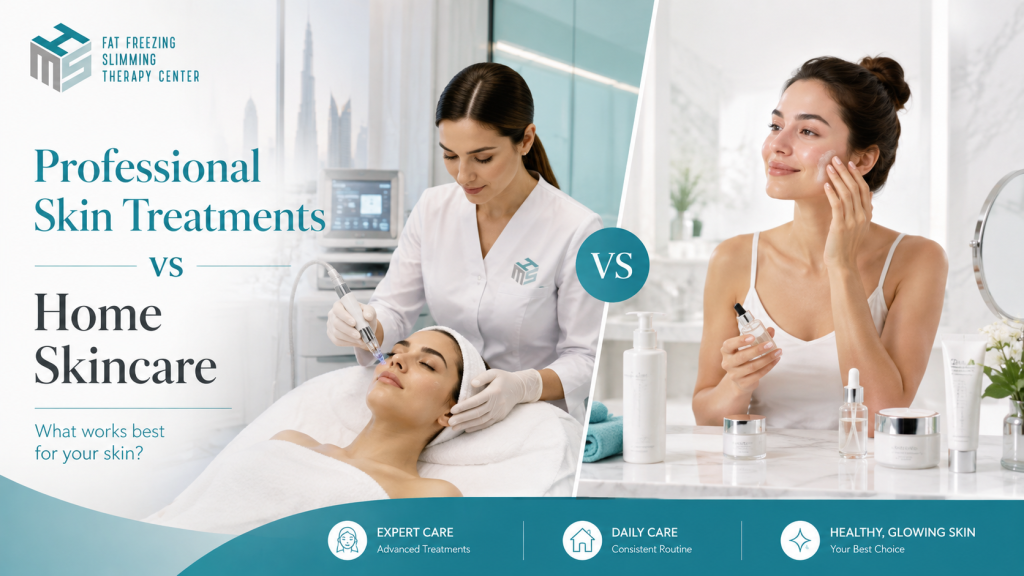
Professional Skin Treatments vs Home Skincare: Which Approach Gives Better Results?
Walk through any beauty aisle or spend a few minutes online and you can find a product promising brighter skin, smaller-looking pores, fewer wrinkles, improved hydration or a clearer complexion. At the same time, aesthetic clinics offer increasingly sophisticated Professional Skin Treatments designed to address many of the same concerns.
It creates an understandable question: if a good cleanser, serum, moisturizer and sunscreen can be used at home every day, why pay for professional treatment?
The answer is not that one approach replaces the other.
Home skincare and Professional Skin Treatments perform different jobs.
Contact HMS Fat Freezing for Professional Skin Treatments
A well-designed home routine protects the skin, supports its barrier and provides consistent maintenance. Professional procedures can work at levels or intensities that ordinary cosmetic products cannot realistically reproduce at home.
For many people, the best results come from combining the two intelligently rather than choosing one side.
At HMS Fat Freezing in Dubai, skin services include options such as HIFU, RF microneedling, fractional laser procedures, chemical peels, skin boosters and other aesthetic treatments. The clinic also provides professional facial options including HydraFacial and specialized facial treatments.
This guide examines what each approach can realistically achieve, when professional care becomes worthwhile and how Dubai’s climate should influence your skincare strategy.
Contact HMS Fat Freezing for Professional Skin Treatments
What Counts as Home Skincare?
Home skincare includes products and routines that you can safely perform without professional equipment or clinical supervision.
A typical routine might include:
- Gentle cleanser
- Moisturizer
- Broad-spectrum sunscreen
- Vitamin C serum
- Niacinamide
- Hyaluronic acid
- Retinoid or retinol products
- Salicylic acid
- Mild exfoliating products
- Acne-supporting ingredients
- Barrier-repair creams
The strength of home skincare is consistency.
A single facial cannot replace sunscreen applied regularly. Likewise, even excellent Professional Skin Treatments cannot compensate indefinitely for harsh cleansing, inadequate moisturization or constant unprotected sun exposure.
Think of daily skincare as maintenance.
Professional treatment is closer to targeted intervention.
Contact HMS Fat Freezing for Professional Skin Treatments
What Are Professional Skin Treatments?
Professional Skin Treatments are procedures performed by appropriately trained professionals using specialized techniques, formulations or devices.
Depending on the treatment and provider, they may be intended to improve:
- Acne
- Acne scars
- Uneven texture
- Hyperpigmentation
- Fine lines
- Wrinkles
- Enlarged-looking pores
- Skin laxity
- Dullness
- Dehydration
- Sun-related damage
At HMS Fat Freezing, available skin-related procedures include chemical peels, fractional laser, RF microneedling, HIFU and skin boosters.
These procedures are fundamentally different from applying another serum because they can involve controlled exfoliation, energy-based technology or treatment at specific tissue depths.
That difference is why Professional Skin Treatments can be useful when skincare products reach their practical limit.
Contact HMS Fat Freezing for Professional Skin Treatments
Professional Skin Treatments vs Home Skincare: Quick Comparison
| Factor | Professional Skin Treatments | Home Skincare |
|---|---|---|
| Main Purpose | Targeted correction | Daily maintenance and prevention |
| Strength | Usually higher | Generally lower |
| Customization | Based on consultation | Often self-selected |
| Equipment | Professional devices may be used | Basic consumer tools/products |
| Frequency | Periodic | Daily or weekly |
| Downtime | Depends on procedure | Usually none |
| Cost Per Session | Higher | Lower per application |
| Skin Assessment | Usually available | Usually self-assessed |
| Best For | Specific or persistent concerns | Protection and ongoing care |
| Results | Can be more targeted | Gradual and consistency-dependent |
The table does not make professional treatment automatically “better.” It simply highlights that the two approaches are built for different purposes.
Contact HMS Fat Freezing for Professional Skin Treatments
Why Home Skincare Still Matters
Before discussing advanced procedures, it is important to recognize that a good home routine is the foundation of healthy-looking skin.
Daily Protection Happens at Home
You cannot schedule a professional procedure every morning.
Daily habits therefore determine much of your skin’s ongoing exposure and recovery.
For Dubai residents, sunscreen is particularly important because strong year-round sunlight and frequent outdoor exposure can contribute to visible photoageing and pigmentation.
A straightforward routine may be more effective than using ten poorly matched products.
For many people, the essentials remain:
Morning: Cleanse → antioxidant or treatment serum → moisturizer → sunscreen.
Evening: Cleanse → targeted active ingredient → moisturizer.
Your provider may recommend changes depending on skin type, treatment schedule or medical history.
Home Skincare Supports Professional Results
Suppose someone receives a treatment intended to improve uneven pigmentation but repeatedly exposes their skin to intense sun without adequate protection.
The clinic procedure may work as intended, yet poor maintenance can work against the desired outcome.
The same principle applies after many Professional Skin Treatments.
Treatment creates an opportunity for improvement. Daily care helps protect that progress.
Where Home Skincare Reaches Its Limits
Home products can improve many mild concerns, but they do not have unlimited capability.
Acne Scarring
A moisturizer cannot physically remodel a deep depressed acne scar.
The American Academy of Dermatology notes that procedures used for depressed acne scars can include microneedling, laser treatment and chemical peels, depending on the scar and individual treatment plan.
Topical products may still help support texture, acne control or discoloration, but deeper scarring often requires assessment for more targeted intervention.
Significant Texture Changes
Skincare can improve surface hydration and exfoliation, making texture appear smoother.
However, persistent irregular texture may respond better to selected Professional Skin Treatments when appropriate.
Advanced Signs of Ageing
Retinoids and sunscreen are valuable parts of ageing-focused skincare, but creams cannot reproduce every effect achievable through energy-based devices or professionally administered procedures.
Persistent Pigmentation
Pigmentation is complicated.
What looks like a simple dark patch could have different causes, and using aggressive brightening ingredients without understanding the cause may irritate the skin and potentially make discoloration more troublesome.
This is one reason consultation can be more valuable than continuously purchasing stronger products.
1. Professional Facials vs At-Home Facials
An at-home facial often involves:
- Cleansing
- Exfoliating
- Applying a mask
- Moisturizing
This can leave skin feeling refreshed, but professional facials can involve more structured cleansing, extraction, exfoliation and hydration protocols.
HMS Fat Freezing’s HydraFacial, for example, is described as a multi-step process incorporating cleansing, exfoliation, extraction and hydration.
A professional facial can therefore be useful when you want deeper cleansing or a more structured treatment than an occasional home mask.
Still, the result needs perspective.
One facial will not permanently eliminate every pore, wrinkle or pigmentation concern.
Realistic expectations are part of responsible Professional Skin Treatments.
2. Professional Chemical Peels vs Home Acids
This is an area where people can easily assume “stronger means better.”
It does not.
Home skincare products may contain exfoliating acids formulated for consumer use. Professional chemical peels can use different concentrations and protocols that require greater knowledge and supervision.
The American Academy of Dermatology notes that chemical peels are used for concerns including uneven skin tone, fine lines, some acne, rough-feeling skin and sun-damaged skin. It also warns that some at-home chemical peels have caused serious injuries and points consumers toward professional supervision.
A proper consultation should evaluate factors such as:
- Skin tone
- Pigmentation tendencies
- Current skincare products
- Previous treatments
- Medications
- Expected downtime
- Treatment goals
The AAD specifically encourages patients to discuss expected results, risks, downtime and the provider’s experience before undergoing a chemical peel.
For this reason, stronger chemical exfoliation belongs in the category of Professional Skin Treatments, not experimental DIY skincare.
3. Professional Microneedling vs Home Dermarolling
Microneedling is another area where professional and home procedures should not be treated as equivalent.
Professional microneedling devices use controlled needles to create precise micro-injuries in the skin.
The FDA explains that legally marketed microneedling devices have specific intended uses and advises consumers considering a procedure to choose a trained provider and discuss potential benefits and risks.
It also states that medical microneedling devices are not authorized for over-the-counter sale.
That matters because deeper penetration increases the importance of:
- Hygiene
- Needle depth
- Skin assessment
- Sterile cartridges
- Treatment suitability
- Aftercare
RF microneedling adds radiofrequency energy to the procedure and therefore introduces additional considerations.
HMS Fat Freezing lists RF microneedling among its Professional Skin Treatments.
The FDA also issued updated safety information in 2025 regarding potential risks associated with certain uses of RF microneedling, which reinforces the importance of qualified assessment and appropriate device use.
4. Professional Hydration Treatments vs Moisturizer
A moisturizer is essential for many skincare routines, but dehydration is not always simply a matter of applying a thicker cream.
Skin can feel dehydrated because of:
- Harsh cleansing
- Over-exfoliation
- Dry indoor air
- Air-conditioning
- Inadequate barrier care
- Environmental exposure
- Unsuitable active ingredients
Dubai residents frequently move between intense outdoor heat and heavily air-conditioned indoor environments.
This can create an uncomfortable cycle where the skin feels oily on the surface yet tight after cleansing.
A professional hydration-oriented facial may provide temporary improvement, but the real long-term solution often requires correcting the daily routine as well.
This illustrates the most important principle of Professional Skin Treatments:
A treatment works best when the home routine supports the same goal.
5. Pigmentation Treatments vs Brightening Serums
Vitamin C, niacinamide and other cosmetic ingredients may support a brighter, more even-looking complexion.
But persistent pigmentation should be approached cautiously.
Overusing strong acids or combining several brightening ingredients can produce irritation.
And irritation itself can be particularly problematic for people prone to post-inflammatory hyperpigmentation.
Professional assessment can help determine whether the issue appears related to:
- Sun exposure
- Post-acne marks
- Inflammation
- Melasma-like pigmentation
- General dullness
- Another skin concern requiring medical evaluation
The appropriate Professional Skin Treatments can then be considered according to the diagnosis, skin type and treatment goal rather than simply choosing the strongest advertised procedure.
The Biggest Mistake: Treating Symptoms Instead of Skin Behaviour
One useful way to choose between professional treatment and home skincare is to stop asking:
“What product removes this?”
Instead ask:
“Why does this keep happening?”
Consider three examples.
Example 1: Repeated Breakouts
A person repeatedly books deep-cleansing facials but uses pore-clogging products at home.
The treatment may temporarily improve congestion, yet the same problem keeps returning.
The better strategy is treatment plus routine correction.
Example 2: Persistent Dryness
Someone spends heavily on monthly facials but exfoliates with acids almost every evening.
The professional hydration treatment is trying to repair what the daily routine repeatedly disrupts.
Example 3: Pigmentation After Every Blemish
A person aggressively scrubs acne marks, causing more irritation.
In this situation, stronger treatment is not automatically the answer. Reducing inflammation and protecting the skin may need to come first.
This behavioural analysis is where carefully planned Professional Skin Treatments can provide more value than chasing individual products.
Pros and Cons of Professional Skin Treatments
Advantages
Targeted treatment
A professional can choose a procedure according to the concern rather than relying on generic marketing claims.
Access to professional technology
Procedures such as RF microneedling, fractional laser and HIFU cannot realistically be replicated with a basic home routine.
Structured assessment
A consultation can identify factors that consumers may overlook when diagnosing their own skin.
Potentially faster visible improvement
Certain treatments can produce more noticeable changes than skincare alone, depending on the concern.
Professional monitoring
Treatment response and aftercare can be reviewed over multiple sessions.
Disadvantages
Higher upfront cost
Clinic procedures generally cost more than individual skincare products.
Potential downtime
Peels, laser-based procedures and some other treatments can involve redness, sensitivity or recovery time.
Risks exist
No professional procedure is completely risk-free. Suitability matters.
Multiple sessions may be required
The FDA notes, for example, that more than one microneedling session may be necessary to achieve the desired cosmetic improvement.
Results still require maintenance
Professional care does not eliminate the need for daily skincare.
Pros and Cons of Home Skincare
Advantages
Home skincare is affordable compared with repeated clinic procedures, easy to maintain and essential for daily protection.
It is particularly valuable for:
- Cleansing
- Moisturization
- Sunscreen
- Barrier maintenance
- Mild acne support
- Long-term ageing prevention
- Maintaining professional results
Disadvantages
Self-diagnosis can lead to buying unsuitable products.
Consumers may also combine too many active ingredients, over-exfoliate or constantly change routines before products have time to work.
Most importantly, skincare has limits.
A serum cannot perform the same function as every Professional Skin Treatment.
Dubai-Specific Skin Considerations
Choosing between home skincare and clinic treatment also depends on where you live.
Dubai presents a distinctive combination of environmental exposures.
Strong Sun Exposure
UV protection deserves priority because pigmentation and premature visible ageing can be worsened by repeated sun exposure.
Heat and Perspiration
Heavy products that work comfortably in cooler climates may feel excessive outdoors in Dubai.
Air Conditioning
Indoor air-conditioning can contribute to a dry or tight skin feeling, especially when combined with aggressive cleansing.
Dust and Urban Exposure
Regular cleansing is valuable, but repeatedly scrubbing the skin to remove dust can weaken the barrier.
Lifestyle Factors
Long work hours, poor sleep, stress, frequent travel and inconsistent hydration may all influence how someone’s skin looks.
For this reason, effective Professional Skin Treatments in Dubai should not be selected according to photographs alone. Lifestyle and environmental exposure matter.
How HMS Fat Freezing Approaches Skin Treatment Planning
HMS Fat Freezing emphasizes consultation and individualized planning rather than choosing treatments only according to trend or popularity. Its broader aesthetic-care guidance highlights the importance of evaluating medical history, lifestyle, skin quality, hydration, texture and individual goals before recommending treatment.
That approach is particularly useful for skin concerns because two people with similar-looking symptoms may require completely different strategies.
Recommendation 1: Build a Simple Home Routine First
Before adding multiple treatments, establish the essentials:
- Gentle cleansing
- Suitable moisturizer
- Sunscreen
- One or two targeted ingredients where appropriate
A complicated routine is not automatically a superior routine.
Recommendation 2: Choose a Treatment for a Specific Goal
Don’t book a treatment simply because it is popular.
Identify the goal:
“Improve acne scarring” is specific.
“Make my skin perfect” is not.
Clear goals make Professional Skin Treatments easier to assess.
Recommendation 3: Disclose Your Full Routine
Tell your provider about retinoids, exfoliating acids, prescription products and previous aesthetic treatments.
These details may affect preparation, suitability and aftercare.
Recommendation 4: Do Not Stack Procedures Randomly
More treatment does not automatically equal better skin.
Allow appropriate recovery and follow professional guidance when combining procedures.
Recommendation 5: Think in Treatment Cycles, Not One-Off Events
Some concerns require several sessions.
The better question is not only, “How much is one treatment?”
Ask:
- How many sessions might I need?
- How far apart are they?
- What home routine should I follow?
- What maintenance is recommended?
- What downtime should I expect?
HMS Fat Freezing publishes session guidance and pricing for several facial services, including acne facials, anti-ageing facial treatments, collagen facials and HydraFacial treatments.
Building a Professional + Home Skincare Strategy
People researching Professional Skin Treatments can explore HMS Fat Freezing’s dedicated Skin Treatments service page to understand available clinical options.
For people primarily concerned with cleansing, exfoliation and hydration, the clinic’s HydraFacial in Dubai page explains its multi-step professional facial process.
Those comparing different facial options can also explore HMS Fat Freezing’s Facial Treatments in Dubai resources, which cover professional facial care for concerns such as acne, rejuvenation and brightening.
For patients considering stronger resurfacing methods, HMS also provides information about Chemical Peel treatments alongside its broader skin-treatment services.
Reliable independent guidance is equally important. The American Academy of Dermatology provides patient information about chemical peels and their potential uses.
The U.S. Food and Drug Administration provides detailed safety guidance regarding microneedling devices.
The AAD’s information on acne scar treatment also explains why different scar types may need different procedures or combinations of treatments.
Frequently Asked Questions About Professional Skin Treatments
1. Are Professional Skin Treatments better than home skincare?
They are not direct replacements for one another. Professional Skin Treatments are usually better suited to targeted concerns that need stronger or device-based intervention, while home skincare is essential for daily cleansing, moisturizing, protection and maintenance. Most people benefit from using both appropriately.
2. How often should I have professional facial treatments?
Frequency depends on the procedure, skin condition and treatment goal. Some facials may be performed every few weeks, while stronger treatments may require longer intervals. HMS Fat Freezing lists different recommended gaps for various facial treatments rather than using one schedule for everything.
3. Can professional treatments completely remove acne scars?
Results vary according to scar type and severity. Acne scars may require different techniques or combination treatment. The AAD notes that approaches can include microneedling, chemical peels, laser procedures and other interventions depending on scar characteristics.
4. Is microneedling at home the same as professional microneedling?
No. Medical microneedling devices can penetrate the skin to alter tissue, and the FDA states that such devices are not authorized for over-the-counter sale. Professional procedures also require attention to sterile cartridges, training, suitability and aftercare.
5. Can I use retinol before a professional facial or peel?
That depends on the procedure and product strength. Some active ingredients may need to be paused before certain treatments. Tell your provider exactly what you are using and follow the preparation instructions provided for your treatment.
6. Which Professional Skin Treatment is best for pigmentation?
There is no single best procedure for all pigmentation. Treatment depends on the underlying cause, skin type, depth of pigmentation and tendency toward post-inflammatory discoloration. A consultation is preferable to selecting a strong peel or laser solely from online recommendations.
7. Are chemical peels safe to perform at home?
Consumer exfoliating products are different from professional peels. The AAD notes that some at-home chemical peels have caused serious injuries and references FDA advice to use chemical peels under appropriate professional supervision.
8. How soon will I see results from Professional Skin Treatments?
Timing depends on the procedure. Some hydration-oriented facials may provide a fresher appearance relatively quickly, while treatments that depend on skin remodeling can take longer and may require multiple sessions. Your provider should explain realistic timelines before treatment.
9. Do I still need skincare after a professional treatment?
Yes. Home care remains important for protecting the skin, supporting recovery and maintaining results. Sunscreen, gentle cleansing and moisturization can be particularly important after treatments that temporarily increase sensitivity.
10. How do I know whether I need a dermatologist or an aesthetic treatment?
Persistent rashes, suspected infections, unusual moles, severe acne, sudden skin changes or conditions requiring diagnosis should be evaluated by an appropriately qualified medical professional. Cosmetic Professional Skin Treatments are intended to address suitable aesthetic concerns, not replace medical diagnosis.
Conclusion: The Best Skin Strategy Uses the Right Tool at the Right Time
The debate between Professional Skin Treatments and home skincare misses an important point.
They are strongest when they work together.
Home skincare handles the everyday work: cleansing, hydration, barrier support, active ingredients and sun protection.
Professional care can provide targeted intervention when a concern needs more than a bottle of serum can reasonably deliver.
The mistake is expecting one side to do everything.
A monthly facial will struggle to compensate for an aggressive, poorly designed daily routine. Equally, buying increasingly expensive creams will not necessarily correct deep acne scarring, significant textural changes or other concerns better suited to professional assessment.
The better approach is to identify the problem, understand why it is occurring, choose the least aggressive effective strategy and maintain the result consistently.
At HMS Fat Freezing, the range of Professional Skin Treatments allows treatment plans to be selected around individual concerns rather than forcing every client into the same procedure. The goal should not be to have more treatments. It should be to use the right treatment, at the right time, for the right reason.
Contact HMS Fat Freezing
HMS Fat Freezing
HAMSAH BUILDING, OFFICE 407&408, BLOCK-A, Business Center – beside ANSAR GALLERY – Dubai
Phone: +971 4 583 2989
Email: info@hmsfatfreezing.com
Website: https://hmsfatfreezing.com/