
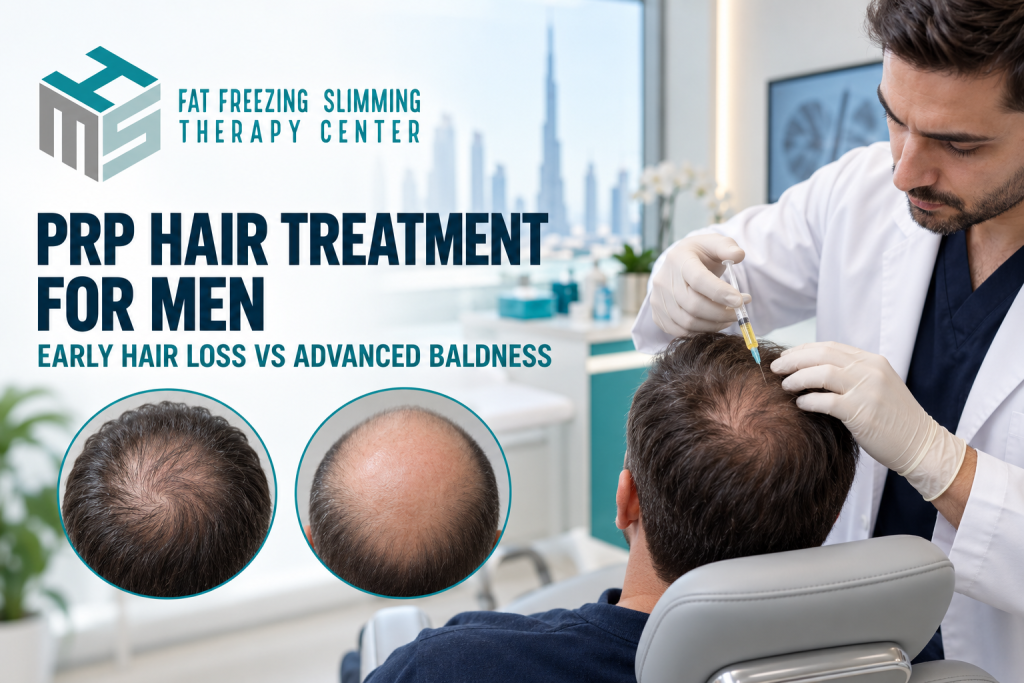
PRP Hair Treatment for Men: Early Hair Loss vs Advanced Baldness
A man noticing extra hair in the shower and a man with a smooth bald crown may both search for the same solution. Clinically, however, they are starting from very different positions.
In early male-pattern hair loss, many follicles are still present. They may be producing increasingly thin, short and lightly pigmented hairs, but they have not necessarily stopped functioning. In advanced baldness, parts of the scalp may contain few follicles capable of producing cosmetically meaningful hair.
This difference matters when considering PRP Hair Treatment.
Platelet-rich plasma therapy is intended to support existing follicles. It does not transplant hair from another area, manufacture new follicles or reliably reverse long-established baldness. Its value therefore depends heavily on timing, diagnosis and realistic candidate selection.
Men researching treatment are often shown dramatic before-and-after images without being told how long the individual had been losing hair, whether medications were used simultaneously, or whether the photographs were captured under identical conditions. A responsible decision requires better evidence.
This guide explains how PRP Hair Treatment differs for early thinning and advanced baldness, what it may reasonably achieve, where its limitations begin and how HMS Fat Freezing approaches treatment planning in Dubai.
Contact HMS Fat Freezing for PRP Hair Treatment
Understanding Male-Pattern Hair Loss
Male-pattern hair loss, medically known as androgenetic alopecia, is influenced by genetics and sensitivity to androgens—particularly dihydrotestosterone, or DHT.
In susceptible follicles, repeated exposure gradually shortens the active growth phase. Each replacement hair may become:
- Finer
- Shorter
- Lighter in colour
- Less visible
- More likely to shed
This process is called follicular miniaturisation.
Hair loss usually develops gradually around the temples, frontal hairline, mid-scalp or crown. Some men notice a receding hairline first, while others retain the front but develop a widening area at the vertex.
The critical point is that visible scalp does not always mean the follicles have disappeared. During early miniaturisation, fine hairs may still be present. Those follicles potentially provide a biological target for PRP Hair Treatment and other evidence-based approaches.
A completely smooth, shiny area that has been bald for years is different. If follicles are no longer viable, regenerative injections cannot recreate them.
Contact HMS Fat Freezing for PRP Hair Treatment
What Is PRP Hair Treatment?
PRP stands for platelet-rich plasma. The treatment uses a concentrated component prepared from the patient’s own blood.
A typical procedure involves:
- Collecting a small blood sample.
- Processing the sample in a centrifuge.
- Separating platelet-containing plasma from other blood components.
- Preparing the selected scalp areas.
- Introducing the PRP through controlled injections.
- Providing aftercare and follow-up instructions.
Platelets are commonly associated with blood clotting, but they also contain growth factors and signalling proteins involved in tissue response and repair.
In hair restoration, PRP Hair Treatment is used with the aim of supporting the environment around existing follicles, improving follicular activity and potentially increasing hair density in suitable candidates.
A 2024 systematic review of PRP for male androgenetic alopecia found encouraging evidence, particularly for hair density, while also recognizing variation between study protocols. Another systematic review and meta-analysis reported that PRP increased hair density but did not find the same clear improvement in hair diameter.
This means PRP should be described as a potentially useful treatment—not a guaranteed cure.
Early Hair Loss Versus Advanced Baldness
| Assessment factor | Early hair loss | Moderate hair loss | Advanced baldness |
|---|---|---|---|
| Visible pattern | Mild recession or reduced density | Noticeable thinning across crown or top | Large smooth or sparsely haired areas |
| Follicular condition | Many active but miniaturising follicles | Mixed active and significantly weakened follicles | Limited viable follicles in bald areas |
| Common objective | Preserve density and slow visible progression | Stabilise loss and improve coverage | Restore coverage where follicles are absent |
| Likely PRP role | Potentially useful for suitable candidates | May help selected areas with viable follicles | Limited as a standalone treatment |
| Need for combination care | Often beneficial | Usually important | Frequently essential |
| Hair transplant discussion | Usually premature | Depends on stability and goals | Often more relevant if donor supply is suitable |
| Expected cosmetic change | Subtle-to-moderate improvement may be possible | Variable improvement | Major regrowth is unlikely from PRP alone |
The most important question is not simply, “How bald am I?” It is, “Are responsive follicles still present in the area I want to improve?”
PRP for Early Hair Loss in Men
What Early Hair Loss Looks Like
Early signs can include:
- Increased scalp visibility under bright light
- A wider or more noticeable crown swirl
- Gradual recession at the temples
- Finer hair around the frontal hairline
- Reduced styling volume
- Greater contrast between wet and dry hair
- Increased shedding over several months
- A family history of early baldness
Men frequently delay assessment because the hairline still appears acceptable from the front. By the time the loss becomes obvious in ordinary photographs, significant miniaturisation may already have occurred.
Why Earlier Treatment May Be More Logical
PRP Hair Treatment needs existing follicles to act upon. During early hair loss, the scalp may contain numerous weakened follicles that continue producing hair. Supporting these follicles is more biologically plausible than attempting to restore hair in an area where follicular structures are no longer functional.
The potential objectives at this stage include:
- Reducing excessive shedding
- Supporting existing follicular activity
- Improving visible density
- Helping miniaturised hairs appear stronger
- Preserving the patient’s current appearance for longer
Early intervention does not guarantee that hereditary hair loss will stop permanently. Male-pattern baldness is usually progressive, which means maintenance and long-term management may still be necessary.
Practical Example: Early Crown Thinning
Consider a 31-year-old man who notices that his crown appears thinner in overhead office lighting. Close examination shows many fine hairs rather than a completely bald patch. His hair loss has progressed slowly over two years.
After clinical assessment confirms androgenetic alopecia, PRP Hair Treatment may be considered as part of a broader plan because the area still contains viable follicles. Progress should be judged using standardized photographs and density measurements—not casual mirror checks.
The objective would be preservation and improved coverage, not restoration of adolescent-level density.
Contact HMS Fat Freezing for PRP Hair Treatment
PRP for Moderate Male Hair Loss
Moderate hair loss presents a more complicated picture. Some scalp areas may contain responsive miniaturised follicles, while others may have experienced extensive loss.
A man might have visible thinning across the crown and mid-scalp but retain many fine hairs. In this situation, PRP Hair Treatment may still have a role, although results can be less predictable than during early loss.
Treatment planning should separate the scalp into zones:
- Areas with good density
- Areas with miniaturised hair
- Areas with very sparse growth
- Completely smooth areas
- Stable donor areas at the sides and back
This zone-based evaluation is more useful than giving the entire scalp one general baldness grade. PRP may be reasonable for the thinning zone even if it is unlikely to change an adjacent bald area.
Contact HMS Fat Freezing for PRP Hair Treatment
Practical Example: Mixed Follicular Activity
A 39-year-old man has a receded hairline, thin mid-scalp and a small smooth patch at the centre of his crown. He wants PRP across the entire area.
A responsible consultation should explain that the surrounding fine hairs may respond differently from the smooth centre. The same procedure can therefore produce uneven biological and cosmetic results across one scalp.
The aim could be to strengthen the existing hair and reduce contrast, while discussing other options for areas where follicles are absent.
PRP for Advanced Baldness
What Advanced Baldness Means
Advanced male-pattern baldness generally involves extensive hairline recession, major crown loss or merging bald areas across the top of the scalp.
Signs that PRP Hair Treatment may have limited value as a standalone procedure include:
- A smooth, shiny scalp
- No visible fine hairs within the target area
- Baldness that has been stable for many years
- Extensive loss across the frontal, mid-scalp and crown
- Scar tissue within the target region
- Expectations of rebuilding a complete hairline
PRP is not a substitute for follicles. It cannot relocate hair from the donor area or create a new follicular architecture.
Contact HMS Fat Freezing for PRP Hair Treatment
Why Results Are Limited in Smooth Bald Areas
Hair growth depends on functioning follicles. Once follicles have undergone advanced miniaturisation or have been replaced by scar tissue, providing platelet-derived signals may not produce visible regrowth.
This is the central difference between PRP Hair Treatment and hair transplantation. A transplant physically redistributes follicles from donor areas into balding regions. PRP attempts to support follicles already present.
Men with advanced baldness may still use PRP in specific circumstances—for example, to support remaining native hair or as an adjunct around a hair-transplant plan—but this must not be confused with restoring an entirely bald scalp through injections alone.
Practical Example: Long-Standing Frontal Baldness
A 48-year-old man has had a smooth frontal scalp for more than ten years. He wants PRP to recreate a lower hairline without surgery.
That goal is unlikely to be achieved because PRP Hair Treatment cannot design a new hairline or supply follicles to the bald area. A transplant consultation may be more relevant if he has suitable donor density, realistic coverage expectations and no medical contraindications.
Who May Be a Good Candidate?
Potential candidates often include men who:
- Have early or moderate androgenetic alopecia
- Still have visible hair within thinning areas
- Have recently noticed reduced density
- Understand that several sessions may be required
- Are willing to attend follow-up assessments
- Have realistic expectations
- Want a non-surgical option
- Can follow appropriate aftercare
- Have no contraindication identified during consultation
A younger age does not automatically predict success. A young man with aggressive hereditary loss may continue progressing quickly. An older man with mild, stable thinning may retain more viable follicles.
Contact HMS Fat Freezing for PRP Hair Treatment
Duration, diagnosis, follicular activity and progression are more informative than age alone.
Who Needs Further Evaluation or Another Approach?
PRP should not be started automatically when a patient says he is losing hair. Men may require medical evaluation if they have:
- Sudden or severe shedding
- Circular bald patches
- Scalp redness, scaling or pain
- Signs of infection
- Hair breakage rather than root-level loss
- Scarring or burns
- Recent major illness
- Significant weight loss
- Suspected nutritional deficiency
- Thyroid or hormonal symptoms
- Medication-related shedding
- A bleeding or platelet disorder
- Use of certain anticoagulant medicines
A clinician may recommend blood investigations or referral depending on the history and examination.
PRP Hair Treatment cannot correct iron deficiency, thyroid disease, autoimmune activity or an inflammatory scalp condition. Treating the cause is more important than repeatedly stimulating a scalp affected by an unresolved medical problem.
Contact HMS Fat Freezing for PRP Hair Treatment
What Results Can Men Realistically Expect?
The first useful result is not always visible regrowth. Some men may initially notice reduced shedding or improved stability.
Possible outcomes include:
- Fewer hairs shed during washing
- Improved thickness of existing hair
- Better coverage under consistent lighting
- Increased density in selected regions
- More styling volume
- Slower visible progression
Visible improvement takes time because hair follicles move through growth, transition, rest and shedding phases. A treatment session cannot instantly produce several centimetres of new hair.
Response should be assessed over months using:
- Photographs from identical angles
- Consistent lighting
- The same hairstyle and hair length
- Dry hair during each comparison
- A defined scalp section
- Magnified follicular assessment where available
- A shedding and treatment diary
Different lighting can make the same crown look full in one photograph and nearly bald in another. Standardisation protects the patient from both unnecessary discouragement and exaggerated claims.
Contact HMS Fat Freezing for PRP Hair Treatment
How Many PRP Sessions Are Usually Needed?
There is no single protocol suitable for every patient. Clinical studies use different platelet concentrations, preparation methods, injection depths, session intervals and maintenance plans.
Many providers recommend an initial series followed by reassessment and possible maintenance. The correct plan should be decided after reviewing:
- Diagnosis
- Severity
- Rate of progression
- Scalp condition
- Treatment response
- Existing medications
- Practical budget and schedule
Before starting PRP Hair Treatment, ask the provider:
- How many initial sessions are proposed?
- Why is that spacing recommended?
- How will results be measured?
- When will response be reviewed?
- What happens if there is no improvement?
- Will maintenance be required?
- Are other treatments necessary?
- Who will perform the procedure?
A fixed package should not replace individualized assessment.
Contact HMS Fat Freezing for PRP Hair Treatment
Can PRP Be Combined with Other Hair-Loss Treatments?
Combination treatment may be appropriate because different options address different parts of the hair-loss process.
A clinician may discuss:
- Topical minoxidil
- Prescription medication for appropriate men
- Low-level light or laser therapy
- Scalp-condition management
- Correction of confirmed nutritional deficiencies
- GFC treatment
- Hair transplantation
- Hairstyling or cosmetic camouflage
Medication decisions must be made with a qualified healthcare professional because side effects, contraindications and monitoring requirements vary.
Research has examined PRP as both a standalone treatment and an adjunct. However, combination therapy can make it harder to determine which component produced the result. Patients should know exactly what is included and why.
Men comparing regenerative options can review HMS Fat Freezing’s guide to the best hair treatments for hair loss and thinning.
Contact HMS Fat Freezing for PRP Hair Treatment
PRP Hair Treatment Versus Hair Transplantation
| Feature | PRP Hair Treatment | Hair Transplantation |
|---|---|---|
| Main action | Supports existing follicles | Redistributes donor follicles |
| Best suited for | Early or moderate thinning | Established bald areas with suitable donor hair |
| Surgical procedure | No | Yes |
| Recovery | Usually limited | Longer healing period |
| Creates a new hairline | No | Can create or rebuild a hairline |
| Sessions | Initial course and possible maintenance | One or more surgical procedures |
| Stops future genetic loss | No | No; untreated native hair may continue thinning |
| Main limitation | Requires viable follicles | Limited by donor supply and surgical suitability |
The treatments are not direct substitutes. For a man with early crown thinning, surgery may be unnecessary. For a man with a long-standing smooth hairline, PRP Hair Treatment alone is unlikely to provide the desired structural restoration.
Contact HMS Fat Freezing for PRP Hair Treatment
Benefits and Limitations of PRP Hair Treatment
Potential Benefits
- Non-surgical procedure
- Uses a preparation derived from the patient’s blood
- Minimal interruption to ordinary activities
- May support density in suitable candidates
- Can target selected thinning regions
- May complement a broader hair-loss plan
- Does not remove follicles from a donor area
- Can be personalized according to the scalp pattern
Limitations and Disadvantages
- Involves multiple scalp injections
- Temporary tenderness, redness or swelling can occur
- More than one session is generally required
- Maintenance may be recommended
- Response differs between patients
- Preparation protocols are not completely standardized
- It cannot create new follicles
- It is unlikely to reverse long-standing smooth baldness
- It does not eliminate the genetic cause of male-pattern loss
- Cost accumulates when repeat sessions are required
Contact HMS Fat Freezing for PRP Hair Treatment
Possible Side Effects and Safety Considerations
Because PRP is derived from the patient’s own blood, allergic reaction to the plasma itself is considered less likely than with many externally manufactured substances. Nevertheless, the procedure is not risk-free.
Potential effects may include:
- Temporary scalp tenderness
- Redness
- Swelling
- Pinpoint bleeding
- Bruising
- Headache
- Temporary sensitivity
- Infection if sterile technique is inadequate
- Vasovagal symptoms during blood collection
- Unsatisfactory or uneven response
Patients should disclose medicines, supplements, bleeding conditions, active infection and relevant medical history before treatment.
PRP Hair Treatment should be performed in an appropriate clinical setting by qualified professionals using sterile equipment and a documented preparation process.
Expert Recommendations from HMS Fat Freezing
HMS Fat Freezing recommends a diagnosis-first, follicle-focused approach instead of selling the same treatment package to every man.
Start Before the Target Area Becomes Smooth
A consultation during early thinning creates more opportunities to protect viable hair. Waiting until an area becomes completely bald can substantially reduce the realistic role of PRP.
Define the Treatment Objective
“Grow my hair back” is too broad. A useful objective might be:
- Reduce shedding
- Improve crown coverage
- Preserve the frontal forelock
- Strengthen miniaturised mid-scalp hair
- Support native hair around a transplant
- Review stability before considering surgery
Clear goals make results easier to evaluate.
Investigate Unusual Hair Loss
Sudden, patchy, painful or inflammatory loss should not be treated as ordinary hereditary baldness. Medical assessment may be required before any cosmetic or regenerative procedure.
Document the Baseline
Take standardized photographs before the first session. Hair length, light, camera position and styling should remain consistent at every review.
Review the Whole Plan
If hair loss continues despite treatment, automatically purchasing more sessions is not the correct response. The diagnosis, adherence, scalp health and other contributing factors should be reassessed.
Do Not Promise Follicles That No Longer Exist
The ethical boundary is straightforward: PRP Hair Treatment may support viable follicles, but it cannot guarantee regrowth in a completely bald area. Advanced cases may require transplant evaluation, cosmetic alternatives or acceptance of limited improvement.
Explore Related Hair and Scalp Guidance
Patients considering PRP can learn more from the following HMS Fat Freezing resources:
- Review the clinic’s dedicated PRP hair restoration service in Dubai for information about the procedure and consultation process.
- Learn when PRP Hair Treatment results may begin to appear, including why reduced shedding and visible density are different outcomes.
- Explore professional hair treatments in Dubai to understand why treatment should match the underlying cause.
- Read about why hair fall may worsen in Dubai, including environmental, lifestyle and medical contributors.
- Compare approaches in the clinic’s hair and scalp treatment guide.
Authoritative Medical Resources
For further evidence-based reading:
- A 2024 systematic review focused on PRP for male androgenetic alopecia assessed the efficacy and safety of PRP in men.
- A systematic review and meta-analysis of PRP effectiveness reported improvement in hair density while highlighting limits in other outcomes.
- Johns Hopkins Medicine explains how platelet-rich plasma is prepared and discusses its use for male-pattern baldness.
- A 2024 open-access systematic review concluded that PRP may increase density while calling for further high-quality randomized trials.
- Cleveland Clinic’s PRP overview explains the procedure, potential uses and general safety considerations.
Frequently Asked Questions
1. Does PRP Hair Treatment work for male-pattern baldness?
It may improve density or support existing hair in selected men with androgenetic alopecia, particularly when miniaturised follicles remain. Results vary, and it does not remove the genetic tendency toward continued hair loss.
2. Can PRP regrow hair on a completely bald scalp?
Meaningful regrowth is unlikely when an area is smooth, long-standing and lacks viable follicles. PRP cannot manufacture or transplant follicles. A hair-transplant assessment may be more relevant when donor hair is suitable.
3. Is PRP better for early hair loss?
Early or moderate thinning generally provides a more logical target because follicles are still present. Treatment may support weakened hair, but outcomes depend on diagnosis, progression, protocol and individual response.
4. Can PRP restore a receding hairline?
It may support miniaturised hairs near a receding hairline if those follicles remain active. It cannot reliably construct a completely new hairline in a bald area. That usually requires transplantation.
5. How long before I see PRP results?
Some patients may first notice reduced shedding, while visible density changes can take several months. Hair grows slowly, and follicles enter growth phases at different times. Any fixed result date should be treated cautiously.
6. Is PRP permanent?
PRP does not cure genetic hair loss. Benefits may require maintenance, and untreated androgenetic alopecia can continue progressing. Long-term planning should address preservation as well as short-term improvement.
7. Is PRP Hair Treatment painful?
Patients usually describe multiple short injections with pressure, stinging or tenderness. Comfort varies according to sensitivity, injection technique and treatment area. Mild soreness can continue temporarily afterwards.
8. Can I return to work after PRP?
Many patients resume normal non-strenuous activities quickly. Temporary redness, tenderness or swelling may occur. Follow the provider’s instructions regarding washing, exercise, heat exposure and scalp products.
9. Is PRP better than minoxidil or finasteride?
These treatments work differently and are not universally interchangeable. PRP is a procedure intended to support follicles, while medications may target other aspects of pattern hair loss. A qualified clinician should compare benefits, side effects and suitability.
10. How do I know whether my follicles are still alive?
Visible fine hairs suggest that some follicles remain active, but casual inspection is insufficient. A professional scalp examination, magnification and consistent photographs can help distinguish miniaturisation from a long-standing bald area.
Conclusion
The most important factor in PRP Hair Treatment is not the patient’s age or the number printed on a clinic package. It is the biological condition of the target follicles.
A man with early crown thinning and numerous miniaturised hairs has a fundamentally different opportunity from someone with a smooth scalp that has been bald for ten years. PRP may support viable follicles, improve density or reduce shedding in appropriate candidates, but it cannot replace follicles that are no longer present.
That distinction should shape every consultation.
Men considering treatment should ask for a diagnosis, realistic objectives, standardized progress measurements and a clear plan for reassessment. Advanced baldness should be discussed honestly, including the possible roles of transplantation, medical management and cosmetic alternatives.
The right decision is not always to begin treatment immediately. Sometimes it is to investigate an underlying cause, combine evidence-based options or recognize that another solution is more appropriate.
Contact HMS Fat Freezing
HMS Fat Freezing
HAMSAH BUILDING, OFFICE 407 & 408, BLOCK-A, Business Center, beside ANSAR GALLERY, Dubai
Phone: +971 4 583 2989
Email: info@hmsfatfreezing.com
Website: https://hmsfatfreezing.com/