
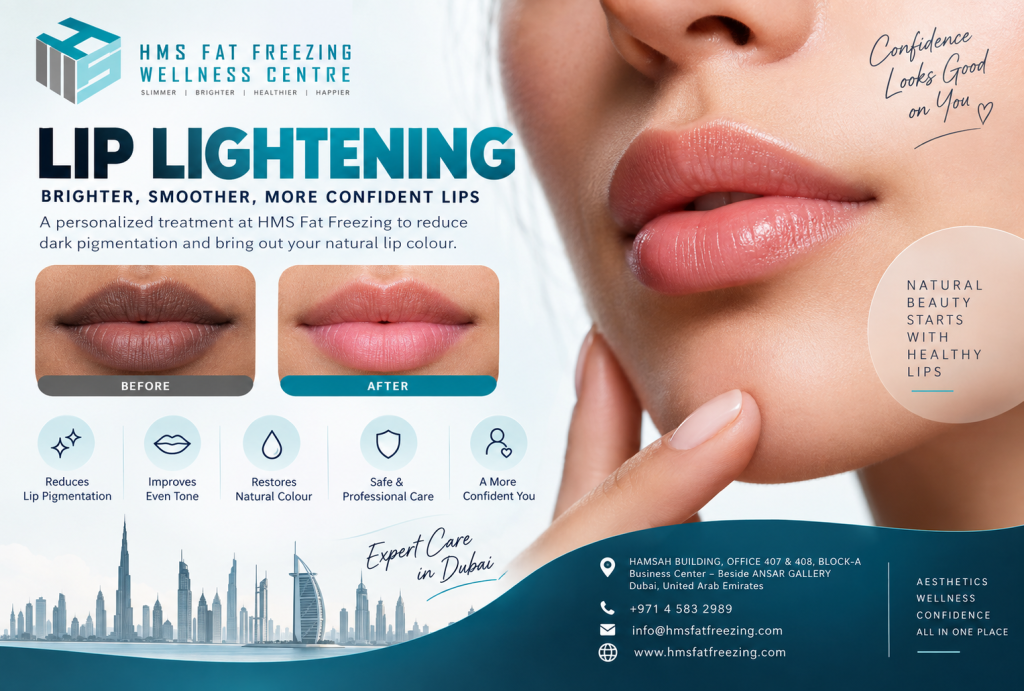
Lip Lightening: Causes, Treatments, Safety, Results and a Complete Dubai Guide
Dark, dull or unevenly pigmented lips can be a cosmetic concern for both men and women. Some people have naturally deeper lip pigmentation, while others notice that their lips gradually become darker because of irritation, sun exposure, smoking, repeated dryness, cosmetics or other factors.
This is why Lip Lightening should not begin with the assumption that every dark lip needs the same procedure.
A professional approach starts by asking a more useful question: why has the pigmentation developed?
Lip pigmentation has many possible causes, ranging from normal physiological pigmentation to inflammatory, medication-related and other medical conditions. A dermatology review on lip hyperpigmentation specifically notes that assessment should take into account factors such as the appearance, distribution, age of onset and associated symptoms.
At HMS Fat Freezing in Dubai, the aim of a Lip Lightening consultation is therefore not simply to make lips “lighter.” It is to assess the visible pigmentation, understand contributing factors and select an appropriate treatment or care strategy while protecting the delicate lip surface.
This guide explains what Lip Lightening involves, why lips become dark, which treatment approaches may be considered, what results are realistic and how to reduce the chance of pigmentation returning.
What Is Lip Lightening?
Lip Lightening is an aesthetic approach intended to reduce the visible appearance of unwanted or uneven lip pigmentation and create a more balanced-looking natural lip tone.
It is not one standardized procedure.
Depending on the person, professional Lip Lightening treatment may involve:
- Improving the condition of dry or irritated lips
- Eliminating products that are triggering irritation
- Professional topical pigmentation care
- Carefully selected exfoliation
- Pigment-targeting laser technology in suitable candidates
- Lifestyle modifications
- Consistent UV protection
- A combination of approaches over time
HMS Fat Freezing describes its Lip Lightening treatment as a personalized aesthetic service in which the treatment method is chosen according to pigmentation, lip sensitivity, condition and individual goals.
That personalized element matters because excessive treatment can actually create more inflammation and, in pigmentation-prone skin, potentially lead to additional discoloration.
Why Do Lips Become Dark?
Before choosing a Lip Lightening procedure, it is important to understand what might be contributing to the discoloration.
Natural or Genetic Lip Pigmentation
Some people naturally have brown, purple-brown or darker pigmentation in their lips. This can simply be part of their normal skin tone.
Naturally pigmented lips are not unhealthy.
In these cases, someone may still request Lip Lightening for cosmetic reasons, but expectations need to be realistic. The goal should generally be a more even-looking or subtly brighter appearance rather than trying to create an unnatural lip colour.
Sun and UV Exposure
The lips are continuously exposed to sunlight.
Repeated UV exposure may contribute to pigmentation changes and can worsen existing areas of hyperpigmentation. More generally, dermatology guidance on hyperpigmentation emphasizes sun protection because UV exposure can darken pigmented areas.
This is especially relevant in Dubai, where outdoor exposure can be significant throughout much of the year.
For this reason, an SPF lip product is often just as important to a long-term Lip Lightening plan as the procedure itself.
Smoking
Smoking is another factor worth discussing.
A published study involving 213 men found a significant association between current smoking and pigmentation of the lips and gingiva, with pigmentation increasing alongside smoking exposure. That study demonstrates an association rather than proving that every case of dark lips is caused by smoking.
If smoking is contributing to lip pigmentation, repeatedly performing Lip Lightening without addressing the trigger may limit how long improvement lasts.
Repeated Irritation and Dryness
Chronically dry, cracked or inflamed lips can become a cycle:
dryness → irritation → inflammation → healing → pigmentation.
Frequent lip licking, biting or peeling loose skin can make that cycle worse.
A useful practical rule is that irritated lips should usually be stabilized before aggressive pigmentation treatment is considered.
Lipsticks, Lip Balms and Other Products
Products applied to the lips may occasionally cause irritant or allergic reactions.
Repeated exposure to an allergen can produce pigmented contact cheilitis, which has been described in medical literature as pigmentation associated with repeated contact with sensitizing substances. Possible accompanying symptoms can include scaling, itching, redness or swelling.
That means switching to another bleaching product without identifying the irritant may make the problem worse rather than better.
Medication and Medical Causes
Lip pigmentation can sometimes occur alongside medication use, inflammatory conditions, hormonal or systemic disorders and other medical conditions.
That is another reason why Lip Lightening is not appropriate for every unexplained pigmented lesion.
A sudden or unusual change deserves proper assessment rather than immediate cosmetic treatment.
When Dark Lips Need Medical Assessment First
Most cosmetic pigmentation concerns are not emergencies, but not every dark spot should automatically be treated as ordinary hyperpigmentation.
Seek an appropriate medical assessment when pigmentation is:
- New and rapidly changing
- Limited to one unusual or irregular spot
- Associated with persistent crusting or scaling
- Bleeding
- Ulcerated
- Painful
- Accompanied by a lump
- Changing noticeably in shape or colour
- Persisting despite removing an obvious irritant
Chronic sun exposure can also produce conditions affecting the lips that require medical evaluation rather than cosmetic Lip Lightening.
The principle is simple: diagnosis comes before cosmetic treatment when the appearance is unusual.
How Does Lip Lightening Work?
There is no single biological mechanism behind every Lip Lightening treatment.
Different methods target different parts of the problem.
1. Restoring the Lip Barrier
For dry or irritated lips, treatment may initially be surprisingly simple.
Reducing irritating products, avoiding picking, introducing suitable moisturising lip care and improving sun protection may allow inflammation to settle.
This matters because treating pigmentation while inflammation is still active can be counterproductive.
2. Professional Topical Care
Certain pigmentation-modifying ingredients are used in dermatology for hyperpigmentation elsewhere on the skin.
However, lips are not identical to facial skin, and products should not automatically be transferred from one area to another.
Particular caution is needed with powerful bleaching products bought online.
The US FDA warns against unapproved over-the-counter skin-lightening products containing ingredients such as mercury or hydroquinone and notes reports of serious adverse reactions from improperly used products.
For Lip Lightening, stronger does not automatically mean safer or more effective.
3. Controlled Exfoliation
Selected superficial exfoliating approaches may be considered when appropriate.
The purpose is controlled removal of superficial cells rather than aggressively stripping the lip surface.
HMS Fat Freezing also provides professional Chemical Peel treatment for suitable skin concerns. Chemical peeling in general must be selected according to skin type, pigmentation tendency and treatment depth because excessive inflammation can trigger post-inflammatory pigmentation.
A facial peel and a treatment applied to the delicate lip area should never be assumed to be interchangeable.
4. Laser Lip Lightening
Pigment-targeting lasers may be considered for selected cases of lip hyperpigmentation.
Certain Q-switched laser wavelengths have been studied for hyperpigmented lips. However, the evidence remains relatively limited and results are not identical for every patient.
For example, a small prospective study of 24 patients treated with a 532-nm Q-switched Nd laser found that some participants improved while others developed worsening or mottled pigmentation.
Another study of physiological lip hyperpigmentation reported improvement in many participants but also recorded complications including herpes reactivation and mottled hypopigmentation.
A randomized study comparing two Nd approaches similarly reported pigment improvement while documenting side effects such as scaling, swelling, hypopigmentation and post-inflammatory hyperpigmentation in some participants.
The takeaway is not that laser Lip Lightening is inherently unsafe. It is that device choice, settings, skin type, pigmentation depth, operator experience and aftercare matter.
Lip Lightening Treatment Comparison
| Treatment Approach | Best Considered For | Typical Advantage | Important Limitation |
|---|---|---|---|
| Barrier repair and lip care | Dry, irritated or frequently chapped lips | Gentle and low downtime | Does not directly remove deeper pigment |
| Professional topical care | Selected superficial pigmentation | Gradual approach | Requires consistency and professional product selection |
| Controlled exfoliation | Suitable superficial uneven pigmentation | Can improve dull surface appearance | Over-treatment may cause irritation |
| Pigment-targeting laser | Selected melanin-related pigmentation | More targeted pigment treatment | Can cause swelling, PIH or uneven lightening |
| Combination approach | Multiple contributing factors | Addresses more than one cause | Requires careful sequencing |
| Trigger management | Smoking, irritation, UV or product-related darkening | Helps protect long-term results | Improvement may be gradual |
What Happens During a Lip Lightening Consultation?
A professional consultation should involve considerably more than looking at the lips for a few seconds and recommending a laser.
At HMS Fat Freezing, Lip Lightening planning can begin with assessment of:
Pigmentation Pattern
Is the pigmentation uniform or patchy?
Does it affect the upper lip, lower lip or both?
Is it longstanding or recently developed?
Lip Condition
Dryness, cracking, inflammation and sensitivity can alter treatment selection.
Treating irritated lips aggressively is rarely a sensible starting point.
Lifestyle Factors
Your practitioner may discuss:
- Sun exposure
- Smoking
- Lip licking
- Current lip products
- Previous pigmentation treatments
- Recent irritation
- Cosmetic procedures
- Regular medications
Previous Treatment Reactions
If you have previously developed prolonged darkening after a laser, peel, burn or skin procedure, that information is particularly important.
Treatment Goals
One of the most useful questions is:
Do you want healthier, more even-looking lips, or are you expecting your natural lip colour to change completely?
Good Lip Lightening planning depends on keeping expectations realistic.
What Results Can You Expect?
The result of Lip Lightening varies according to the cause of pigmentation.
Someone with surface pigmentation caused largely by irritation may respond differently from someone with genetically determined pigmentation.
Possible improvements include:
- More even-looking colour
- Reduced appearance of darker areas
- A fresher lip appearance
- Smoother-looking surface texture
- Less contrast between unevenly pigmented areas
Treatment should not be promoted as permanent whitening.
Pigmentation can recur, particularly if the original trigger continues.
Research on laser treatment also shows variation between patients, which is another reason fixed guarantees such as “permanent pink lips in one session” should be approached cautiously.
How Many Lip Lightening Sessions Are Needed?
There is no universal number.
Some people may need only conservative care and monitoring. Others undergoing a procedure may require a planned series of sessions.
The number of Lip Lightening sessions can depend on:
- Cause of pigmentation
- Depth of pigment
- Treatment technology
- Skin tone
- Lip sensitivity
- Response after the first treatment
- Lifestyle triggers
- Healing pattern
A responsible practitioner should reassess the lips between sessions instead of automatically repeating treatment regardless of response.
Does Lip Lightening Hurt?
Comfort varies with the procedure.
Gentle topical or surface treatments may cause little discomfort. Laser Lip Lightening can cause sensations commonly described as warmth, snapping or stinging.
Depending on the method, temporary tenderness may follow treatment.
Pain that becomes severe, steadily worsens or is accompanied by significant blistering or other concerning symptoms should be reported to the treating professional.
Possible Side Effects and Risks
Every effective aesthetic procedure has limitations.
Possible effects following procedural Lip Lightening can include:
- Temporary redness
- Swelling
- Tenderness
- Dryness
- Flaking
- Crusting
- Temporary darkening
- Uneven pigmentation
- Post-inflammatory hyperpigmentation
- Hypopigmentation
- Infection
- Herpes simplex reactivation in susceptible individuals
Published laser studies have documented pigment changes and other temporary complications in some patients.
Discussing these possibilities before treatment is part of proper informed consent.
Pros and Cons of Lip Lightening
Pros
Targets a specific cosmetic concern: Professional Lip Lightening can directly address unwanted uneven pigmentation.
Personalizable: Different causes can be managed differently rather than using one standard procedure.
Non-surgical options are available: Many approaches do not require surgery.
Potential for gradual natural-looking improvement: The goal can be controlled improvement rather than an artificial-looking colour change.
Can encourage better lip care: A good treatment program often improves UV protection and everyday lip-care habits as well.
Cons
Results vary: Natural pigmentation, pigment depth and treatment response differ substantially.
Maintenance may be necessary: UV exposure, smoking, irritation and other triggers can contribute to recurrence.
Procedures have risks: Laser and exfoliating treatments can sometimes worsen pigmentation.
Not every pigmentation problem is cosmetic: Some conditions require medical diagnosis.
Multiple sessions may be required: Improvement is often progressive rather than immediate.
Lip Lightening Aftercare
Aftercare can significantly influence how the lips heal.
Keep the Lips Moisturised
Use the product recommended by your practitioner.
Dry, cracked lips are easier to irritate and more tempting to pick.
Do Not Pull Flaking Skin
If mild flaking occurs, allow it to separate naturally.
Picking can create unnecessary inflammation.
Protect Your Lips From the Sun
Sun protection should continue after Lip Lightening, not just during recovery.
AAD guidance for hyperpigmentation emphasizes the role of consistent UV protection in preventing pigment from becoming darker.
A suitable SPF lip balm is particularly practical in Dubai.
Avoid Unapproved Whitening Products
Do not add bleaching creams, strong acids or online “pink lip” products simply because results are not developing quickly enough.
FDA safety information highlights the risks associated with unapproved lightening products containing potentially harmful ingredients.
Follow Procedure-Specific Advice
Laser aftercare differs from topical treatment or superficial exfoliation.
Follow the instructions given for your specific procedure.
Lip Lightening in Dubai: Why Local Conditions Matter
Dubai creates several practical considerations for anyone undergoing Lip Lightening.
Strong Sun Exposure
People frequently move between indoor environments and intense outdoor sunlight.
Lip SPF therefore needs to become a daily habit rather than something used only during beach visits.
Dehydration and Dry Indoor Air
Air conditioning combined with environmental heat can leave some people experiencing dry-feeling lips.
Repeated cracking and lip licking can then create additional irritation.
Lifestyle Habits
Outdoor dining, commuting, smoking, frequent coffee consumption and repeated application of lip cosmetics may all be relevant during a consultation depending on the individual.
A good Dubai Lip Lightening plan therefore considers what happens between clinic visits, not only what happens during the procedure.
Who May Be Suitable for Lip Lightening?
You may be worth assessing for Lip Lightening if you:
- Have stable, unwanted lip pigmentation
- Have uneven-looking lip colour
- Understand that results vary
- Can follow aftercare instructions
- Are willing to protect the lips from UV exposure
- Have realistic expectations
Treatment selection should still depend on professional assessment.
When Treatment May Need to Be Delayed
Treatment may need to be postponed when the lips are actively inflamed, infected, severely cracked or affected by another condition requiring treatment first.
A history of recurrent cold sores is also important to disclose before certain laser procedures because laser treatment around the mouth can potentially reactivate herpes simplex in susceptible people. Reactivation was reported in participants in one published lip laser study.
Medication use, allergies, pregnancy status and relevant medical conditions should also be discussed before an aesthetic procedure.
A Better Strategy Than Simply Asking for “Pink Lips”
One of the most useful changes in approach is to stop defining successful Lip Lightening as making every person’s lips pink.
Healthy lips come in many natural colours.
A more realistic treatment objective is to improve pigmentation that is unwanted, acquired or visibly uneven while keeping the result compatible with the person’s natural complexion.
This distinction protects patients from chasing increasingly aggressive procedures in pursuit of an unrealistic colour target.
Expert Recommendations From HMS Fat Freezing
Based on the personalized approach described by HMS Fat Freezing for its skin and lip treatments, several practical principles stand out.
Identify the Trigger Before Treating the Pigment
If irritation, smoking, sun exposure or a product reaction is continuously stimulating pigmentation, treatment alone may provide incomplete or temporary improvement.
Use Conservative Treatment on Sensitive Lips
The lip surface deserves greater caution than many other facial areas.
More energy, stronger acids or more frequent sessions do not automatically create better Lip Lightening results.
Reassess Between Sessions
The response after the first procedure provides valuable information about pigmentation behaviour and sensitivity.
Protect Results at Home
Daily lip care and UV protection are part of treatment, not optional extras.
Ask What Is Being Used
For any peel, injection, topical product or device-based procedure, clients should know what treatment is being performed, what it is intended to do and what risks or alternatives exist.
HMS Fat Freezing also provides a wider range of for clients with other pigmentation, hydration or texture concerns. Where the concern extends beyond the lips, assessment may therefore involve the surrounding skin rather than treating one isolated area.
For wider facial pigmentation concerns, clients can also learn about the clinic’s , although injectables and Lip Lightening are different treatments and should not be considered interchangeable.
People primarily concerned about skin hydration and quality rather than pigmentation can review HMS Fat Freezing’s .
Evidence and Safety Resources Worth Reading
Patients researching Lip Lightening should favour credible medical resources over dramatic social-media before-and-after claims.
Useful sources include the , , the and the .
The important point is that cosmetic treatment should be guided by the cause of pigmentation, not simply by a desire to use the strongest available product.
Trusted Health Resources
For additional information regarding healthy weight management and wellness, explore these trusted resources:
These resources provide educational information about healthy lifestyles, body composition, and wellness practices.
Frequently Asked Questions About Lip Lightening
1. Can dark lips really be lightened?
Some types of unwanted pigmentation may improve with appropriate Lip Lightening treatment, especially when the trigger can also be addressed. Results depend on whether the pigmentation is superficial or deeper, natural or acquired, and whether continuing factors such as irritation, UV exposure or smoking are present.
The goal should be improvement rather than guaranteed transformation into a specific lip colour.
2. Is Lip Lightening permanent?
Not necessarily.
Even after successful Lip Lightening, pigmentation may gradually return. UV exposure, smoking, irritation, certain products and natural pigment production can influence recurrence.
Maintenance care and daily sun protection may therefore be recommended.
3. How many sessions of Lip Lightening do I need?
There is no fixed number.
Some laser studies have used one to several treatments, while other treatment approaches require gradual management. The correct number depends on your pigmentation pattern, selected procedure and response after treatment.
Your practitioner should reassess progress rather than promising a predetermined result.
4. Is laser Lip Lightening safe for darker skin tones?
Laser treatment can be used in selected patients, but darker and pigmentation-prone skin requires careful assessment.
Any procedure that produces inflammation can potentially lead to post-inflammatory hyperpigmentation. Laser studies involving lip pigmentation have also documented temporary or uneven pigment changes in some participants.
Appropriate device selection and conservative parameters are therefore important.
5. Why did my lips become darker suddenly?
Sudden pigmentation can have many potential explanations, including irritation, a new cosmetic product, inflammation, medication-related changes or other conditions.
Because Lip Lightening treats appearance rather than diagnosing every underlying condition, newly developing or unusual pigmentation should be assessed before treatment.
6. Can smoking cause dark lips?
Research has demonstrated an association between smoking exposure and pigmentation of the lips and gingiva.
However, smoking is not the only cause of pigmented lips. Natural pigmentation, sun exposure, inflammation and contact reactions can also contribute.
If smoking is an important trigger, treating pigmentation without addressing smoking may reduce the durability of the cosmetic result.
7. Can I use lemon, baking soda or toothpaste to lighten my lips?
This is not recommended.
The lips have a delicate barrier, and irritating DIY mixtures can cause dryness or inflammation. In pigmentation-prone individuals, inflammation itself can contribute to further darkening.
Professional Lip Lightening should aim to reduce irritation, not repeatedly create it.
8. Can I use skin whitening cream on my lips?
Do not assume a product designed for facial or body skin is safe for the lips.
Some strong skin-lightening products can cause adverse reactions, and regulators such as the FDA have issued safety warnings about unapproved products containing mercury or hydroquinone.
Ask a qualified professional before using an active pigmentation product directly on the lips.
9. What should I avoid after Lip Lightening treatment?
Exact instructions depend on the procedure, but patients may be advised to avoid picking or peeling the lips, unnecessary irritating products and excessive sun exposure.
Consistent moisturisation and appropriate SPF lip protection are usually important components of aftercare.
Follow your treating professional’s specific instructions because aftercare for laser Lip Lightening may differ from aftercare following a gentler topical treatment.
10. How do I choose a Lip Lightening clinic in Dubai?
Look beyond promotional photographs.
Ask how the pigmentation will be assessed, what procedure or product will be used, what results are realistic, what complications are possible and what happens if pigmentation becomes darker after treatment.
A responsible provider should also recognise when Lip Lightening is not the correct first step and when referral for medical assessment is more appropriate.
Conclusion: Lip Lightening Should Start With Understanding the Pigmentation
The most effective approach to Lip Lightening is not simply finding the strongest laser or the fastest bleaching product.
It starts with understanding why the lips look darker.
Natural pigmentation, UV exposure, smoking, repeated irritation, lip products, inflammation and medical factors can all create different treatment situations. That is why the same Lip Lightening procedure will not produce identical results for everyone.
For appropriate candidates, professional topical care, controlled exfoliation, pigment-targeting technologies or a carefully planned combination of treatments may improve the appearance of unwanted pigmentation. At the same time, realistic expectations are essential. Pigmentation can return, treatments can cause side effects, and healthy natural lips do not need to be a particular shade of pink.
HMS Fat Freezing’s approach to Lip Lightening in Dubai emphasizes professional assessment, individualized treatment planning, realistic expectations and appropriate aftercare.
If dark or uneven lip pigmentation is bothering you, a consultation can help determine whether the first step should be treatment, improved lip care, trigger management or further medical assessment.
Book a Consultation With HMS Fat Freezing
HMS Fat Freezing
HAMSAH BUILDING, OFFICE 407 & 408, BLOCK-A
Business Center – Beside ANSAR GALLERY
Dubai, United Arab Emirates
Phone: +971 4 583 2989
Email: info@hmsfatfreezing.com
Visit HMS Fat Freezing
Medical information notice: This article provides general educational information about cosmetic lip pigmentation and does not replace an individual diagnosis or consultation with an appropriately qualified healthcare professional.