
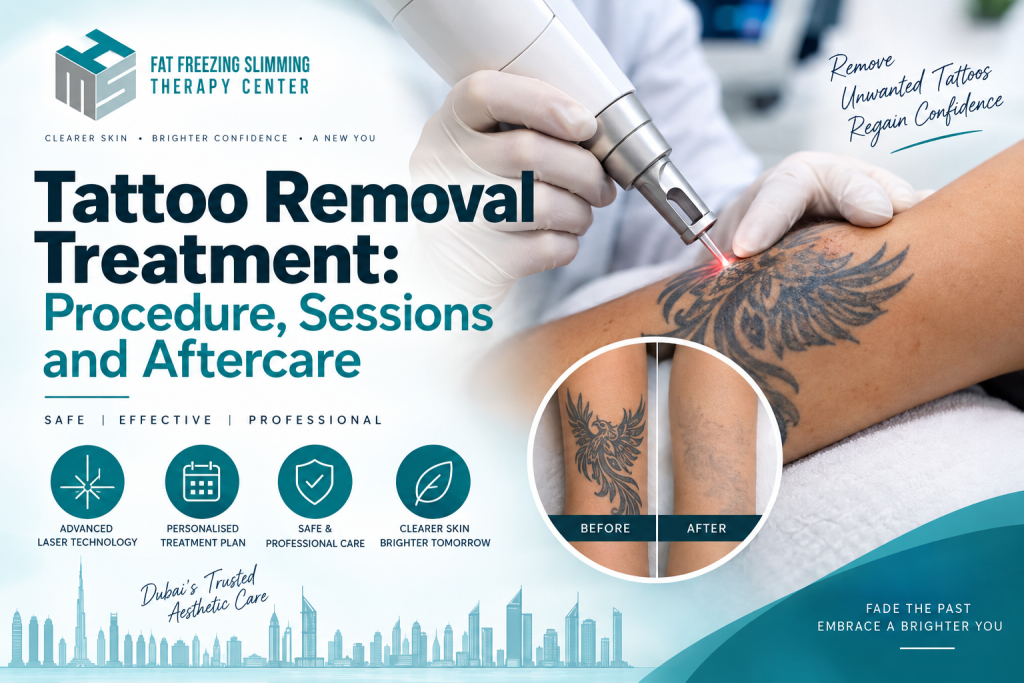
Tattoo Removal Treatment: Procedure, Sessions and Aftercare
A tattoo may take only a few hours to create, but removing it is a very different process. Tattoo pigment sits below the skin’s surface, which means it cannot simply be washed, peeled or scrubbed away. Modern Tattoo Removal Treatment therefore focuses on breaking tattoo pigment into smaller particles while allowing the body and skin time to respond between appointments.
For someone considering removal, the biggest questions are usually straightforward: How does the procedure work? How many sessions will I need? Does it hurt? Will the tattoo disappear completely? What will my skin look like afterwards?
The answers are more individual than many advertisements suggest.
Tattoo colour, pigment density, tattoo age, skin tone, location on the body, previous scarring and even the goal—complete removal versus enough fading for a cover-up—can change the treatment plan.
According to the U.S. Food and Drug Administration, laser removal is the most commonly used professional approach. Laser energy breaks tattoo ink into smaller particles that the body’s immune system can gradually clear. Multiple sessions are normally needed, and complete removal cannot be guaranteed in every case.
At HMS Fat Freezing in Dubai, the existing Tattoo Removal Treatment service is based on controlled laser energy designed to progressively fade unwanted tattoo pigment while taking the surrounding skin into consideration.
This guide explains how the process works, what influences the number of appointments, what realistic results look like and why aftercare deserves as much attention as the laser session itself.
Medical note: This guide is educational and does not replace an individual assessment by an appropriately qualified healthcare professional. Skin disease, infection, abnormal scarring, allergic tattoo reactions or suspicious lesions around a tattoo require appropriate medical evaluation.
What Is Tattoo Removal Treatment?
Tattoo Removal Treatment is a procedure intended to lighten or remove unwanted tattoo pigment.
Permanent tattoos are difficult to remove because ink is deposited in the dermis, below the epidermis or outermost layer of skin. Tattoo particles are large enough to remain within the skin rather than being rapidly eliminated.
Laser treatment uses short, concentrated pulses of light energy. Specific wavelengths are selected according to the pigment being targeted. When the ink absorbs this energy, pigment particles are fragmented into smaller pieces.
The laser does not simply “erase” the tattoo during the appointment. Instead, the treatment starts a process. Your body subsequently clears part of the fragmented pigment over time.
This is one of the most important concepts to understand before beginning Tattoo Removal Treatment: the visible result develops between appointments, not only while the laser is touching the skin.
The American Academy of Dermatology explains that the body, rather than the laser itself, ultimately removes the fragmented ink particles. Skin also requires adequate time to recover before another treatment is performed.
How Does Laser Tattoo Removal Work?
Step 1: Tattoo and skin assessment
A responsible treatment plan should begin before the laser is switched on.
The practitioner needs to consider factors such as:
- Tattoo colour
- Size and surface area
- Pigment density
- Professional versus amateur tattoo
- Tattoo age
- Location
- Skin tone
- Previous laser sessions
- History of abnormal scars
- Current medications and relevant health conditions
- Whether the goal is complete removal or partial fading
This consultation helps determine whether Tattoo Removal Treatment is appropriate and what results may realistically be achievable.
The American Academy of Dermatology specifically recommends considering tattoo age, ink depth, colours, location, health, medication use and history of raised scars before laser removal.
Step 2: Preparing the treatment area
The tattooed area is normally examined and cleaned.
Protective eyewear is required when laser equipment is used. Depending on the treatment protocol, tattoo size and individual sensitivity, cooling or an appropriate numbing method may also be considered.
Step 3: Delivering laser pulses
The laser handpiece is directed across the tattoo.
The energy is selected to interact preferentially with tattoo pigment. Different tattoo colours absorb different wavelengths, which is one reason a multicoloured tattoo may be more complicated than a simple black tattoo.
Immediately after treatment, the area can appear temporarily whitened, red or swollen. Sensations differ from one patient to another.
Step 4: Healing and pigment clearance
This is the stage that many people underestimate.
Once the session is finished, your skin begins recovering while the body gradually processes fragmented ink particles. The tattoo may continue to change in appearance for weeks after the appointment.
Repeating Tattoo Removal Treatment too aggressively does not necessarily produce faster removal. Skin recovery and biological pigment clearance need time.
Which Tattoo Colours Are Easier to Remove?
Colour matters because different pigments absorb laser wavelengths differently.
Dark pigments, particularly black and dark blue, generally respond more predictably because they absorb a wider range of laser energy. The FDA notes that colours including green, red and yellow can be more challenging, while black and dark blue are often easier to treat.
That does not mean every black tattoo disappears quickly or every coloured tattoo responds poorly.
Pigment chemistry varies between tattoo inks. Two tattoos that look almost identical may react differently because the ink composition, depth and concentration are different.
White, flesh-coloured and some cosmetic pigments require particular caution because certain pigments can darken after laser exposure. The FDA specifically notes that some white, flesh-toned and permanent-makeup pigments can oxidise and turn darker.
This is another reason Tattoo Removal Treatment should be planned individually rather than using the same settings for every tattoo.
How Many Tattoo Removal Sessions Are Needed?
There is no reliable universal number.
Some people search for promises such as “tattoo removal in three sessions,” but the skin and ink do not follow a fixed calendar.
The FDA states that multiple treatments are required and that treatment count depends on factors including tattoo size and colour. Cleveland Clinic notes that laser removal can require approximately six to twelve visits in some cases, while individual tattoos may require fewer or more.
A consultation is therefore more useful than an online session calculator.
Factors that can increase the number of sessions
Dense professional ink
Professional tattoos may contain multiple layers and substantial pigment density.
Multiple colours
Different colours may require different wavelengths or treatment strategies.
Large tattoos
A large tattoo contains more pigment and requires more treatment area.
Tattoo location
Circulation and lymphatic drainage vary across the body and may influence the rate at which fragmented pigment is cleared.
Previous cover-up work
A cover-up often adds another layer of pigment over the previous tattoo, making removal more complicated.
Scarring within the tattoo
Tattooing itself can sometimes cause textural change or scarring. Removing pigment does not automatically remove pre-existing scar tissue.
Treatment goal
Someone who wants a tattoo faded for new artwork may need substantially less treatment than someone aiming for the greatest possible clearance.
This last point is particularly important. Before beginning Tattoo Removal Treatment, decide whether your goal is removal or cover-up preparation. It can significantly change how the treatment journey is planned.
Why Are Sessions Spaced Apart?
More treatment is not automatically better treatment.
After each laser session, two processes have to occur: the treated skin needs to recover, and your body needs time to clear disrupted pigment.
The AAD notes that spacing treatments allows both skin healing and removal of ink particles by the body.
Trying to compress Tattoo Removal Treatment into unnecessarily frequent appointments can expose recovering skin to additional irritation without allowing enough time to judge the previous session’s effect.
The correct interval should therefore be determined according to the procedure used, healing response and practitioner assessment rather than simply choosing the shortest available appointment gap.
What Does Tattoo Removal Feel Like?
Laser tattoo removal is commonly described as a rapid snapping, stinging or hot sensation.
The FDA compares the feeling to a thin rubber band snapping against the skin, while the AAD notes that treatment may be uncomfortable or painful and that numbing options may be used when appropriate.
Discomfort can vary according to:
- Tattoo location
- Tattoo size
- Laser settings
- Individual pain tolerance
- Skin sensitivity
- Length of the treatment session
A small wrist tattoo and a large densely coloured shoulder tattoo should not be expected to feel identical.
Tattoo Removal Treatment Comparison
| Method | How It Works | Typical Advantages | Main Limitations |
|---|---|---|---|
| Laser Tattoo Removal Treatment | Laser energy fragments selected tattoo pigments | Precise targeting, staged treatment, widely used professional method | Usually requires multiple sessions; pigment and skin changes are possible |
| Surgical Excision | Tattooed skin is surgically removed and the edges are closed | Can physically remove a small tattoo | Produces a surgical scar and is generally unsuitable for large areas |
| Dermabrasion | Skin is mechanically resurfaced to deeper levels | May reduce pigment in selected cases | Less predictable, more wound healing and potential scarring |
| Tattoo Removal Creams/DIY Products | Usually claim to bleach, peel or chemically fade skin | Easily available | Do not reliably reach deep tattoo pigment and may cause irritation, burns or scars |
Mayo Clinic describes laser treatment, surgical excision and dermabrasion as established tattoo-removal approaches but notes that laser surgery is commonly a treatment of choice.
The FDA does not approve tattoo-removal ointments, creams or DIY kits and warns that such products may cause burns, rashes or scars.
Advantages and Limitations of Tattoo Removal Treatment
Pros
Progressive tattoo fading
Laser technology can progressively reduce visible tattoo pigment over a planned course of appointments.
No surgical incision in routine laser treatment
Unlike excision, laser treatment generally does not involve cutting out the tattooed skin.
Suitable for different treatment goals
A Tattoo Removal Treatment plan may aim for substantial removal or simply enough fading to make a future cover-up easier.
Customisable approach
Treatment can be adjusted according to pigment colour, density, location and skin characteristics.
Relatively limited downtime for many patients
Many people can continue normal daily activities, although the treated area itself requires protection while healing.
Cons
Multiple sessions are usually necessary
Permanent ink was designed to remain in the skin. Removing it requires patience.
Complete clearance is not guaranteed
Residual pigment or a faint “ghost” of the tattoo may remain.
Temporary skin reactions can occur
Redness, swelling, tenderness, blistering or crusting may develop after treatment.
Pigment changes are possible
The skin may temporarily or, less commonly, persistently become lighter or darker than surrounding skin.
Scarring and infection are possible
These risks are higher when inappropriate treatment, poor healing or inadequate aftercare occurs.
Tattoo Removal Aftercare: What Matters Most
Good Tattoo Removal Treatment does not finish when you leave the treatment room.
The next several days—and your behaviour between sessions—can affect healing and complication risk.
Keep the area clean
Follow the cleansing instructions provided by your practitioner.
Avoid aggressive scrubbing, exfoliating products or unnecessary rubbing while the skin is recovering.
Do not pick blisters or crusts
A blister or small crust can be part of the healing response. Picking it may interfere with healing and potentially increase the chance of scarring or pigmentation.
Allow the area to recover naturally unless your treating professional gives different instructions.
Follow dressing instructions
Some areas may require temporary covering or a recommended topical product.
Do not assume that the same routine used after getting a new tattoo is automatically appropriate after laser removal. Follow your Tattoo Removal Treatment provider’s specific instructions.
Protect treated skin from sunlight
UV exposure deserves special attention after laser procedures.
The AAD recommends protecting treated skin from the sun following tattoo removal and notes that pigmentation changes can occur.
For Dubai residents, this is particularly relevant. Even brief exposure while driving, walking to a car or sitting near strong sunlight may add up.
Protective clothing and any sunscreen recommended once appropriate for the healing stage should become part of the recovery plan.
Avoid unnecessary heat and friction
Depending on your practitioner’s instructions and how the area is healing, activities involving heavy rubbing, excessive sweating or heat may need temporary modification.
A tattoo under a tight gym waistband, for example, may receive repeated friction during exercise. A shoulder tattoo may rub against a backpack strap.
Good aftercare is therefore location-specific, not only product-specific.
Be careful with swimming
Pools, hot tubs, the sea and prolonged water exposure may be inappropriate while the treated skin is healing.
If you are planning a Dubai beach weekend or holiday, consider this before scheduling your Tattoo Removal Treatment appointment.
Dubai-Specific Tattoo Removal Considerations
Dubai creates a few practical challenges that should be factored into treatment planning.
Strong sunlight
Post-treatment skin needs careful UV protection. Scheduling sessions immediately before a beach holiday, desert trip or prolonged outdoor activity may make aftercare unnecessarily difficult.
Heat and perspiration
Freshly treated skin can feel more irritated when exposed to heavy sweating and friction.
Frequent travel
Tattoo removal is a staged process. If work or travel means you cannot attend appropriate follow-up appointments, discuss the schedule before starting.
Diverse skin tones
Dubai’s population includes a very wide spectrum of skin tones.
Melanin-rich skin may be more vulnerable to post-inflammatory hyperpigmentation after excessive inflammation. Proper assessment, suitable technology and conservative treatment parameters can therefore be particularly important.
A personalised Tattoo Removal Treatment strategy should consider both tattoo pigment and natural skin pigmentation.
Is Tattoo Removal Safe for Darker Skin Tones?
Laser tattoo removal can be performed on many different skin tones, but treatment parameters need to be chosen carefully.
The challenge is distinguishing tattoo pigment from natural melanin while avoiding unnecessary injury to surrounding skin.
Mayo Clinic notes that particular laser approaches may be selected for darker skin to reduce the chance of unwanted pigment alteration.
This is why copying the exact settings used on another person’s tattoo is not an appropriate treatment strategy.
Skin tone, recent sun exposure, tendency toward pigmentation, tattoo colour and previous treatment response all matter.
What Results Should You Realistically Expect?
Think of Tattoo Removal Treatment as progressive fading rather than instant deletion.
After one session, a tattoo may look only slightly different. Some areas can respond faster than others. Lines may fade unevenly because different parts of the original tattoo contain different pigment concentrations.
With subsequent sessions, further fading may occur.
However, three realistic possibilities should be discussed from the start:
- Significant or near-complete clearance
- Visible residual pigment
- Enough fading for a successful cover-up tattoo
A responsible consultation should never promise perfect skin.
The FDA states clearly that complete tattoo removal may not always be possible.
Can Tattoo Removal Cause Scarring?
Scarring is possible, although risk depends on the removal technique, skin response, treatment parameters, pre-existing tattoo scars and aftercare.
Mayo Clinic notes that scarring, infection and changes in skin colour are recognised risks associated with tattoo removal.
It is also important to separate two issues.
Sometimes a tattoo already contains scar tissue created when the tattoo was originally applied. Once dark pigment begins disappearing, that existing texture may simply become easier to see.
Not every visible scar after Tattoo Removal Treatment was therefore necessarily caused by the laser.
This distinction can often be discussed during an initial examination.
When Should You Seek Medical Advice After Treatment?
Mild redness, tenderness or swelling can occur after treatment.
Contact your treating professional if a reaction seems unusual or significantly worse than what you were told to expect.
Urgent assessment may be appropriate for symptoms such as increasing severe pain, expanding redness, pus or unusual drainage, fever or other signs suggesting infection.
Do not attempt to treat a significant reaction by repeatedly applying random cosmetic products.
Expert Recommendations From HMS Fat Freezing
For people considering Tattoo Removal Treatment, the practical focus should be on planning rather than rushing.
1. Start with an individual consultation
Do not choose your number of sessions from somebody else’s before-and-after photos.
Tattoo depth, pigment colour, skin characteristics and treatment goals vary considerably.
2. Decide whether you want removal or fading
If you want a future cover-up, tell the practitioner from the beginning. You may not need to pursue maximum possible clearance.
3. Plan around sun exposure
In Dubai, avoid creating an aftercare problem by booking treatment immediately before prolonged outdoor activity or a beach holiday.
4. Give your skin enough recovery time
Treatment frequency should follow appropriate clinical assessment, not impatience.
5. Treat aftercare as part of the procedure
The quality of Tattoo Removal Treatment depends not only on laser technology but also on how the skin is protected between appointments.
HMS Fat Freezing provides a dedicated Tattoo Removal Treatment service page for people who want to learn more about the procedure. View HMS Tattoo Removal Treatment
You can also explore the clinic’s broader range of professional skin procedures before deciding which treatment is relevant to your concern. Explore HMS Skin Treatments
For patients researching uneven pigmentation or other concerns alongside tattoo removal, HMS also provides information about pigmentation-focused treatments. Learn About Anti Pigmentation Treatment
Additional educational information about skin treatments and Dubai-specific sun exposure is available in the HMS guide to professional skin treatments. Read the HMS Skin Treatments Guide
Trusted Medical Resources About Tattoo Removal
Patients who want to research Tattoo Removal Treatment further can consult independent medical sources:
FDA: Tattoo Removal – Options and Results
American Academy of Dermatology: Laser Tattoo Removal
Cleveland Clinic: Tattoo Removal Process and Healing
Frequently Asked Questions About Tattoo Removal Treatment
1. How many sessions does Tattoo Removal Treatment usually take?
There is no fixed number. Many tattoos require several appointments, and some treatment courses extend beyond six sessions. Size, colour, pigment density, location, tattoo depth, skin response and treatment goal all influence the total. An assessment after the first few sessions may provide a more useful estimate than guessing before treatment begins.
2. Can a tattoo be completely removed?
Sometimes substantial clearance is possible, but complete removal cannot be guaranteed. Certain pigments are more resistant, and residual colour, skin texture or a faint outline may remain. The FDA specifically advises that complete removal is not possible in every case.
3. Is black tattoo ink easier to remove?
Black and dark-blue pigments often respond more readily than some lighter or brighter colours because of the way they absorb laser wavelengths. However, tattoo depth and pigment density also influence how quickly the tattoo fades.
4. Does Tattoo Removal Treatment hurt more than getting a tattoo?
Pain perception is highly individual. Laser pulses are often described as sharp snapping, stinging or heat. Treatment is delivered relatively quickly over small areas, and suitable comfort measures may be considered depending on the patient and procedure.
5. Can I remove a tattoo in one session?
Usually not. A laser cannot safely eliminate every layer of tattoo pigment in a single routine session. The skin also needs time to heal while the body processes fragmented pigment between treatments.
6. How long should I wait between tattoo removal sessions?
The correct interval varies according to laser type, treated area and healing response. Sessions are generally spaced weeks apart rather than performed on consecutive days. Follow the schedule recommended after your skin has been assessed.
7. Will tattoo removal leave a scar?
Scarring is possible but is not inevitable. The risk depends on treatment method, skin response, existing tattoo scarring, treatment intensity and aftercare. Do not pick crusts or blisters, and report abnormal healing promptly.
8. Can I go to the gym after Tattoo Removal Treatment?
This depends on the treated location and your practitioner’s advice. Heavy sweating, friction from clothing and equipment rubbing against freshly treated skin may cause irritation. Ask when normal exercise can safely resume for your specific treatment area.
9. Can I swim after laser tattoo removal?
Swimming is usually avoided while the treated skin is still healing. Pools, hot tubs and seawater can expose healing skin to irritation or contamination. Follow your clinician’s instructions before returning to swimming.
10. Can tattoo removal creams replace laser treatment?
There is no FDA-approved tattoo removal cream capable of reliably removing dermal tattoo pigment. The FDA warns that DIY creams and kits may cause rashes, burns or scars. Professional assessment is a safer starting point.
Conclusion: Successful Tattoo Removal Is a Process, Not a Single Appointment
The most important expectation to set before Tattoo Removal Treatment is that removal happens progressively.
Laser energy can fragment unwanted tattoo pigment, but the body’s clearing process, the skin’s recovery and the physical characteristics of the tattoo determine how quickly visible fading develops.
A good treatment plan therefore asks more than, “How many sessions will this take?”
It should also ask:
What colours are present? How deeply is the ink placed? Has the tattoo already been treated? Is there scar tissue? How does this person’s skin respond to inflammation? Is the goal complete clearance or preparation for a cover-up? Can the patient realistically protect the area from Dubai’s strong sun during recovery?
Those questions create a more useful treatment strategy than promising a fixed number of sessions.
When Tattoo Removal Treatment is approached with realistic expectations, appropriate technology, professional assessment and disciplined aftercare, patients are better positioned to achieve progressive fading while protecting the health and appearance of their skin.
Contact HMS Fat Freezing Dubai
For an individual consultation regarding Tattoo Removal Treatment, contact HMS Fat Freezing.
HMS Fat Freezing
HAMSAH BUILDING, OFFICE 407 & 408, BLOCK-A
Business Center – Beside ANSAR GALLERY
Dubai, United Arab Emirates
Phone: +971 4 583 2989
Email: info@hmsfatfreezing.com
HMS Fat Freezing’s current website lists the same Dubai clinic location, phone number and email contact details.