
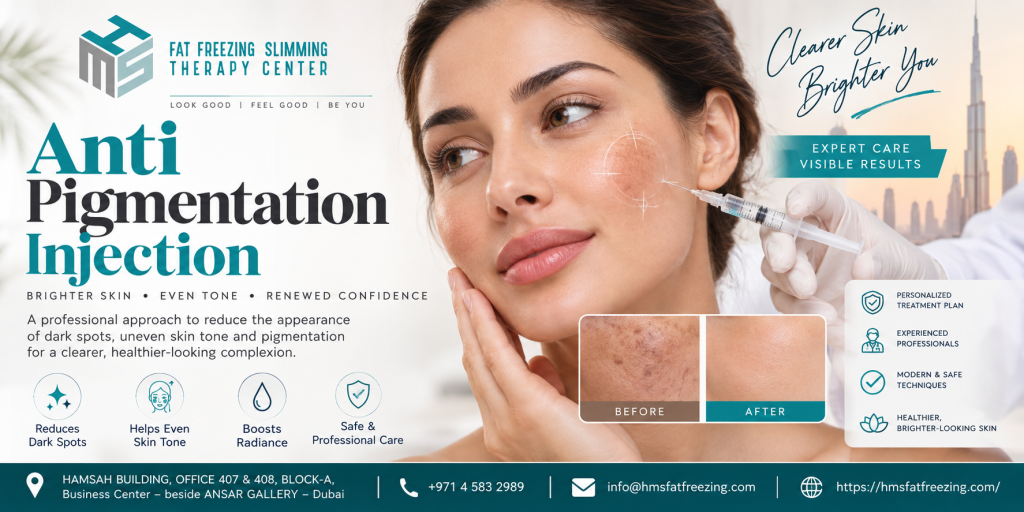
Anti Pigmentation Injection: What It Is, How It Works, Safety, Results and Dubai Considerations
Pigmentation is one of the most common reasons people seek professional skin treatments in Dubai. Dark patches on the cheeks, forehead or upper lip, marks left after acne, uneven tone and sun-related discoloration can all fall under the broad description of hyperpigmentation.
Because Dubai combines intense ultraviolet exposure with heat and frequent outdoor-to-indoor temperature changes, pigmentation can also be persistent. Treating it effectively requires more than simply choosing the strongest-looking treatment.
An Anti Pigmentation Injection is one option promoted for improving the appearance of uneven pigmentation and supporting a brighter-looking complexion. However, one of the most important facts consumers should understand is that the term does not refer to one universally standardized medical formulation.
Different clinics and practitioners may use the phrase Anti Pigmentation Injection for different injectable protocols, ingredients or methods. That means the first question should never be simply, “How many sessions do I need?” It should be, “Exactly what product is being injected, why is it appropriate for my pigmentation, and what evidence supports its use?”
At HMS Fat Freezing in Dubai, the clinic describes its Anti Pigmentation Injection as a personalized aesthetic treatment chosen according to individual skin concerns and medical history. The clinic also advises patients to ask about the complete ingredient list, intended use, possible adverse effects and regulatory status before treatment.
This guide explains what that means in practical terms.
What Is an Anti Pigmentation Injection?
An Anti Pigmentation Injection is an injectable aesthetic treatment marketed to improve the appearance of hyperpigmentation, dullness or uneven-looking skin tone.
Unlike a standardized medication with one fixed composition, the name itself does not identify a particular ingredient.
Depending on the practitioner and treatment plan, pigmentation-related injectable protocols discussed in aesthetic medicine may involve substances such as antioxidants, vitamins or other compounds. Some treatments described online as “whitening injections” use glutathione, while certain medical approaches to melasma may involve other medications or procedures.
This distinction matters because efficacy and safety can vary substantially according to:
- The ingredient
- Concentration
- Route of administration
- Injection technique
- Treatment frequency
- Patient’s medical history
- Type and depth of pigmentation
- Other treatments being used simultaneously
For that reason, an Anti Pigmentation Injection should not be viewed as a generic product that produces the same result for everyone.
Pigmentation should be diagnosed before it is treated
Brown marks can develop for very different reasons.
Common possibilities include:
- Melasma
- Post-inflammatory hyperpigmentation after acne
- Sun-related lentigines
- Pigmentation following irritation
- Hormone-related pigmentation
- Freckles
- Medication-related pigmentation
- Pigmentation after cosmetic procedures
A treatment that is appropriate for one condition may not be appropriate for another.
The American Academy of Dermatology notes that dermatologists may use clinical examination, dermoscopy or a Wood’s lamp to assess melasma and how deeply pigmentation is located.
That diagnostic step is far more important than simply choosing a treatment because it is advertised as “brightening.”
How Does Pigmentation Develop?
Skin colour is influenced by melanin, a pigment produced by cells called melanocytes.
Melanin is protective. It helps absorb ultraviolet radiation and plays an important biological role. The problem in hyperpigmentation is not that melanin is inherently undesirable; rather, certain areas produce or retain more pigment than the surrounding skin.
Pigmentation can become more noticeable after inflammation, ultraviolet exposure or hormonal stimulation.
The Dubai connection
For someone living in Dubai, pigmentation treatment has to account for the environment.
Even an excellent Anti Pigmentation Injection cannot compensate for uncontrolled sun exposure.
Ultraviolet light can stimulate melanocytes, and visible light may also worsen melasma in some people. The American Academy of Dermatology recommends broad-spectrum SPF 30 or higher for melasma and notes that tinted sunscreens containing iron oxide can help protect against visible light.
This is why professional pigmentation management should include prevention as well as treatment.
What Can an Anti Pigmentation Injection Potentially Improve?
The expected result depends entirely on the diagnosis and formulation.
An Anti Pigmentation Injection may be discussed for cosmetic concerns such as:
- Uneven-looking skin tone
- Dull appearance
- Certain superficial dark spots
- Post-acne pigmentation
- Melasma-related discoloration
- General brightness concerns
However, consumers should be cautious with claims such as “permanent whitening,” “instant pigmentation removal” or “guaranteed fair skin.”
Pigment production is biologically complex, and pigmentation conditions such as melasma frequently recur.
The American Academy of Dermatology states that melasma may persist for years and that treatment often combines sun protection with topical medications and sometimes procedures.
A realistic goal is generally improvement in uneven pigmentation rather than permanently changing someone’s natural skin colour.
Anti Pigmentation Injection vs Other Pigmentation Treatments
There is no single treatment that is best for every pigmentation problem.
| Treatment | Typical Role | Downtime | Best Considered For |
|---|---|---|---|
| Anti Pigmentation Injection | Depends on formulation and diagnosis | Usually low to moderate | Selected pigmentation or brightening concerns after assessment |
| Prescription topical treatment | Reducing excess pigment production | Low | Melasma and other diagnosed pigmentation |
| Chemical peel | Controlled exfoliation and pigment improvement | Mild to moderate | Superficial pigmentation and uneven texture |
| Microneedling | Supports skin renewal and can accompany selected pigmentation protocols | Mild | Texture plus pigmentation concerns |
| Laser/light treatment | Targets selected pigment or vascular components | Variable | Carefully selected pigmentation types |
| Professional facial | Surface exfoliation, hydration and temporary brightness | Usually low | Dullness and mild surface discoloration |
| Sunscreen and preventive care | Prevents worsening and recurrence | None | Essential for almost every pigmentation plan |
The AAD describes topical hydroquinone, tretinoin combinations, azelaic acid, kojic acid and vitamin C among options dermatologists may use for melasma, while procedures can include chemical peels, microneedling and selected laser or light treatments.
The key lesson is that Anti Pigmentation Injection is one possible component of pigmentation care, not automatically the foundation of every treatment plan.
Is Glutathione the Same as Anti Pigmentation Injection?
Not necessarily.
This is an important distinction because many online searches for Anti Pigmentation Injection lead to information about glutathione injections.
Glutathione is an antioxidant naturally produced in the body and has been studied for potential effects on melanogenesis and skin colour.
However, the evidence differs substantially between topical, oral and intravenous use.
A 2025 systematic review found some evidence supporting topical and oral glutathione for skin-lightening outcomes but concluded that evidence for intravenous glutathione was limited and raised concerns about efficacy and adverse effects.
Another systematic review concluded that evidence concerning glutathione’s effect on skin colour was inconsistent and limited by study quality.
There are also important safety concerns regarding injectable products. In August 2026, the U.S. FDA reported adverse events in at least 30 patients who received certain compounded intravenous glutathione products made with inappropriate dietary-supplement-grade material; reported effects included fever, chills, dizziness and sepsis-like reactions.
This does not mean every product marketed as an Anti Pigmentation Injection is glutathione or that all injection protocols carry identical risks.
It means you should always ask exactly what is being administered.
What Should Happen Before Treatment?
A responsible Anti Pigmentation Injection consultation should begin with assessment rather than an injection.
1. Identify the pigmentation pattern
A practitioner should determine whether the concern appears to be melasma, post-inflammatory pigmentation, sun damage or something else.
2. Review medical history
Relevant information may include:
- Pregnancy or breastfeeding
- Allergies
- Current medications
- Blood-thinning medication
- Previous cosmetic procedures
- Previous reactions to injections
- Skin infections
- Chronic medical conditions
3. Review current skin care
Harsh exfoliating acids, retinoids and irritating products may worsen pigmentation if they cause inflammation.
4. Identify the exact injectable product
Before accepting an Anti Pigmentation Injection, ask:
What is the brand? What ingredients does it contain? What dose is being administered? How is it approved or regulated? Who manufactures it?
HMS Fat Freezing’s own treatment information advises clients to request the product name, complete ingredient list, intended purpose, possible side effects and regulatory status.
That is a useful consumer checklist for any injectable aesthetic treatment.
What Happens During an Anti Pigmentation Injection Session?
The exact procedure depends on the product and technique.
A typical appointment may begin with cleansing and skin assessment, followed by administration of the selected formulation according to the treatment protocol.
Some injectable aesthetic treatments involve several small injections rather than one injection.
Patients may experience temporary effects around injection sites such as:
- Mild redness
- Tenderness
- Small raised areas
- Bruising
- Swelling
More significant reactions can occur depending on the injected substance and individual medical factors.
Because the phrase Anti Pigmentation Injection does not specify a standardized medication, no responsible article can give one universal procedure or recovery timeline.
How Many Anti Pigmentation Injection Sessions Are Needed?
There is no evidence-based universal number.
The number of sessions can depend on:
- The pigmentation diagnosis
- How long pigmentation has been present
- Skin type
- Product being used
- Treatment response
- Sun exposure
- Home skin-care routine
- Combination treatments
This is another area where unrealistic advertising should raise concern.
A longstanding pigmentation problem is unlikely to behave like a temporary surface stain.
The AAD notes that melasma treatment commonly requires months rather than days and may take approximately 3–12 months to produce noticeable results depending on individual circumstances.
Benefits of Anti Pigmentation Injection
Potential advantages may include the following when treatment is appropriately selected.
Personalized approach
An Anti Pigmentation Injection can potentially form part of an individualized skin plan rather than a one-size-fits-all facial.
Minimal surface disruption
Injectable procedures do not necessarily involve aggressive resurfacing of the entire skin surface.
Can be combined with broader pigmentation management
Professional treatment may be paired with sunscreen, skin-care changes and other appropriate procedures.
Useful consultation opportunity
Perhaps the most underrated benefit is that seeking professional treatment can encourage proper assessment of what is actually causing pigmentation.
Possible Disadvantages and Risks
The term itself is vague
“Anti Pigmentation Injection” does not tell you what substance you are receiving.
That makes ingredient transparency critical.
Evidence varies between products
Some ingredients have considerably stronger research than others.
Results cannot be guaranteed
Pigmentation can recur, particularly when triggered by sunlight, hormones or inflammation.
Injection-related side effects are possible
These may include:
- Bruising
- Pain
- Redness
- Swelling
- Infection
- Allergic reaction
HMS Fat Freezing similarly states that injectable treatment safety depends on formulation, dosage, administration method and medical history, and notes risks including bruising, swelling, infection and allergic reactions.
Poorly sourced products are a serious concern
Consumers should avoid unlabelled products or injections bought online for self-administration.
The FDA has warned that some skin-lightening products may contain undeclared or harmful ingredients.
Pros and Cons of Anti Pigmentation Injection
Pros
- May support improvement in selected pigmentation concerns
- Can be personalized after skin assessment
- Usually involves limited surface disruption
- May complement a broader pigmentation treatment plan
- Professional supervision allows progress to be monitored
Cons
- “Anti Pigmentation Injection” is not a standardized formulation
- Effectiveness varies according to ingredient and diagnosis
- Several sessions may be suggested
- Pigmentation can recur
- Injection-related complications are possible
- Certain widely marketed “skin whitening injections” lack strong clinical evidence
- Sun protection remains necessary even after treatment
Why Sunscreen Matters More Than Many People Expect
This is where many pigmentation treatment plans fail.
Someone may invest in an Anti Pigmentation Injection, chemical peel or other professional treatment and then spend significant time outdoors without adequate protection.
That can undermine improvement.
Dubai’s year-round sunlight means photoprotection is not an optional aftercare extra.
A practical pigmentation routine may include:
Broad-spectrum SPF 30 or higher every morning, sufficient quantity, sensible reapplication when outdoors and physical protection such as shade or hats.
People with melasma may also benefit from tinted sunscreen containing iron oxides because visible light can contribute to pigmentation.
A strong pigmentation strategy treats both the visible problem and the trigger.
Expert Recommendations From HMS Fat Freezing
Based on the safety-focused information published by HMS Fat Freezing, several principles are particularly important before considering an Anti Pigmentation Injection.
Know exactly what is being injected
Do not accept descriptions such as “brightening formula” without knowing the ingredients.
Discuss your medical history
An injectable treatment should be planned according to individual medical factors rather than copied from another client’s package.
Set realistic expectations
Pigmentation reduction usually occurs gradually. Claims promising permanent whitening after one session should be approached cautiously.
Combine treatment with pigmentation prevention
Sunscreen, gentle skin care and reducing unnecessary irritation can be as important as the procedure itself.
Treat the cause rather than simply the colour
Pigmentation after acne inflammation needs a different strategy from hormonally influenced melasma or isolated sun spots.
This diagnostic-first approach provides much more meaningful long-term value than simply repeating procedures.
A Smarter Way to Evaluate Results
Instead of looking only at whether the skin appears “lighter,” evaluate an Anti Pigmentation Injection using more useful criteria.
Ask whether:
- Dark patches are becoming less contrasted
- Skin tone looks more even
- New pigmentation has slowed
- Existing marks are fading
- Skin irritation is decreasing
- The treatment is creating sustainable improvement
- The plan includes relapse prevention
Photographs taken under the same lighting can be more useful than relying on memory.
This is especially important because lighting, makeup, camera exposure and skin hydration can dramatically change how pigmentation appears.
Related HMS Fat Freezing Treatments and Skin Resources
People researching an Anti Pigmentation Injection may also benefit from understanding the broader range of treatments used for skin quality concerns.
HMS Fat Freezing’s Skin Treatments in Dubai page provides an overview of available aesthetic skin services.
For hydration and texture concerns, the clinic also offers Skin Booster treatment, which uses microinjections and is positioned primarily around hydration, texture and radiance rather than simply pigmentation reduction.
Those dealing with dullness or superficial discoloration can also explore the clinic’s Face Whitening Facial, which may involve cleansing, controlled exfoliation and brightening products.
For readers interested in environmental causes of discoloration, HMS Fat Freezing also discusses professional treatments for sun-damaged skin in Dubai.
Trusted Medical Resources for Pigmentation Research
For further reading, reliable resources include:
The American Academy of Dermatology’s melasma treatment guidance, which explains diagnosis, topical treatments, procedures and photoprotection.
The FDA’s skin-lightening product safety information, which explains risks associated with unregulated or inappropriate skin-lightening products.
The World Health Organization’s information on mercury in skin-lightening products, which warns that mercury-containing lightening products are hazardous.
The PubMed systematic review on glutathione and pigmentation provides a useful review of existing evidence for different glutathione formulations.
Frequently Asked Questions About Anti Pigmentation Injection
1. What exactly is an Anti Pigmentation Injection?
An Anti Pigmentation Injection is a broad marketing term used for injectable aesthetic treatments intended to address uneven-looking pigmentation or support skin brightening.
It is not one standardized medication.
Always ask for the exact product name, ingredients, concentration and intended purpose before treatment.
2. Does Anti Pigmentation Injection permanently remove pigmentation?
Usually, permanent removal should not be promised.
Pigmentation can return if underlying triggers remain active.
Melasma in particular is well known for recurrence. Sun exposure, hormonal factors and inflammation can reactivate pigment production even after visible improvement.
Long-term management is therefore more realistic than expecting a permanent cure.
3. Is Anti Pigmentation Injection the same as a glutathione injection?
Not automatically.
Some skin-lightening injections marketed internationally contain glutathione, but an Anti Pigmentation Injection could refer to a different formulation.
This is why ingredient disclosure is essential.
Evidence for intravenous glutathione specifically for cosmetic skin lightening remains limited, and recent systematic reviews have raised efficacy and safety concerns.
4. Can Anti Pigmentation Injection treat melasma?
Possibly in selected circumstances depending on the formulation, but melasma generally requires a broader treatment strategy.
AAD guidance emphasises sun protection and commonly uses topical prescription therapy, with selected procedures used when appropriate.
An injectable should therefore not automatically replace established melasma management.
5. How soon can I see results?
This varies according to the product, pigmentation type and individual response.
Some people may notice gradual improvement after several sessions, while deeper or longstanding pigmentation can take much longer.
Melasma treatment overall often requires months rather than a few days.
6. Does Anti Pigmentation Injection hurt?
Most injections may cause a brief pinching, stinging or pressure sensation.
Comfort depends on the treatment area, technique and individual sensitivity.
Temporary tenderness, redness or small injection marks can occur.
7. Is there downtime after Anti Pigmentation Injection?
Downtime may be limited, but it depends on the treatment.
Some patients may experience temporary redness, mild swelling or bruising.
A clinician should explain expected recovery and warning signs before treatment.
8. Who should avoid Anti Pigmentation Injection?
Suitability depends on the formulation.
Pregnancy, breastfeeding, allergies, medications, active infection and certain medical conditions can influence whether an injectable is appropriate.
A qualified healthcare professional should assess these factors individually rather than relying on a generic exclusion list.
9. Can I combine Anti Pigmentation Injection with facials, peels or lasers?
Combination treatment can sometimes be useful, but timing matters.
Stacking aggressive treatments too closely can irritate the skin, and inflammation itself can worsen pigmentation, particularly in people prone to post-inflammatory hyperpigmentation.
A structured plan is safer than combining multiple procedures independently.
10. What should I ask before booking Anti Pigmentation Injection in Dubai?
Ask the clinic:
- What exact substance will be injected?
- Who manufactures the product?
- What are the complete ingredients?
- Why is it appropriate for my specific pigmentation?
- What evidence supports it?
- What are the possible side effects?
- How many sessions are realistically expected?
- Who will perform the procedure?
- What aftercare is required?
- What should I do if I experience a reaction?
These questions tell you far more about treatment quality than a before-and-after photograph alone.
Conclusion: Is Anti Pigmentation Injection Worth Considering?
An Anti Pigmentation Injection may form part of a professional approach to uneven skin tone or selected pigmentation concerns, but the phrase should never be treated as though it refers to one universal procedure.
The most important decision happens before the injection.
Identify the pigmentation correctly. Understand the formulation. Review your medical history. Ask about evidence and safety. Protect your skin from ultraviolet and visible light. Then assess whether the proposed treatment genuinely matches the problem.
This is particularly relevant in Dubai, where persistent sun exposure can continually stimulate pigmentation and make prevention essential to maintaining results.
The strongest pigmentation plan is rarely the one containing the greatest number of procedures. It is the one that combines accurate assessment, appropriate treatment, realistic expectations and consistent prevention.
For an Anti Pigmentation Injection consultation at HMS Fat Freezing, discuss your specific skin concerns with the treatment team and request complete information about the proposed formulation before proceeding.
Contact HMS Fat Freezing Dubai
HMS Fat Freezing
Location: HAMSAH BUILDING, OFFICE 407 & 408, BLOCK-A, Business Center – beside ANSAR GALLERY – Dubai
Phone: +971 4 583 2989
Email: info@hmsfatfreezing.com
Website: https://hmsfatfreezing.com/
Medical note: This article is for general educational purposes. Injectable pigmentation treatments should only be considered after an appropriate professional medical assessment; product formulation, suitability and regulatory status should be confirmed before treatment.