
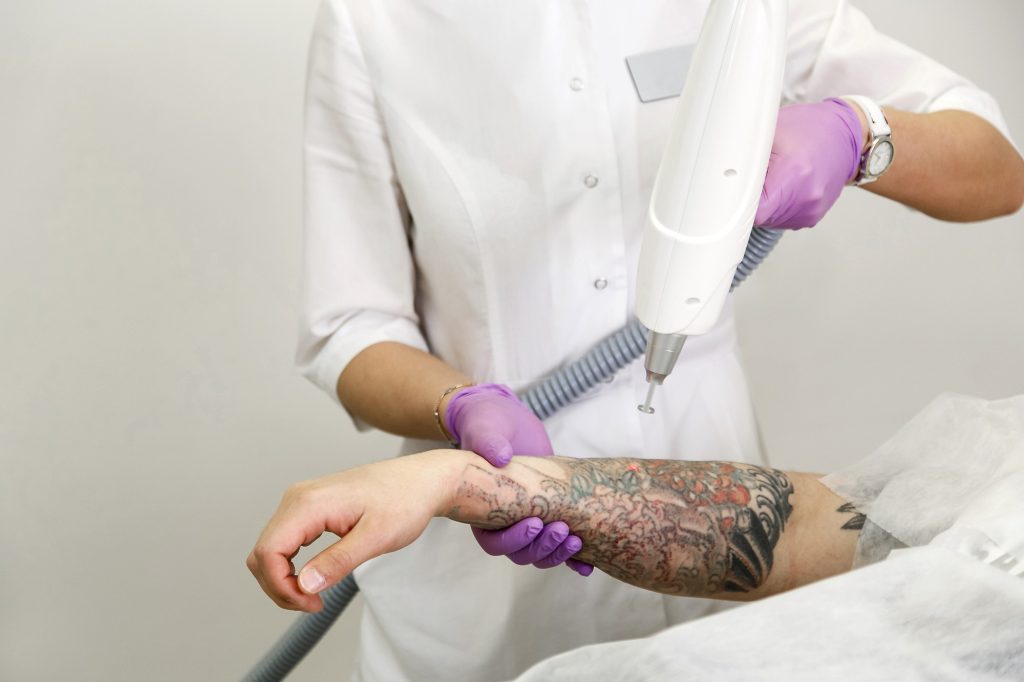
How Does Laser Tattoo Removal Treatment Work?
A tattoo may be created in a single afternoon, but removing one is a very different process.
Tattoo ink is intentionally placed deep enough in the skin to remain visible for years. That permanence is exactly what makes Tattoo Removal Treatment more complex than simply removing pigment from the skin’s surface.
Modern laser treatment works by directing carefully selected wavelengths of light toward tattoo pigment. Instead of physically cutting out the tattoo, laser energy breaks the ink into increasingly smaller particles. The body’s own immune system then gradually clears some of those fragmented particles over the weeks following treatment.
This is why a tattoo does not normally disappear immediately after one session.
According to the U.S. Food and Drug Administration, laser tattoo removal is the most commonly used professional method for lightening or removing permanent tattoos. The laser fragments tattoo ink while the body’s immune processes gradually clear the particles.
At HMS Fat Freezing in Dubai, Tattoo Removal Treatment is offered as part of its professional skin-treatment services and is designed around individual factors such as tattoo colour, depth, size, skin type and previous tattoo work.
This guide explains exactly what happens during laser tattoo removal, why multiple sessions are usually required, which colours may respond differently, what affects treatment time and what clients should realistically expect.
Contact HMS Fat Freezing for Tattoo Removal Treatment
What Is Laser Tattoo Removal Treatment?
Laser Tattoo Removal Treatment is a procedure that uses concentrated pulses of light energy to target pigment particles inside a tattoo.
Permanent tattoo ink is deposited into the dermis, the deeper layer of the skin beneath the epidermis. Cells in this layer are relatively stable, which is one reason tattoos can remain visible for decades.
During treatment, laser energy is selected so that tattoo pigment absorbs a significant portion of the light.
That energy produces a rapid photoacoustic or photomechanical effect within the pigment particles. The larger ink particles fragment into smaller pieces, making it easier for the body’s natural clearance processes to gradually deal with them.
The important distinction is this:
The laser breaks down the pigment; the body does much of the subsequent clearing.
The American Academy of Dermatology explains that the laser shatters tattoo ink into tiny particles, which the body then gradually removes.
This process occurs progressively, which is why Tattoo Removal Treatment is generally performed as a series rather than as a one-time procedure.
For more information about the treatment offered at HMS, see the dedicated Tattoo Removal Treatment service page.
Contact HMS Fat Freezing for Tattoo Removal Treatment
Why Is Tattoo Ink So Difficult to Remove?
To understand laser removal, it helps to understand how a permanent tattoo survives in the first place.
When a tattoo is applied, needles penetrate the outer skin and place pigment into the dermis.
Your immune system recognises the tattoo pigment as foreign material and attempts to remove it. However, many pigment particles are too large to be efficiently cleared.
Some are taken up by cells such as macrophages, while other pigment remains embedded within the dermal tissue.
The result is a design that remains visible.
Laser Tattoo Removal Treatment changes this situation by breaking larger particles into smaller fragments.
Imagine trying to remove large pieces of stone through a narrow opening. They will not pass through easily. Break those stones into tiny particles, however, and removal becomes much more practical.
Laser technology applies a similar principle to tattoo pigment.
How Does Tattoo Removal Treatment Work Step by Step?
Step 1: The Tattoo Is Assessed
Effective Tattoo Removal Treatment begins before the laser is switched on.
A professional assessment may consider:
- tattoo size;
- location;
- ink colour;
- tattoo density;
- professional versus amateur tattooing;
- whether the design contains multiple layers;
- age of the tattoo;
- skin tone;
- history of scarring;
- medications;
- previous laser treatments;
- underlying skin conditions.
Two tattoos that appear similar from a distance may respond very differently.
A small black amateur tattoo, for example, may contain less pigment than a heavily saturated professional tattoo containing multiple colours and several layers of ink.
This is why treatment plans should not be based only on tattoo dimensions.
Step 2: The Appropriate Laser Wavelength Is Selected
Different colours absorb different wavelengths of light.
Therefore, one laser wavelength is not necessarily equally effective for every pigment.
Common laser systems used in professional tattoo removal include Q-switched and picosecond devices using wavelengths such as 1064 nm, 532 nm, 755 nm or other wavelength configurations depending on the device.
A review of laser tattoo-removal principles notes that tattoo colour, tattoo origin, layering and skin type can all influence laser selection and treatment planning.
Black and other dark pigments often respond well because they absorb a broad spectrum of light.
Some colours can be more challenging.
Green, blue, yellow and certain lighter pigments may require different wavelengths or approaches.
Research comparing laser technologies has found that picosecond systems may offer advantages for some blue, green and yellow pigments, although results vary between tattoos and treatment protocols.
Contact HMS Fat Freezing for Tattoo Removal Treatment
Step 3: Protective Measures Are Taken
Eye protection is essential during laser procedures.
The treatment area is normally cleaned before the session, and appropriate protective eyewear is used by the client and practitioner.
Depending on the device, treatment area and individual sensitivity, cooling or other comfort measures may also be used.
The practitioner then works systematically across the tattoo.
Step 4: Laser Pulses Target the Tattoo Ink
During Tattoo Removal Treatment, very short pulses of laser energy are delivered to the targeted pigment.
The objective is to concentrate enough energy within the tattoo particles to fragment them while limiting unnecessary injury to surrounding tissue.
The treatment is highly dependent on correct device selection and settings.
This is one reason laser tattoo removal should not simply be viewed as pressing a laser over a tattoo until it disappears.
Professional judgement matters.
The FDA specifically notes that successful tattoo removal requires selection of the appropriate laser, understanding how tissue responds to laser treatment and appropriate care after the procedure.
Step 5: The Tattoo May Temporarily Look Different
Immediately after laser treatment, people sometimes notice a temporary whitening or “frosting” effect over the tattoo.
Redness and swelling may also occur.
The area may feel similar to mild sunburn or may become tender.
Some people experience temporary blistering or crusting as the area heals.
These reactions do not mean the tattoo pigment has already been permanently removed.
The visible changes immediately after Tattoo Removal Treatment are different from the gradual fading that develops later.
Contact HMS Fat Freezing for Tattoo Removal Treatment
Step 6: The Body Gradually Clears Fragmented Pigment
After the laser fragments the ink, biological clearance begins.
Over the following weeks, immune cells process and remove some of the smaller pigment fragments.
The tattoo therefore usually fades gradually rather than overnight.
This delay explains why photographs taken immediately before and after laser treatment may not accurately demonstrate the final response from that session.
The meaningful change becomes easier to assess after the skin has healed and enough time has passed for pigment clearance.
Why Are Several Tattoo Removal Sessions Usually Needed?
One of the most common questions about Tattoo Removal Treatment is:
“Why can’t the laser remove everything in one session?”
There are several reasons.
First, tattoos contain multiple layers and concentrations of pigment.
Second, excessively aggressive laser treatment could increase the risk of burns, scarring and pigmentation changes.
Third, your skin needs time to recover.
Fourth, the body needs time to process fragmented tattoo pigment.
The American Academy of Dermatology explains that tattoo artists deposit ink in layers and that a laser cannot safely break down every layer during a single session.
Therefore, responsible Tattoo Removal Treatment prioritises gradual progress rather than attempting to produce complete clearance immediately.
Contact HMS Fat Freezing for Tattoo Removal Treatment
How Many Tattoo Removal Treatment Sessions Will I Need?
There is no scientifically responsible answer such as “every tattoo needs six sessions.”
Some tattoos respond faster, while others require considerably more treatments.
The total number of sessions can be influenced by:
Tattoo Colour
Black and dark blue pigments often respond more predictably than certain bright colours.
Tattoo Density
A heavily saturated professional tattoo contains more pigment than a light amateur tattoo.
Tattoo Layering
Cover-up tattoos may contain multiple layers of different inks.
Tattoo Location
Circulation and lymphatic drainage vary throughout the body, which may affect how efficiently fragmented pigment is cleared.
Skin Type
Skin tone influences laser selection and treatment parameters.
Tattoo Age
Older tattoos are sometimes partially faded before treatment begins, although age alone does not guarantee easier removal.
Individual Biological Response
Healing and immune response vary from person to person.
For these reasons, an initial consultation is much more valuable than relying on a universal session estimate.
Contact HMS Fat Freezing for Tattoo Removal Treatment
Picosecond vs Q-Switched Tattoo Removal
Both technologies may be used for tattoo removal depending on the tattoo and available equipment.
| Feature | Q-Switched Laser | Picosecond Laser |
|---|---|---|
| Pulse duration | Nanosecond range | Picosecond range |
| Main action | Breaks tattoo pigment using short energy pulses | Uses ultra-short pulses to fragment pigment |
| Black ink | Commonly used | Commonly used |
| Coloured ink | Effectiveness varies by wavelength | May offer advantages for selected colours |
| Sessions required | Multiple treatments typically needed | Multiple treatments may still be required |
| Suitable for everyone? | Depends on tattoo and skin characteristics | Depends on tattoo and skin characteristics |
| Professional assessment | Essential | Essential |
Systematic research supports both Q-switched and picosecond technologies for tattoo removal. Evidence suggests picosecond systems may offer particular advantages with some blue, green and yellow pigments, but no device guarantees complete removal of every tattoo.
The better question is therefore not simply “Which laser is newer?”
It is:
Which wavelength and treatment parameters are appropriate for this tattoo, this pigment and this person’s skin?
Does Tattoo Colour Affect Tattoo Removal Treatment?
Yes. Colour matters significantly.
Black Tattoos
Black pigment generally absorbs a broad range of laser wavelengths and often responds comparatively well.
Red Tattoos
Red pigments may respond to wavelengths such as 532 nm, depending on pigment composition and device selection.
Green and Blue Tattoos
These colours can be more resistant to some traditional laser wavelengths.
Specific wavelength systems may be required.
Yellow and Light-Coloured Tattoos
Some lighter colours can be more difficult to target effectively.
White and Cosmetic Tattoo Pigments
Cosmetic inks require particular caution.
Certain pigments may darken after laser exposure rather than immediately becoming lighter.
This is one reason permanent makeup and cosmetic tattoos should be assessed carefully before Tattoo Removal Treatment.
Is Laser Tattoo Removal Suitable for Darker Skin?
Laser treatment can be performed on a broad range of skin tones, but darker skin requires particularly thoughtful device selection and conservative treatment parameters.
Melanin in the skin can compete with tattoo pigment for laser energy.
A 2026 clinical review on laser use in skin of colour notes that higher epidermal melanin can increase the risk of effects such as hyperpigmentation, hypopigmentation, blistering and scarring if treatment is not appropriately selected and performed.
For Dubai’s diverse population, this consideration is especially relevant.
A personalised Tattoo Removal Treatment plan should therefore consider both ink colour and natural skin pigmentation rather than using identical settings for everyone.
Does Laser Tattoo Removal Hurt?
Pain varies.
People commonly describe laser tattoo removal as:
- sharp snapping sensations;
- heat;
- brief stinging;
- repeated pinpricks;
- sensations similar to an elastic band snapping against the skin.
Smaller tattoos may be treated relatively quickly, while larger designs require a longer session.
Treatment comfort also depends on:
- tattoo location;
- sensitivity;
- laser settings;
- pigment density;
- individual pain tolerance;
- cooling methods.
For most clients, discomfort occurs mainly while the laser is actively firing.
Discuss pain management and cooling options during your consultation.
What Happens After Tattoo Removal Treatment?
After Tattoo Removal Treatment, the treated area needs time to recover.
Temporary reactions can include:
- redness;
- warmth;
- swelling;
- tenderness;
- mild blistering;
- crusting;
- temporary pigment changes.
The AAD notes that temporary lightening or darkening of the skin can occur following treatment, while complications such as burns, wounds, texture changes and scarring are more likely when laser removal is performed without appropriate medical expertise.
Follow the aftercare instructions provided by your treatment professional.
Tattoo Removal Treatment Aftercare
Good aftercare is part of treatment, not an optional extra.
Keep the Area Clean
Follow the instructions provided for cleansing and dressing the area.
Avoid unnecessary touching, scratching or rubbing.
Do Not Pick Blisters or Crusts
If blistering or crusting occurs, allow the skin to heal naturally.
Picking can increase irritation and potentially increase the risk of marks or infection.
Protect the Area From Sun
Sun exposure can contribute to unwanted pigmentation changes.
Use suitable sun protection once appropriate for the healing stage and follow your practitioner’s instructions.
Avoid Aggressive Skincare
Do not immediately apply harsh exfoliating acids, retinoids, scrubs or strongly fragranced products over freshly treated skin unless your clinician says they are appropriate.
Follow Healing Instructions
Contact your provider if you develop unexpected or worsening symptoms.
Benefits of Tattoo Removal Treatment
Pros
Non-surgical approach:
Laser removal does not normally require surgically cutting out the tattoo.
Selective pigment targeting:
Appropriate laser wavelengths can target tattoo ink while limiting unnecessary treatment of surrounding tissue.
Gradual fading:
The tattoo can become progressively lighter over successive treatments.
Multiple ink colours can be addressed:
Different laser wavelengths may allow treatment of several pigment colours.
Customisable treatment planning:
Settings can be adapted according to tattoo characteristics and skin type.
Useful for tattoo modification:
Complete removal is not always the goal. Some clients choose partial fading before getting a cover-up tattoo.
Limitations and Cons of Tattoo Removal Treatment
No ethical clinic should describe Tattoo Removal Treatment as effortless or guaranteed.
Multiple Sessions May Be Required
Permanent tattoos are designed to remain in the skin.
Removing their pigment is usually a gradual process.
Complete Clearance Cannot Be Guaranteed
Some residual pigment or “ghosting” may remain.
Some Colours Are More Resistant
Multicoloured tattoos often require more complex treatment planning.
Temporary Skin Reactions Can Occur
Redness, swelling, blistering and temporary pigment changes are possible.
Rare Complications Are Possible
Scarring, burns, prolonged pigmentation changes and textural changes can occur, particularly when inappropriate settings or techniques are used.
Treatment Requires Patience
Spacing sessions appropriately is important for both healing and pigment clearance.
Laser Tattoo Removal vs Other Tattoo Removal Methods
| Method | How It Works | Main Consideration |
|---|---|---|
| Laser Tattoo Removal | Breaks pigment into smaller particles | Most established professional approach for many tattoos |
| Surgical Excision | Physically removes tattooed skin | Leaves a surgical scar and is generally limited to smaller tattoos |
| Dermabrasion | Mechanically removes layers of skin | More traumatic to skin and can affect texture |
| Tattoo Removal Creams | Marketed as topical fading products | Do not reliably remove pigment embedded deep within the dermis |
| Cover-Up Tattoo | Places new ink over old tattoo | Hides rather than removes pigment |
The FDA specifically warns that tattoo-removal creams, ointments and DIY removal kits are not approved tattoo-removal methods and may cause skin reactions or injury.
A Practical Example: Why Two Tattoos May Need Different Plans
Imagine two people visit a clinic.
Client A:
A six-year-old small black amateur tattoo on the wrist.
Client B:
A recent professional cover-up tattoo containing dense black, green, yellow and blue pigment over an older tattoo.
Both tattoos may occupy approximately the same surface area.
Yet Client B could require a significantly more complex Tattoo Removal Treatment plan because:
- there is more pigment;
- there are multiple colours;
- different wavelengths may be required;
- the tattoo contains layered ink;
- more sessions may be necessary.
This illustrates why price and session estimates based exclusively on tattoo size can be misleading.
A detailed assessment matters.
Can a Tattoo Be Partially Removed for a Cover-Up?
Yes.
Not everyone wants complete removal.
Some people choose Tattoo Removal Treatment simply to fade a dark existing tattoo enough for a tattoo artist to create a more successful cover-up.
For example, reducing the density of a black tattoo may give the tattoo artist more flexibility when designing new artwork.
The treatment objective should therefore be discussed clearly from the beginning:
- complete removal where realistically achievable;
- substantial fading;
- selective removal of part of a design;
- fading before a cover-up.
The plan may differ depending on the objective.
When Should Tattoo Removal Be Postponed?
Treatment suitability should always be assessed professionally.
Laser treatment may need to be postponed or reconsidered when there is:
- active infection;
- open or damaged skin;
- significant irritation in the treatment area;
- recent intense sun exposure or tanning;
- certain medical conditions;
- medications affecting healing or light sensitivity;
- pregnancy or breastfeeding.
The AAD advises that pregnancy and breastfeeding are situations in which laser tattoo removal should not be performed.
Always disclose medications, previous skin reactions, history of abnormal scarring and relevant medical conditions during consultation.
Expert Recommendations From HMS Fat Freezing
At HMS Fat Freezing, clients considering Tattoo Removal Treatment should approach the process as a planned treatment journey rather than expecting instant erasure.
1. Start With a Proper Assessment
The tattoo needs to be evaluated for colour, depth, density, age, location and previous treatment.
2. Be Realistic About Session Numbers
Avoid assuming your tattoo will require the same number of sessions as someone else’s.
3. Do Not Rush Treatment Intervals
More frequent treatment is not automatically better treatment.
The skin needs appropriate recovery time while the body continues clearing fragmented pigment.
4. Protect Treated Skin From Dubai Sun Exposure
Strong UV exposure may increase the risk of pigmentation changes after laser procedures.
Plan treatment and aftercare carefully, particularly during periods of frequent outdoor activity.
5. Do Not Pick Healing Skin
Allow temporary crusting or blistering to resolve according to professional aftercare instructions.
6. Tell Your Practitioner About Previous Tattoo Work
Cover-ups, cosmetic tattooing and previously lasered tattoos may behave differently.
7. Think in Terms of Progress, Not Perfection
Every session should be assessed according to safe pigment reduction rather than pressure to remove all visible ink immediately.
You can also explore HMS Fat Freezing’s wider range of skin treatments in Dubai or learn more about the clinic through the HMS Fat Freezing website.
Authoritative Resources for Further Reading
For readers who want evidence-based information beyond this guide:
- The U.S. Food and Drug Administration’s tattoo removal guidance explains how lasers fragment tattoo pigment, why professional treatment matters and the limitations of creams and DIY methods.
- The American Academy of Dermatology’s laser tattoo removal guidance discusses treatment sessions, healing and potential side effects.
- A PubMed systematic review comparing laser technologies reviews evidence regarding Q-switched and picosecond lasers.
- A clinical review of laser tattoo-removal principles discusses wavelength selection, tattoo colour, skin type and treatment considerations.
Frequently Asked Questions About Tattoo Removal Treatment
1. Can a tattoo be completely removed with laser treatment?
Some tattoos can fade substantially, and some may approach near-complete clearance, but complete removal cannot be guaranteed.
Results depend on tattoo colour, pigment composition, density, depth, layering, skin type, laser technology and individual response.
A realistic Tattoo Removal Treatment plan should therefore focus on expected progressive fading rather than promising 100% removal.
2. How many laser sessions does tattoo removal usually take?
There is no fixed number suitable for everyone.
Some tattoos require relatively few sessions, while dense, multicoloured or layered tattoos may require many treatments.
A practitioner can provide a more useful estimate after examining the tattoo.
Even then, the estimate may change depending on how the tattoo responds.
3. How long should I wait between tattoo removal sessions?
The interval varies according to treatment intensity, healing, tattoo characteristics and professional protocol.
Adequate spacing allows the skin to recover and gives the body time to clear fragmented pigment.
Trying to perform Tattoo Removal Treatment too frequently does not necessarily make the tattoo disappear faster and may increase unnecessary skin irritation.
4. Does laser tattoo removal leave scars?
Scarring is possible but is not an inevitable result of professional laser tattoo removal.
Risk depends on treatment settings, skin response, aftercare, previous tattoo scarring and whether healing skin is picked or damaged.
The AAD notes that scarring and textural changes are potential complications, particularly when laser treatment is performed without appropriate professional expertise.
5. Which tattoo colours are easiest to remove?
Dark pigments, particularly black, often respond more predictably because they absorb a broad range of laser wavelengths.
Green, blue, yellow and lighter colours may require specific wavelengths and can be more challenging.
However, pigment chemistry varies, so colour alone cannot predict the final result.
6. Can permanent makeup be removed with the same laser?
Permanent makeup is technically a form of tattooing, but cosmetic pigments can behave differently from conventional tattoo inks.
Some cosmetic pigments may darken after exposure to certain lasers.
Eyebrow, eyeliner and lip tattoos therefore require particularly careful assessment before Tattoo Removal Treatment.
7. Can I remove only part of my tattoo?
Potentially, yes.
Laser treatment can sometimes be used to selectively fade or remove sections of a tattoo.
This can be useful when someone wants to modify a name, symbol or section of a design while preserving another area.
Precision depends on tattoo layout and treatment characteristics.
8. Can I get another tattoo after laser removal?
Many people undergo laser fading specifically because they want a new tattoo or cover-up.
The skin should be fully healed before new tattooing is considered.
Discuss timing with both your laser practitioner and tattoo artist rather than tattooing over recently treated skin.
9. Can I exercise after Tattoo Removal Treatment?
Recommendations depend on the treated area, intensity and skin response.
Activities that create significant friction, sweating or irritation around freshly treated skin may need to be temporarily reduced.
Follow the aftercare guidance provided for your specific procedure.
10. Is Tattoo Removal Treatment safe?
Laser tattoo removal can be safe when an appropriate laser and treatment protocol are used by properly trained professionals.
However, it is still a medical/aesthetic laser procedure and can cause side effects.
The FDA advises discussing expected results, benefits and risks with an appropriately trained health professional before undergoing laser tattoo removal.
Final Thoughts: Is Laser Tattoo Removal Worth Considering?
Modern Tattoo Removal Treatment has made it possible to significantly fade many tattoos without surgically removing the tattooed skin.
But the science is more sophisticated than simply “burning away” ink.
Short laser pulses interact with selected pigment, fragmenting tattoo particles. Your body’s natural clearance mechanisms then gradually deal with some of those fragments. The process is repeated over multiple sessions while allowing adequate time for healing.
Results vary considerably.
Tattoo colour, ink composition, pigment density, skin tone, location, layering and individual biological response all influence progress.
That is why the most responsible approach to Tattoo Removal Treatment begins with assessment rather than guarantees.
If you are considering removing an old tattoo, fading a design before a cover-up or treating a tattoo that no longer fits your preferences, HMS Fat Freezing offers professional tattoo-removal and skin-treatment consultations in Dubai.
The aim should not be the fastest possible laser session.
It should be carefully planned treatment that considers your tattoo, your skin and realistic expectations.
Contact HMS Fat Freezing
HMS Fat Freezing
Address:
HAMSAH BUILDING, OFFICE 407 & 408, BLOCK-A, Business Center – Beside ANSAR GALLERY – Dubai, UAE
Phone:
+971 4 583 2989
Email:
info@hmsfatfreezing.com
For appointments, treatment suitability or questions about laser Tattoo Removal Treatment, contact HMS Fat Freezing for a personalised consultation. The clinic’s current website lists its Dubai location, telephone number and email contact information.
Medical note: This article is for general educational information and does not replace individual medical assessment. Treatment suitability, laser settings, risks and expected outcomes should be determined after an appropriate consultation.How Does Laser Tattoo Removal Treatment Work?
A tattoo may be created in a single afternoon, but removing one is a very different process.
Tattoo ink is intentionally placed deep enough in the skin to remain visible for years. That permanence is exactly what makes Tattoo Removal Treatment more complex than simply removing pigment from the skin’s surface.
Modern laser treatment works by directing carefully selected wavelengths of light toward tattoo pigment. Instead of physically cutting out the tattoo, laser energy breaks the ink into increasingly smaller particles. The body’s own immune system then gradually clears some of those fragmented particles over the weeks following treatment.
This is why a tattoo does not normally disappear immediately after one session.
According to the U.S. Food and Drug Administration, laser tattoo removal is the most commonly used professional method for lightening or removing permanent tattoos. The laser fragments tattoo ink while the body’s immune processes gradually clear the particles.
At HMS Fat Freezing in Dubai, Tattoo Removal Treatment is offered as part of its professional skin-treatment services and is designed around individual factors such as tattoo colour, depth, size, skin type and previous tattoo work.
This guide explains exactly what happens during laser tattoo removal, why multiple sessions are usually required, which colours may respond differently, what affects treatment time and what clients should realistically expect.
What Is Laser Tattoo Removal Treatment?
Laser Tattoo Removal Treatment is a procedure that uses concentrated pulses of light energy to target pigment particles inside a tattoo.
Permanent tattoo ink is deposited into the dermis, the deeper layer of the skin beneath the epidermis. Cells in this layer are relatively stable, which is one reason tattoos can remain visible for decades.
During treatment, laser energy is selected so that tattoo pigment absorbs a significant portion of the light.
That energy produces a rapid photoacoustic or photomechanical effect within the pigment particles. The larger ink particles fragment into smaller pieces, making it easier for the body’s natural clearance processes to gradually deal with them.
The important distinction is this:
The laser breaks down the pigment; the body does much of the subsequent clearing.
The American Academy of Dermatology explains that the laser shatters tattoo ink into tiny particles, which the body then gradually removes.
This process occurs progressively, which is why Tattoo Removal Treatment is generally performed as a series rather than as a one-time procedure.
For more information about the treatment offered at HMS, see the dedicated Tattoo Removal Treatment service page.
Why Is Tattoo Ink So Difficult to Remove?
To understand laser removal, it helps to understand how a permanent tattoo survives in the first place.
When a tattoo is applied, needles penetrate the outer skin and place pigment into the dermis.
Your immune system recognises the tattoo pigment as foreign material and attempts to remove it. However, many pigment particles are too large to be efficiently cleared.
Some are taken up by cells such as macrophages, while other pigment remains embedded within the dermal tissue.
The result is a design that remains visible.
Laser Tattoo Removal Treatment changes this situation by breaking larger particles into smaller fragments.
Imagine trying to remove large pieces of stone through a narrow opening. They will not pass through easily. Break those stones into tiny particles, however, and removal becomes much more practical.
Laser technology applies a similar principle to tattoo pigment.
How Does Tattoo Removal Treatment Work Step by Step?
Step 1: The Tattoo Is Assessed
Effective Tattoo Removal Treatment begins before the laser is switched on.
A professional assessment may consider:
- tattoo size;
- location;
- ink colour;
- tattoo density;
- professional versus amateur tattooing;
- whether the design contains multiple layers;
- age of the tattoo;
- skin tone;
- history of scarring;
- medications;
- previous laser treatments;
- underlying skin conditions.
Two tattoos that appear similar from a distance may respond very differently.
A small black amateur tattoo, for example, may contain less pigment than a heavily saturated professional tattoo containing multiple colours and several layers of ink.
This is why treatment plans should not be based only on tattoo dimensions.
Step 2: The Appropriate Laser Wavelength Is Selected
Different colours absorb different wavelengths of light.
Therefore, one laser wavelength is not necessarily equally effective for every pigment.
Common laser systems used in professional tattoo removal include Q-switched and picosecond devices using wavelengths such as 1064 nm, 532 nm, 755 nm or other wavelength configurations depending on the device.
A review of laser tattoo-removal principles notes that tattoo colour, tattoo origin, layering and skin type can all influence laser selection and treatment planning.
Black and other dark pigments often respond well because they absorb a broad spectrum of light.
Some colours can be more challenging.
Green, blue, yellow and certain lighter pigments may require different wavelengths or approaches.
Research comparing laser technologies has found that picosecond systems may offer advantages for some blue, green and yellow pigments, although results vary between tattoos and treatment protocols.
Step 3: Protective Measures Are Taken
Eye protection is essential during laser procedures.
The treatment area is normally cleaned before the session, and appropriate protective eyewear is used by the client and practitioner.
Depending on the device, treatment area and individual sensitivity, cooling or other comfort measures may also be used.
The practitioner then works systematically across the tattoo.
Step 4: Laser Pulses Target the Tattoo Ink
During Tattoo Removal Treatment, very short pulses of laser energy are delivered to the targeted pigment.
The objective is to concentrate enough energy within the tattoo particles to fragment them while limiting unnecessary injury to surrounding tissue.
The treatment is highly dependent on correct device selection and settings.
This is one reason laser tattoo removal should not simply be viewed as pressing a laser over a tattoo until it disappears.
Professional judgement matters.
The FDA specifically notes that successful tattoo removal requires selection of the appropriate laser, understanding how tissue responds to laser treatment and appropriate care after the procedure.
Step 5: The Tattoo May Temporarily Look Different
Immediately after laser treatment, people sometimes notice a temporary whitening or “frosting” effect over the tattoo.
Redness and swelling may also occur.
The area may feel similar to mild sunburn or may become tender.
Some people experience temporary blistering or crusting as the area heals.
These reactions do not mean the tattoo pigment has already been permanently removed.
The visible changes immediately after Tattoo Removal Treatment are different from the gradual fading that develops later.
Step 6: The Body Gradually Clears Fragmented Pigment
After the laser fragments the ink, biological clearance begins.
Over the following weeks, immune cells process and remove some of the smaller pigment fragments.
The tattoo therefore usually fades gradually rather than overnight.
This delay explains why photographs taken immediately before and after laser treatment may not accurately demonstrate the final response from that session.
The meaningful change becomes easier to assess after the skin has healed and enough time has passed for pigment clearance.
Why Are Several Tattoo Removal Sessions Usually Needed?
One of the most common questions about Tattoo Removal Treatment is:
“Why can’t the laser remove everything in one session?”
There are several reasons.
First, tattoos contain multiple layers and concentrations of pigment.
Second, excessively aggressive laser treatment could increase the risk of burns, scarring and pigmentation changes.
Third, your skin needs time to recover.
Fourth, the body needs time to process fragmented tattoo pigment.
The American Academy of Dermatology explains that tattoo artists deposit ink in layers and that a laser cannot safely break down every layer during a single session.
Therefore, responsible Tattoo Removal Treatment prioritises gradual progress rather than attempting to produce complete clearance immediately.
How Many Tattoo Removal Treatment Sessions Will I Need?
There is no scientifically responsible answer such as “every tattoo needs six sessions.”
Some tattoos respond faster, while others require considerably more treatments.
The total number of sessions can be influenced by:
Tattoo Colour
Black and dark blue pigments often respond more predictably than certain bright colours.
Tattoo Density
A heavily saturated professional tattoo contains more pigment than a light amateur tattoo.
Tattoo Layering
Cover-up tattoos may contain multiple layers of different inks.
Tattoo Location
Circulation and lymphatic drainage vary throughout the body, which may affect how efficiently fragmented pigment is cleared.
Skin Type
Skin tone influences laser selection and treatment parameters.
Tattoo Age
Older tattoos are sometimes partially faded before treatment begins, although age alone does not guarantee easier removal.
Individual Biological Response
Healing and immune response vary from person to person.
For these reasons, an initial consultation is much more valuable than relying on a universal session estimate.
Picosecond vs Q-Switched Tattoo Removal
Both technologies may be used for tattoo removal depending on the tattoo and available equipment.
| Feature | Q-Switched Laser | Picosecond Laser |
|---|---|---|
| Pulse duration | Nanosecond range | Picosecond range |
| Main action | Breaks tattoo pigment using short energy pulses | Uses ultra-short pulses to fragment pigment |
| Black ink | Commonly used | Commonly used |
| Coloured ink | Effectiveness varies by wavelength | May offer advantages for selected colours |
| Sessions required | Multiple treatments typically needed | Multiple treatments may still be required |
| Suitable for everyone? | Depends on tattoo and skin characteristics | Depends on tattoo and skin characteristics |
| Professional assessment | Essential | Essential |
Systematic research supports both Q-switched and picosecond technologies for tattoo removal. Evidence suggests picosecond systems may offer particular advantages with some blue, green and yellow pigments, but no device guarantees complete removal of every tattoo.
The better question is therefore not simply “Which laser is newer?”
It is:
Which wavelength and treatment parameters are appropriate for this tattoo, this pigment and this person’s skin?
Does Tattoo Colour Affect Tattoo Removal Treatment?
Yes. Colour matters significantly.
Black Tattoos
Black pigment generally absorbs a broad range of laser wavelengths and often responds comparatively well.
Red Tattoos
Red pigments may respond to wavelengths such as 532 nm, depending on pigment composition and device selection.
Green and Blue Tattoos
These colours can be more resistant to some traditional laser wavelengths.
Specific wavelength systems may be required.
Yellow and Light-Coloured Tattoos
Some lighter colours can be more difficult to target effectively.
White and Cosmetic Tattoo Pigments
Cosmetic inks require particular caution.
Certain pigments may darken after laser exposure rather than immediately becoming lighter.
This is one reason permanent makeup and cosmetic tattoos should be assessed carefully before Tattoo Removal Treatment.
Is Laser Tattoo Removal Suitable for Darker Skin?
Laser treatment can be performed on a broad range of skin tones, but darker skin requires particularly thoughtful device selection and conservative treatment parameters.
Melanin in the skin can compete with tattoo pigment for laser energy.
A 2026 clinical review on laser use in skin of colour notes that higher epidermal melanin can increase the risk of effects such as hyperpigmentation, hypopigmentation, blistering and scarring if treatment is not appropriately selected and performed.
For Dubai’s diverse population, this consideration is especially relevant.
A personalised Tattoo Removal Treatment plan should therefore consider both ink colour and natural skin pigmentation rather than using identical settings for everyone.
Does Laser Tattoo Removal Hurt?
Pain varies.
People commonly describe laser tattoo removal as:
- sharp snapping sensations;
- heat;
- brief stinging;
- repeated pinpricks;
- sensations similar to an elastic band snapping against the skin.
Smaller tattoos may be treated relatively quickly, while larger designs require a longer session.
Treatment comfort also depends on:
- tattoo location;
- sensitivity;
- laser settings;
- pigment density;
- individual pain tolerance;
- cooling methods.
For most clients, discomfort occurs mainly while the laser is actively firing.
Discuss pain management and cooling options during your consultation.
What Happens After Tattoo Removal Treatment?
After Tattoo Removal Treatment, the treated area needs time to recover.
Temporary reactions can include:
- redness;
- warmth;
- swelling;
- tenderness;
- mild blistering;
- crusting;
- temporary pigment changes.
The AAD notes that temporary lightening or darkening of the skin can occur following treatment, while complications such as burns, wounds, texture changes and scarring are more likely when laser removal is performed without appropriate medical expertise.
Follow the aftercare instructions provided by your treatment professional.
Tattoo Removal Treatment Aftercare
Good aftercare is part of treatment, not an optional extra.
Keep the Area Clean
Follow the instructions provided for cleansing and dressing the area.
Avoid unnecessary touching, scratching or rubbing.
Do Not Pick Blisters or Crusts
If blistering or crusting occurs, allow the skin to heal naturally.
Picking can increase irritation and potentially increase the risk of marks or infection.
Protect the Area From Sun
Sun exposure can contribute to unwanted pigmentation changes.
Use suitable sun protection once appropriate for the healing stage and follow your practitioner’s instructions.
Avoid Aggressive Skincare
Do not immediately apply harsh exfoliating acids, retinoids, scrubs or strongly fragranced products over freshly treated skin unless your clinician says they are appropriate.
Follow Healing Instructions
Contact your provider if you develop unexpected or worsening symptoms.
Benefits of Tattoo Removal Treatment
Pros
Non-surgical approach:
Laser removal does not normally require surgically cutting out the tattoo.
Selective pigment targeting:
Appropriate laser wavelengths can target tattoo ink while limiting unnecessary treatment of surrounding tissue.
Gradual fading:
The tattoo can become progressively lighter over successive treatments.
Multiple ink colours can be addressed:
Different laser wavelengths may allow treatment of several pigment colours.
Customisable treatment planning:
Settings can be adapted according to tattoo characteristics and skin type.
Useful for tattoo modification:
Complete removal is not always the goal. Some clients choose partial fading before getting a cover-up tattoo.
Limitations and Cons of Tattoo Removal Treatment
No ethical clinic should describe Tattoo Removal Treatment as effortless or guaranteed.
Multiple Sessions May Be Required
Permanent tattoos are designed to remain in the skin.
Removing their pigment is usually a gradual process.
Complete Clearance Cannot Be Guaranteed
Some residual pigment or “ghosting” may remain.
Some Colours Are More Resistant
Multicoloured tattoos often require more complex treatment planning.
Temporary Skin Reactions Can Occur
Redness, swelling, blistering and temporary pigment changes are possible.
Rare Complications Are Possible
Scarring, burns, prolonged pigmentation changes and textural changes can occur, particularly when inappropriate settings or techniques are used.
Treatment Requires Patience
Spacing sessions appropriately is important for both healing and pigment clearance.
Laser Tattoo Removal vs Other Tattoo Removal Methods
| Method | How It Works | Main Consideration |
|---|---|---|
| Laser Tattoo Removal | Breaks pigment into smaller particles | Most established professional approach for many tattoos |
| Surgical Excision | Physically removes tattooed skin | Leaves a surgical scar and is generally limited to smaller tattoos |
| Dermabrasion | Mechanically removes layers of skin | More traumatic to skin and can affect texture |
| Tattoo Removal Creams | Marketed as topical fading products | Do not reliably remove pigment embedded deep within the dermis |
| Cover-Up Tattoo | Places new ink over old tattoo | Hides rather than removes pigment |
The FDA specifically warns that tattoo-removal creams, ointments and DIY removal kits are not approved tattoo-removal methods and may cause skin reactions or injury.
A Practical Example: Why Two Tattoos May Need Different Plans
Imagine two people visit a clinic.
Client A:
A six-year-old small black amateur tattoo on the wrist.
Client B:
A recent professional cover-up tattoo containing dense black, green, yellow and blue pigment over an older tattoo.
Both tattoos may occupy approximately the same surface area.
Yet Client B could require a significantly more complex Tattoo Removal Treatment plan because:
- there is more pigment;
- there are multiple colours;
- different wavelengths may be required;
- the tattoo contains layered ink;
- more sessions may be necessary.
This illustrates why price and session estimates based exclusively on tattoo size can be misleading.
A detailed assessment matters.
Can a Tattoo Be Partially Removed for a Cover-Up?
Yes.
Not everyone wants complete removal.
Some people choose Tattoo Removal Treatment simply to fade a dark existing tattoo enough for a tattoo artist to create a more successful cover-up.
For example, reducing the density of a black tattoo may give the tattoo artist more flexibility when designing new artwork.
The treatment objective should therefore be discussed clearly from the beginning:
- complete removal where realistically achievable;
- substantial fading;
- selective removal of part of a design;
- fading before a cover-up.
The plan may differ depending on the objective.
When Should Tattoo Removal Be Postponed?
Treatment suitability should always be assessed professionally.
Laser treatment may need to be postponed or reconsidered when there is:
- active infection;
- open or damaged skin;
- significant irritation in the treatment area;
- recent intense sun exposure or tanning;
- certain medical conditions;
- medications affecting healing or light sensitivity;
- pregnancy or breastfeeding.
The AAD advises that pregnancy and breastfeeding are situations in which laser tattoo removal should not be performed.
Always disclose medications, previous skin reactions, history of abnormal scarring and relevant medical conditions during consultation.
Expert Recommendations From HMS Fat Freezing
At HMS Fat Freezing, clients considering Tattoo Removal Treatment should approach the process as a planned treatment journey rather than expecting instant erasure.
1. Start With a Proper Assessment
The tattoo needs to be evaluated for colour, depth, density, age, location and previous treatment.
2. Be Realistic About Session Numbers
Avoid assuming your tattoo will require the same number of sessions as someone else’s.
3. Do Not Rush Treatment Intervals
More frequent treatment is not automatically better treatment.
The skin needs appropriate recovery time while the body continues clearing fragmented pigment.
4. Protect Treated Skin From Dubai Sun Exposure
Strong UV exposure may increase the risk of pigmentation changes after laser procedures.
Plan treatment and aftercare carefully, particularly during periods of frequent outdoor activity.
5. Do Not Pick Healing Skin
Allow temporary crusting or blistering to resolve according to professional aftercare instructions.
6. Tell Your Practitioner About Previous Tattoo Work
Cover-ups, cosmetic tattooing and previously lasered tattoos may behave differently.
7. Think in Terms of Progress, Not Perfection
Every session should be assessed according to safe pigment reduction rather than pressure to remove all visible ink immediately.
You can also explore HMS Fat Freezing’s wider range of skin treatments in Dubai or learn more about the clinic through the HMS Fat Freezing website.
Authoritative Resources for Further Reading
For readers who want evidence-based information beyond this guide:
- The U.S. Food and Drug Administration’s tattoo removal guidance explains how lasers fragment tattoo pigment, why professional treatment matters and the limitations of creams and DIY methods.
- The American Academy of Dermatology’s laser tattoo removal guidance discusses treatment sessions, healing and potential side effects.
- A PubMed systematic review comparing laser technologies reviews evidence regarding Q-switched and picosecond lasers.
- A clinical review of laser tattoo-removal principles discusses wavelength selection, tattoo colour, skin type and treatment considerations.
Frequently Asked Questions About Tattoo Removal Treatment
1. Can a tattoo be completely removed with laser treatment?
Some tattoos can fade substantially, and some may approach near-complete clearance, but complete removal cannot be guaranteed.
Results depend on tattoo colour, pigment composition, density, depth, layering, skin type, laser technology and individual response.
A realistic Tattoo Removal Treatment plan should therefore focus on expected progressive fading rather than promising 100% removal.
2. How many laser sessions does tattoo removal usually take?
There is no fixed number suitable for everyone.
Some tattoos require relatively few sessions, while dense, multicoloured or layered tattoos may require many treatments.
A practitioner can provide a more useful estimate after examining the tattoo.
Even then, the estimate may change depending on how the tattoo responds.
3. How long should I wait between tattoo removal sessions?
The interval varies according to treatment intensity, healing, tattoo characteristics and professional protocol.
Adequate spacing allows the skin to recover and gives the body time to clear fragmented pigment.
Trying to perform Tattoo Removal Treatment too frequently does not necessarily make the tattoo disappear faster and may increase unnecessary skin irritation.
4. Does laser tattoo removal leave scars?
Scarring is possible but is not an inevitable result of professional laser tattoo removal.
Risk depends on treatment settings, skin response, aftercare, previous tattoo scarring and whether healing skin is picked or damaged.
The AAD notes that scarring and textural changes are potential complications, particularly when laser treatment is performed without appropriate professional expertise.
5. Which tattoo colours are easiest to remove?
Dark pigments, particularly black, often respond more predictably because they absorb a broad range of laser wavelengths.
Green, blue, yellow and lighter colours may require specific wavelengths and can be more challenging.
However, pigment chemistry varies, so colour alone cannot predict the final result.
6. Can permanent makeup be removed with the same laser?
Permanent makeup is technically a form of tattooing, but cosmetic pigments can behave differently from conventional tattoo inks.
Some cosmetic pigments may darken after exposure to certain lasers.
Eyebrow, eyeliner and lip tattoos therefore require particularly careful assessment before Tattoo Removal Treatment.
7. Can I remove only part of my tattoo?
Potentially, yes.
Laser treatment can sometimes be used to selectively fade or remove sections of a tattoo.
This can be useful when someone wants to modify a name, symbol or section of a design while preserving another area.
Precision depends on tattoo layout and treatment characteristics.
8. Can I get another tattoo after laser removal?
Many people undergo laser fading specifically because they want a new tattoo or cover-up.
The skin should be fully healed before new tattooing is considered.
Discuss timing with both your laser practitioner and tattoo artist rather than tattooing over recently treated skin.
9. Can I exercise after Tattoo Removal Treatment?
Recommendations depend on the treated area, intensity and skin response.
Activities that create significant friction, sweating or irritation around freshly treated skin may need to be temporarily reduced.
Follow the aftercare guidance provided for your specific procedure.
10. Is Tattoo Removal Treatment safe?
Laser tattoo removal can be safe when an appropriate laser and treatment protocol are used by properly trained professionals.
However, it is still a medical/aesthetic laser procedure and can cause side effects.
The FDA advises discussing expected results, benefits and risks with an appropriately trained health professional before undergoing laser tattoo removal.
Final Thoughts: Is Laser Tattoo Removal Worth Considering?
Modern Tattoo Removal Treatment has made it possible to significantly fade many tattoos without surgically removing the tattooed skin.
But the science is more sophisticated than simply “burning away” ink.
Short laser pulses interact with selected pigment, fragmenting tattoo particles. Your body’s natural clearance mechanisms then gradually deal with some of those fragments. The process is repeated over multiple sessions while allowing adequate time for healing.
Results vary considerably.
Tattoo colour, ink composition, pigment density, skin tone, location, layering and individual biological response all influence progress.
That is why the most responsible approach to Tattoo Removal Treatment begins with assessment rather than guarantees.
If you are considering removing an old tattoo, fading a design before a cover-up or treating a tattoo that no longer fits your preferences, HMS Fat Freezing offers professional tattoo-removal and skin-treatment consultations in Dubai.
The aim should not be the fastest possible laser session.
It should be carefully planned treatment that considers your tattoo, your skin and realistic expectations.
Contact HMS Fat Freezing
HMS Fat Freezing
Address:
HAMSAH BUILDING, OFFICE 407 & 408, BLOCK-A, Business Center – Beside ANSAR GALLERY – Dubai, UAE
Phone:
+971 4 583 2989
Email:
info@hmsfatfreezing.com
For appointments, treatment suitability or questions about laser Tattoo Removal Treatment, contact HMS Fat Freezing for a personalised consultation. The clinic’s current website lists its Dubai location, telephone number and email contact information.
Medical note: This article is for general educational information and does not replace individual medical assessment. Treatment suitability, laser settings, risks and expected outcomes should be determined after an appropriate consultation.