
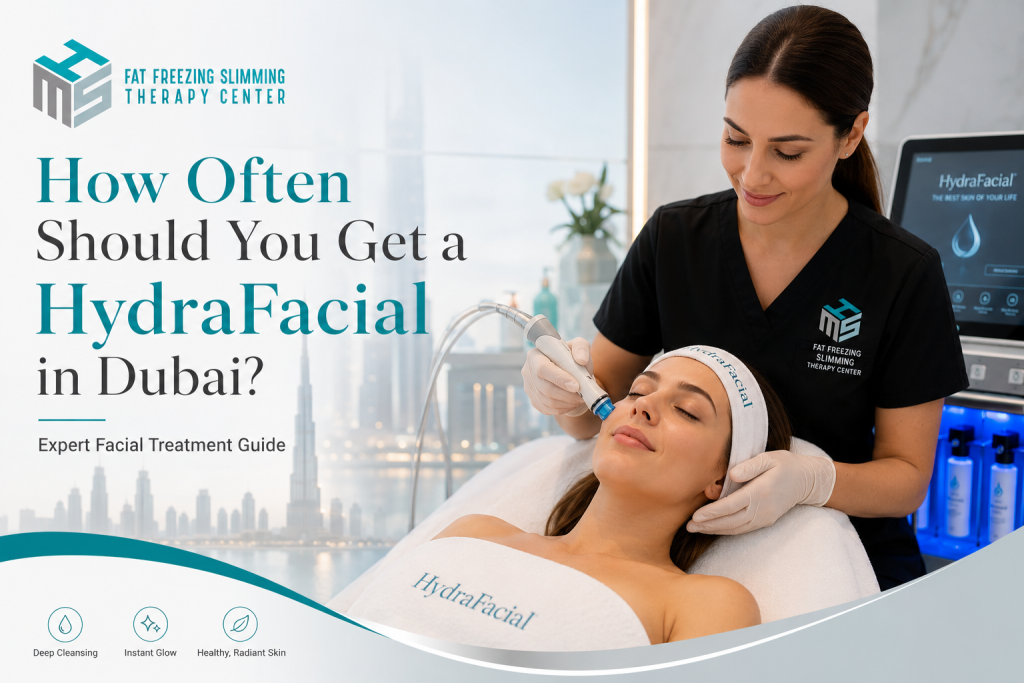
How Often Should You Get a HydraFacial in Dubai?
If your skin looks fresh and hydrated immediately after a HydraFacial, it is natural to wonder how soon you should repeat it.
Should you book one every month? Every two weeks? Only before an important event?
The answer depends less on a fixed calendar and more on what your skin actually needs.
HydraFacial describes its treatment as a customizable procedure combining cleansing, exfoliation, extraction and hydration. According to the brand’s current guidance, many clients schedule treatments roughly once a month, while others may find every two to three months sufficient. In some situations, providers may recommend more frequent treatments based on individual goals.
For people living in Dubai, the schedule deserves additional thought.
Daily exposure to heat, air conditioning, sunscreen, perspiration, makeup, dust and an active outdoor lifestyle can influence how oily, dry, congested or dehydrated the skin feels. A professional Facial Treatment can help manage these concerns, but having treatments too frequently without considering skin sensitivity or the rest of your routine can also be counterproductive.
HMS Fat Freezing currently lists HydraFacial among its facial services and describes the procedure as combining deep cleansing, exfoliation, extraction and hydration. Its published treatment pricing page lists a three-week gap for HydraFacial sessions, providing a useful example of how a clinic may structure regular maintenance.
This guide explains how to choose a sensible HydraFacial schedule based on skin type, age, lifestyle and Dubai-specific conditions rather than blindly following a monthly appointment rule.
What Happens During a HydraFacial?
Before deciding how often to schedule the procedure, it helps to understand what the treatment actually does.
A HydraFacial is a multi-step Facial Treatment designed to cleanse the surface, exfoliate dead skin cells, remove congestion and deliver hydrating solutions.
At HMS Fat Freezing, the HydraFacial service is described as a six-step treatment beginning with deep cleansing and exfoliation and progressing through additional skin-cleansing and hydration stages.
The treatment is commonly chosen by people concerned about:
- Dull-looking skin
- Dehydration
- Congested pores
- Uneven texture
- Excess surface oil
- Roughness
- Lack of radiance
- Fine surface lines
Unlike stronger resurfacing procedures, a HydraFacial is generally intended to provide visible refreshment with limited downtime.
That is one reason it has become a popular Facial Treatment for people who want regular maintenance rather than aggressive resurfacing.
So, How Often Should You Get a HydraFacial?
For many people, every three to four weeks is a practical maintenance interval.
This aligns reasonably closely with HydraFacial’s own guidance that many clients return around once per month, although individual schedules can range from more frequent sessions to every two or three months.
HMS Fat Freezing’s current service-price page lists HydraFacial with a three-week treatment gap.
However, that does not mean everybody in Dubai should automatically book every three weeks.
A better schedule looks like this:
| Skin Situation | Possible Starting Frequency | Main Goal |
|---|---|---|
| Normal skin, maintenance | Every 4–6 weeks | Maintain hydration and brightness |
| Dry/dehydrated skin | Around every 3–4 weeks initially | Improve hydration and surface smoothness |
| Oily/congested skin | Around every 3–4 weeks | Support pore cleansing |
| Sensitive skin | Every 4–8 weeks or as advised | Avoid unnecessary irritation |
| Before a special event | Several days to 1–2 weeks before | Fresh-looking complexion |
| Heavy makeup/lifestyle exposure | Around every 3–4 weeks | Reduce surface build-up |
| Occasional skincare maintenance | Every 2–3 months | Periodic refreshment |
These are general planning ranges, not medical prescriptions.
A qualified skincare professional should adjust your Facial Treatment plan after examining your skin.
Why the Three-to-Four-Week Interval Often Makes Sense
Skin constantly renews itself.
Rather than performing treatments repeatedly within a short period simply because immediate results look appealing, spacing sessions gives you time to observe how your skin responds.
A useful maintenance cycle is:
Treatment → recovery and hydration → home care → reassessment → next treatment
This approach has two advantages.
First, it makes it easier to tell whether the Facial Treatment is actually helping.
Second, it prevents your routine from becoming an unnecessary combination of constant exfoliation, acids, scrubs, retinoids, masks and clinic treatments.
The American Academy of Dermatology warns that overusing products with exfoliating ingredients can contribute to dryness and irritation.
More skincare is not automatically better skincare.
How Dubai’s Climate Can Affect Your HydraFacial Schedule
Dubai creates an unusual skincare combination: high outdoor temperatures and intensely air-conditioned indoor environments.
This can leave some people experiencing both surface oiliness and dehydration at the same time.
Heat and Perspiration
People who commute outdoors, exercise frequently or work in hot conditions may experience increased sweating and a greater feeling of congestion.
Sweat itself is not dirt, but sweat mixed with sunscreen, makeup, oil and environmental particles can make the skin feel heavy.
A periodic cleansing Facial Treatment can therefore be useful.
Air Conditioning and Dehydration
Dubai residents often spend most of the day in air-conditioned offices, cars, malls and homes.
Skin may feel tight even when the T-zone remains oily.
In this situation, repeatedly using harsh acne cleansers may worsen dryness.
Hydrating skincare and an appropriately timed HydraFacial can be more useful than simply increasing exfoliation.
Sunscreen Build-Up
Daily sunscreen is essential in Dubai.
The American Academy of Dermatology recommends broad-spectrum, water-resistant SPF 30 or higher for sun protection.
However, sunscreen, makeup and skincare layers must also be cleansed properly in the evening.
A Facial Treatment can support your routine, but it should not replace good daily cleansing.
Outdoor Activity
Beach days, running, outdoor work and prolonged commuting can affect how the skin feels between appointments.
Rather than saying, “I live in Dubai, so I need a facial every two weeks,” it is better to assess actual symptoms:
- Is the skin congested?
- Is it irritated?
- Is it dehydrated?
- Are products stinging?
- Are you breaking out?
- Is your normal routine maintaining the results?
Those questions should determine treatment frequency.
HydraFacial Frequency by Skin Type
Oily Skin
People with oily skin often assume they need the most frequent treatments.
That is not always true.
A regular Facial Treatment can help remove surface debris and pore congestion, but aggressive or excessive cleansing may leave the skin irritated.
A starting interval of approximately three to four weeks may be reasonable for many oily-skin clients, followed by reassessment.
Watch for These Signs
You may benefit from ongoing maintenance if:
- Blackheads return quickly
- Skin feels congested
- Makeup sits unevenly
- Excess oil is accompanied by rough texture
But persistent or severe acne should be evaluated appropriately rather than relying solely on cosmetic facials.
Dry or Dehydrated Skin
Dry skin lacks oil, while dehydrated skin lacks water.
You can have oily yet dehydrated skin.
This distinction matters because the goal of the Facial Treatment may need to shift away from aggressive extraction and toward hydration and barrier support.
The AAD notes that moisturizers help trap water in the skin and recommends applying moisturizer to damp skin.
HydraFacial sessions every three to six weeks may work for some clients, but daily skincare will have a larger cumulative effect than a monthly treatment alone.
Sensitive Skin
Sensitive skin requires more caution.
If your skin frequently burns, stings, becomes red or reacts to skincare, shorter intervals are not necessarily appropriate.
The AAD advises avoiding irritating ingredients and notes that overusing exfoliating products may damage the skin barrier.
For sensitive skin, a professional may:
- Reduce treatment intensity
- Modify serums
- Limit exfoliation
- Extend the interval
- Recommend dermatologist assessment where appropriate
A Facial Treatment should leave your skin more comfortable, not chronically inflamed.
Combination Skin
Combination skin may be oily around the nose and forehead but dry around the cheeks.
A customized HydraFacial can be useful because treatment settings and emphasis can be adjusted by area.
Instead of trying to make the entire face equally “deep cleaned,” the practitioner can focus on congestion where needed while preserving hydration elsewhere.
Acne-Prone Skin
HydraFacial can help with surface cleansing and congestion, but it should not be presented as a cure for acne.
Active inflammatory acne can have multiple causes.
If acne is persistent, painful, scarring or worsening, seek appropriate medical evaluation.
For mild congestion, your treatment provider may recommend a Facial Treatment schedule of roughly every three to four weeks alongside a suitable home routine.
Does Age Change How Often You Need HydraFacial?
Age alone should not determine the interval.
Two people aged 40 may have completely different skin.
One may have oily, resilient skin.
The other may have dry, sensitive skin affected by pigmentation and irritation.
The more useful question is:
What are you trying to improve?
In Your 20s
Treatment goals often include:
- Congestion control
- Hydration
- Event preparation
- Oil balance
- General maintenance
A treatment every four to eight weeks may be sufficient if your skin is already healthy.
In Your 30s
Goals may expand to include:
- More consistent hydration
- Improved surface texture
- Early fine lines
- Uneven tone
A monthly Facial Treatment may suit some people, particularly when combined with consistent home skincare.
In Your 40s and Beyond
HydraFacial can still be used for hydration and surface radiance.
However, clients concerned about deeper wrinkles, skin laxity or significant pigmentation may need a broader treatment plan rather than simply increasing HydraFacial frequency.
HMS Fat Freezing also lists other skin services including RF microneedling, PRP, HIFU, chemical peel and skin booster treatments.
The correct approach is to match the procedure to the concern.
HydraFacial Before a Wedding or Special Event
Dubai has a busy calendar of weddings, corporate events, celebrations and photoshoots.
A common question is:
How close to my event should I get HydraFacial?
If you have previously tolerated the treatment well, many people prefer scheduling several days before an important event rather than on the same day.
This allows any temporary redness to settle while preserving the refreshed appearance.
If it is your first-ever Facial Treatment, avoid experimenting immediately before a major event.
Try the procedure several weeks beforehand so you know how your skin responds.
HydraFacial Before and After Travel
Frequent air travel can affect the skin because aircraft cabins are dry environments.
People travelling in and out of Dubai may notice dullness or tightness.
A HydraFacial before or after travel may be useful for hydration and refreshing the surface, but do not automatically book one after every flight.
Instead, focus on:
- Gentle cleansing
- Moisturizer
- Sunscreen
- Adequate hydration
- Avoiding unnecessary exfoliation
Then use professional treatment periodically.
What Happens If You Get HydraFacial Too Often?
HydraFacial is generally considered gentle, but excessive treatment is still unnecessary for most people.
Potential problems from overly aggressive or too-frequent skincare may include:
- Temporary sensitivity
- Redness
- Dryness
- Barrier disruption
- Increased stinging
- Irritation from overlapping exfoliating products
The risk becomes greater when clinic treatments are combined with:
- Strong retinoids
- AHA/BHA exfoliants
- Physical scrubs
- Peels
- Strong acne products
- Other resurfacing procedures
The AAD specifically cautions that combining multiple exfoliating products can increase irritation.
Your Facial Treatment schedule should therefore consider everything you apply and everything you have done professionally—not just HydraFacial itself.
HydraFacial vs Traditional Facial: Frequency Comparison
| Factor | HydraFacial | Traditional Facial |
|---|---|---|
| Cleansing | Device-assisted multi-step cleansing | Primarily manual |
| Exfoliation | Controlled exfoliation | Depends on products used |
| Extraction | Often suction-assisted | May be manual |
| Hydration | Serum infusion is central | Masks/creams commonly used |
| Typical maintenance | Often around monthly | Commonly every 4–6 weeks |
| Customization | High | High, depending on provider |
| Downtime | Usually minimal | Usually minimal |
| Best for | Hydration, surface texture, congestion | General maintenance and relaxation |
HMS Fat Freezing’s own broader guide to facial treatments notes that HydraFacial is commonly chosen for immediate glow, hydration, pore congestion and smoother texture.
Pros and Cons of Regular HydraFacial Treatments
Pros
Minimal downtime
Most clients can return to normal daily activities quickly.
Combines several steps
Cleansing, exfoliation, extraction and hydration are performed within one appointment.
Customizable
Different skin concerns can be emphasized during the treatment.
Useful before events
It can be incorporated into a pre-event skincare plan when you already know your skin tolerates it.
Supports a consistent skincare routine
A professional Facial Treatment appointment provides an opportunity to reassess skin condition rather than repeatedly buying new products without guidance.
Cons
Results are not permanent
Hydration and surface glow require ongoing skincare.
Repeat appointments add cost
Regular monthly treatments represent a continuing expense.
Not a cure for every skin concern
Severe acne, significant pigmentation, deep scars or pronounced skin laxity may require different treatments.
Overtreatment is possible
More frequent sessions are not automatically more effective.
Results vary
Skin type, lifestyle, products, age and treatment customization all influence outcomes.
The HMS Fat Freezing Approach to HydraFacial Frequency
At HMS Fat Freezing, the published HydraFacial schedule lists approximately a three-week gap between sessions.
However, a useful treatment strategy should begin with assessment rather than simply repeating that interval forever.
HMS Fat Freezing Recommendations
1. Start With Your Actual Skin Condition
Do not select a Facial Treatment because it is trending.
Identify whether your primary issue is dehydration, congestion, sensitivity, uneven texture or another concern.
2. Reassess After Each Session
Ask:
- Did the skin remain comfortable?
- How long did the refreshed appearance last?
- Did dryness improve?
- Did congestion return quickly?
- Was there prolonged redness?
Your next appointment can then be adjusted.
3. Do Not Stack Exfoliating Treatments Without Guidance
If you recently had a chemical peel, laser procedure, microneedling or another resurfacing treatment, disclose it before booking.
HMS Fat Freezing provides several advanced skin treatments, so treatment sequencing is especially important.
4. Protect Results With Sunscreen
A facial cannot compensate for repeated unprotected UV exposure.
The AAD recommends broad-spectrum, water-resistant sunscreen with SPF 30 or higher.
5. Keep Home Skincare Simple
A good daily routine often includes:
Morning: gentle cleanser → moisturizer → sunscreen
Evening: cleanser → appropriate treatment product if advised → moisturizer
Your Facial Treatment should complement this routine, not replace it.
Build a More Complete Skin-Care Plan at HMS Fat Freezing
If HydraFacial is only one part of your skincare goals, these HMS Fat Freezing resources can help you compare options.
The clinic’s HydraFacial treatment page explains its multi-step approach to cleansing, exfoliation and hydration.
For a wider overview, explore the HMS Fat Freezing skin treatments page, which includes RF microneedling, PRP Face, HIFU, chemical peels and skin boosters.
The clinic’s complete guide to facial treatments in Dubai explains how professional facial procedures may address hydration, texture, pigmentation and other concerns.
You can also compare HydraFacial with other options through the best facial treatments in Dubai guide.
For people focused on firmness and hydration, HMS Fat Freezing also provides information about Skin Booster treatment.
Authoritative Skincare Guidance Worth Following
Professional treatments work best when they are supported by evidence-based everyday habits.
The American Academy of Dermatology sunscreen guidance recommends broad-spectrum, water-resistant sunscreen with SPF 30 or higher.
The AAD’s healthy skin-care recommendations emphasize daily sunscreen and a consistent routine rather than relying only on treatments.
For people using exfoliating products alongside facials, the AAD’s guidance on facial masks and skincare ingredients is particularly useful because it warns about irritation caused by excessive exfoliation.
For treatment-specific frequency information, the official HydraFacial FAQ notes that schedules vary according to skin needs, with monthly treatment common for maintenance and longer intervals suitable for some clients.
Frequently Asked Questions
1. How often should I get a HydraFacial in Dubai?
Many people use a three-to-four-week interval for maintenance. HydraFacial’s official guidance says monthly treatment is common, although some clients may wait two to three months. HMS Fat Freezing currently lists a three-week treatment gap. Your individual schedule should still depend on skin type, goals and tolerance.
2. Can I get a HydraFacial every two weeks?
HydraFacial says some clients may receive treatments as frequently as every one to two weeks when a provider considers it appropriate. That frequency is not necessary for everyone, however.
For routine maintenance, a longer interval is usually more practical.
3. Is a monthly HydraFacial good for the skin?
For people who tolerate the procedure well, monthly treatment can be a reasonable maintenance schedule. Home cleansing, moisturizing and sun protection still remain essential.
4. How long do HydraFacial results last?
Visible hydration and glow vary between individuals. Lifestyle, skincare habits, sun exposure, skin type and the treatment protocol all influence how long the effect remains noticeable.
This is why Facial Treatment frequency should be based partly on how your own skin behaves between appointments.
5. Can HydraFacial help oily skin?
It may help remove surface build-up and congestion while providing hydration. However, persistent acne or very oily skin may require additional assessment rather than simply increasing treatment frequency.
6. Is HydraFacial good for sensitive skin?
The treatment can be customized, but sensitive skin deserves extra care. Tell your practitioner about reactions, allergies, active dermatitis, recent procedures and skincare medications before treatment.
7. Can I get HydraFacial before a wedding?
Yes, many people schedule it before events. If you have already had the treatment without problems, several days before the event may be preferable to a same-day appointment. First-time clients should test the treatment earlier.
8. Can I use retinol after HydraFacial?
Product timing depends on treatment intensity and your skin. Ask the treating professional when to restart retinoids, acids or other strong active ingredients. Avoid combining multiple exfoliating products without guidance because this can increase irritation.
9. Do I still need sunscreen after HydraFacial?
Yes. A professional Facial Treatment does not replace sun protection. The AAD recommends broad-spectrum, water-resistant SPF 30 or higher when protecting exposed skin.
10. Is HydraFacial better than a normal facial?
Neither is automatically better.
HydraFacial uses a structured device-assisted process for cleansing, extraction and hydration. Traditional facials vary widely in technique. The better choice depends on whether your goal is hydration, congestion management, relaxation, exfoliation, acne care or another concern.
Conclusion: Choose the Schedule Your Skin Needs, Not the One Social Media Suggests
The most useful answer to “How often should I get a HydraFacial?” is not simply “once a month.”
For many people in Dubai, approximately every three to four weeks is a sensible starting point. Some will need appointments less frequently. Others may temporarily benefit from a shorter interval after professional assessment.
What matters is whether the schedule fits your skin.
A successful Facial Treatment plan considers your current skin condition, hydration level, sensitivity, home products, Dubai lifestyle, sun exposure and other cosmetic treatments.
It also recognizes the limits of professional facials.
A 60-minute appointment cannot compensate for three weeks of poor cleansing, inconsistent moisturizer and no sunscreen. Likewise, daily skincare cannot always provide the type of professional extraction and multi-step hydration available during a HydraFacial.
The strongest approach combines both.
Use HydraFacial strategically to maintain surface clarity and hydration. Keep your home routine consistent. Protect your skin from UV exposure. Avoid unnecessary product overload. And adjust your treatment interval based on how your skin responds rather than how frequently somebody else gets theirs.
That is how a Facial Treatment becomes part of a sustainable skincare plan rather than simply a temporary glow before the next appointment.
Contact HMS Fat Freezing
HMS Fat Freezing
Location: HAMSAH BUILDING, OFFICE 407 & 408, BLOCK-A, Business Center – beside ANSAR GALLERY – Dubai
Phone: +971 4 583 2989
Email: info@hmsfatfreezing.com
Website: https://hmsfatfreezing.com/