
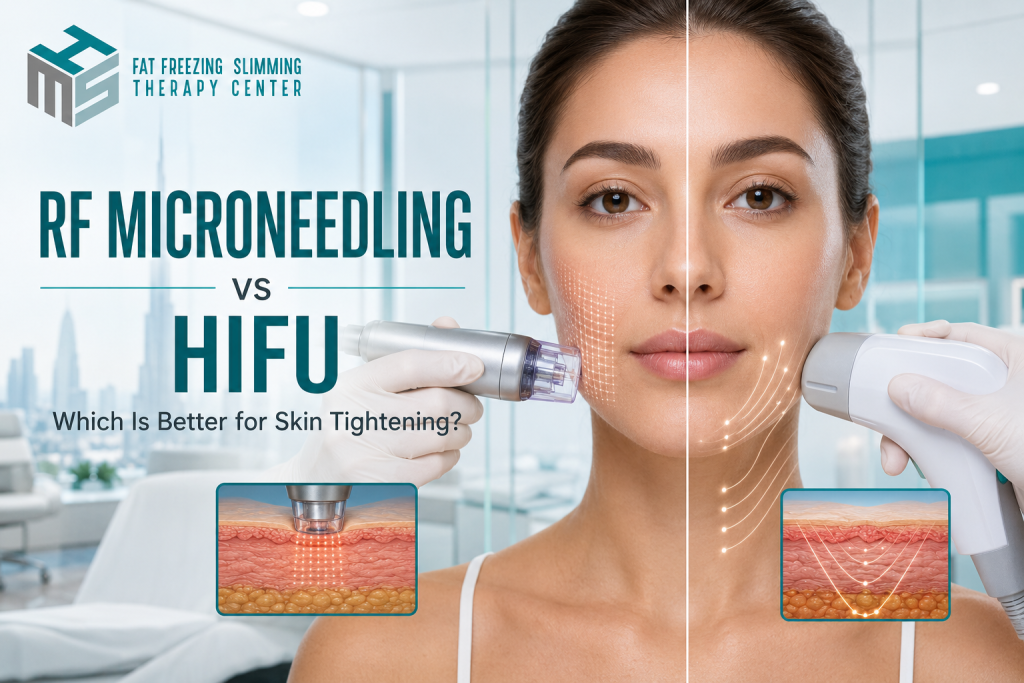
RF Microneedling vs HIFU: Which Is Better for Skin Tightening?
Loose skin, a less defined jawline and changing facial texture rarely develop in exactly the same way for every person. One client may notice enlarged pores and fine lines around the cheeks, while another is mainly concerned about early sagging along the lower face. Although both may request a skin-tightening Facial Treatment, they may not benefit equally from the same technology.
RF microneedling and HIFU are frequently compared because both encourage collagen remodelling without conventional surgery. However, they deliver energy differently, work at different tissue depths and suit different aesthetic priorities.
RF microneedling combines controlled needle penetration with radiofrequency energy. It is commonly selected when skin texture, acne scars, pores, fine lines and mild laxity need to be addressed together. HIFU—high-intensity focused ultrasound—delivers focused ultrasound energy into deeper tissue levels without needles. It is commonly considered when the principal goal is deeper tightening, contour definition or a modest lifting effect.
Neither procedure is automatically “better.” The more useful question is: which Facial Treatment is better matched to the depth, location and character of your concern?
This guide offers a detailed comparison while recognising an important limitation: an online article cannot determine individual suitability. Skin condition, medical history, implanted devices, previous aesthetic work and treatment settings must be assessed by an appropriately licensed and trained professional.
Understanding Skin Laxity Before Comparing Treatments
Skin firmness depends on more than age. Collagen and elastin provide structural support, while facial fat compartments, retaining ligaments, bone structure and muscle activity influence facial shape.
Visible laxity may be affected by:
- Natural ageing and declining collagen production
- Prolonged ultraviolet exposure
- Smoking
- Genetics
- Significant weight loss
- Hormonal changes
- Dehydration and poor barrier health
- Repetitive facial movement
- Changes in facial fat and bone support
This matters because an energy-based Facial Treatment cannot correct every cause of apparent sagging. A person with mild skin laxity may be a reasonable candidate for non-surgical tightening. Someone with substantial redundant skin, pronounced jowls or major volume loss may need a different strategy or specialist referral.
The American Academy of Dermatology notes that non-invasive tightening tends to provide gradual and generally modest improvement. It should not be presented as equivalent to surgical lifting. Its guidance on ways to firm sagging skin also explains that collagen-related results can take several months to become visible.
What Is RF Microneedling?
RF microneedling is a procedure in which a cartridge containing fine needles enters the skin at controlled depths. Radiofrequency energy is then delivered through or around those needle tips, producing targeted thermal zones beneath the surface.
The treatment creates two controlled stimuli:
- Mechanical microchannels produced by the needles
- Heat generated by radiofrequency energy at selected depths
The body’s repair response may support new collagen and elastin formation over time. Because needle depth and energy can often be adjusted by treatment area, RF microneedling can be customised for concerns such as textural irregularity, mild laxity, wrinkles and some types of acne scarring.
HMS Fat Freezing’s dedicated RF microneedling service describes a consultation-led process involving controlled microneedling and radiofrequency delivery for skin rejuvenation.
What can RF microneedling address?
Depending on the device, protocol and individual assessment, this Facial Treatment may be considered for:
- Mild skin laxity
- Fine lines
- Uneven skin texture
- Enlarged-looking pores
- Selected acne scars
- Crepey skin
- Early jawline softness
- Neck texture
- Overall collagen stimulation
RF microneedling is particularly relevant when surface quality and firmness are both priorities. It does not merely aim at lifting; it can be used as a resurfacing-oriented collagen procedure.
What does RF microneedling feel like?
A topical numbing product may be used before treatment where appropriate. Clients can experience pressure, prickling and heat during the procedure. Immediately afterwards, temporary redness, swelling, warmth, sensitivity or pinpoint marks may occur.
Downtime varies according to needle depth, energy, number of passes, treated area and individual healing response. More intensive settings may involve more noticeable recovery than a light protocol.
An important RF microneedling safety update
RF microneedling must not be treated like a casual home facial. In a 2025 safety communication, the US Food and Drug Administration reported serious complications associated with certain uses of RF microneedling devices, including burns, scarring, fat loss, disfigurement and nerve damage. The FDA advises patients to seek appropriately licensed providers with specific device training and to ask which device will be used.
Readers considering this procedure should review the FDA safety communication on RF microneedling and discuss the benefits, limitations and known risks with a qualified healthcare professional.
The safest Facial Treatment is not necessarily the mildest-sounding procedure. It is the properly indicated procedure performed with suitable equipment, conservative settings and appropriate clinical oversight.
What Is HIFU?
HIFU stands for high-intensity focused ultrasound. It uses focused acoustic energy to create precise thermal points below the skin’s surface. Unlike RF microneedling, it does not rely on needles entering the skin.
The energy is intended to reach predetermined tissue depths while largely bypassing the skin’s surface. This thermal stimulation may trigger collagen contraction and subsequent remodelling. HIFU is therefore usually discussed in relation to deeper tightening and contouring rather than pore refinement or scar resurfacing.
HMS Fat Freezing includes HIFU among its available skin treatments and describes it as a non-surgical procedure that targets deeper skin layers using ultrasound energy.
What can HIFU address?
After assessment, HIFU may be considered for:
- Mild-to-moderate facial laxity
- Early jowling
- Reduced jawline definition
- Loose-looking skin beneath the chin
- Mild neck laxity
- Brow-area lifting goals
- General facial contour support
HIFU is not primarily a pigmentation, pore-cleansing or acne-scar procedure. A client whose main complaint is rough texture may be disappointed if deeper tightening is achieved without meaningful surface refinement.
What does HIFU feel like?
Sensations vary considerably. Some clients report warmth, tingling or brief pulses of discomfort at the energy-delivery points. Temporary redness, swelling, tenderness, tingling or numbness may occur.
Although HIFU is non-invasive, non-invasive does not mean risk-free. Device quality, correct cartridge depth, anatomical knowledge and energy selection matter. Sensitive anatomical areas require particular care.
How quickly does HIFU work?
Some people perceive early firmness, but collagen remodelling is gradual. The American Academy of Dermatology states that ultrasound tightening may produce modest lifting and tightening over approximately two to six months.
A responsible provider should therefore avoid promising an instant surgical transformation from a non-surgical Facial Treatment.
RF Microneedling vs HIFU: Detailed Comparison
| Factor | RF Microneedling | HIFU |
|---|---|---|
| Energy | Radiofrequency heat | Focused ultrasound |
| Skin entry | Fine needles penetrate the skin | No needles |
| Typical priority | Texture, scars, pores, fine lines and mild tightening | Deeper tightening, lifting and contour definition |
| Treatment depth | Adjustable dermal and subdermal levels, depending on device | Selected deeper focal depths, depending on cartridge and device |
| Surface improvement | Usually more relevant | Usually limited |
| Acne-scar application | May be useful for selected scars | Not a primary acne-scar treatment |
| Jawline tightening | Can help mild laxity | Often selected for deeper contouring goals |
| Downtime | Commonly more visible | Often less visible at the surface |
| Result development | Gradual over weeks to months | Gradual over several months |
| Number of sessions | Often planned as a series | Sometimes fewer sessions, depending on assessment and device |
| Main limitation | Involves needles and post-treatment recovery | Less suitable for surface texture and scarring |
| Main safety concern | Burns, scarring, pigment changes, infection, fat loss or nerve injury | Burns, prolonged tenderness, nerve effects or unintended tissue injury |
| Best candidate | Someone seeking texture improvement plus mild tightening | Someone mainly seeking deeper tightening with minimal surface disruption |
The table identifies common differences, but device specifications vary. Two treatments marketed under the same name may use different technologies, cartridges, energy ranges and protocols.
Which Treatment Is Better for Specific Concerns?
For fine lines and crepey texture
RF microneedling will often be the more logically aligned Facial Treatment because it works through controlled dermal injury and thermal stimulation. It may improve both texture and mild laxity.
HIFU may support deeper firmness but is not designed as a conventional resurfacing procedure. If lines are mainly caused by dehydration, dynamic facial movement or sun damage, additional skincare or another treatment category may be needed.
For enlarged pores
RF microneedling is normally the more relevant option. Collagen remodelling around the skin’s structural framework may make pores appear less prominent.
No procedure permanently “closes” pores. Genetics, oil production, acne and loss of skin support all affect their appearance.
For acne scars
Selected atrophic acne scars may respond to RF microneedling, depending on scar type and skin assessment. Rolling, boxcar and ice-pick scars do not all respond identically. Some scars may require subcision, chemical reconstruction, laser treatment or a combined plan.
HIFU is not usually the first-choice Facial Treatment for acne scars because its primary strength is deeper tightening rather than controlled scar remodelling at the surface and dermal levels.
For jawline definition
HIFU may be preferred when the main concern is mild lower-face laxity and the skin surface is otherwise healthy. Its deeper energy delivery can be more directly aligned with contouring goals.
However, a poorly defined jawline may result from submental fat, bone structure, volume loss or muscle anatomy rather than skin laxity alone. HIFU cannot correct every cause.
For mild laxity with rough skin
RF microneedling may offer broader value because it can address both concerns within one treatment plan. It is commonly chosen when the client wants better texture as well as gradual firming.
For a low-downtime priority
HIFU often causes less visible surface disruption because there are no needle-created microchannels. It may suit clients who cannot accommodate several days of redness.
Low visible downtime should not be confused with a lack of biological activity. Tenderness or altered sensation may still occur below the surface.
For substantial sagging
Neither treatment should be presented as a substitute for surgery when excess skin is advanced. An ethical consultation may conclude that an energy-based Facial Treatment is unlikely to meet the client’s expectations.
That conclusion protects the client from spending repeatedly on procedures that cannot produce the desired structural change.
A Practical Decision Framework
Instead of choosing from before-and-after photographs, assess the problem through five questions.
1. Is the concern mainly surface, structural or both?
- Pores, acne scars and rough texture suggest a surface and dermal priority.
- Jowling and reduced contour suggest a deeper structural priority.
- Mixed concerns may support staged or combination treatment.
2. How much laxity is present?
Mild laxity may respond better than pronounced sagging. A professional assessment should include the face at rest and in motion rather than relying on a tightly posed photograph.
3. How much recovery can you accept?
A client with an important event in three days should not begin an intensive RF microneedling plan. Temporary redness or swelling may persist unpredictably.
Those preparing for an event can review the wider guide to facial treatments in Dubai while allowing adequate time for assessment, treatment and recovery.
4. What previous procedures have you had?
Disclose fillers, threads, implants, facial surgery, lasers, energy-based procedures and recent injectables. These details can affect treatment timing, settings and suitability.
5. What result would count as success?
“Look younger” is too vague. More measurable goals include:
- Softer appearance of selected acne scars
- Improved cheek texture
- A slightly firmer lower face
- Better jawline visibility
- Reduced appearance of fine lines
- Gradual rather than dramatic improvement
A realistic goal makes it easier to select and evaluate a Facial Treatment.
Pros and Cons of RF Microneedling
Advantages
- Addresses texture and mild laxity together
- May improve selected acne scars
- Can soften the appearance of fine lines
- Offers adjustable depth and energy settings
- Suitable for several facial and neck areas after assessment
- Encourages gradual collagen remodelling
- Can form part of a staged rejuvenation plan
Disadvantages
- Involves needles and temporary skin barrier disruption
- Redness, swelling and sensitivity may occur
- Usually requires more visible recovery than HIFU
- Multiple sessions may be recommended
- Improper treatment can cause burns, scars or pigment changes
- Serious complications, including fat loss and nerve injury, have been reported
- Results vary and are not equivalent to surgery
Pros and Cons of HIFU
Advantages
- No needle penetration
- Targets deeper tissue levels
- Often selected for jawline and lower-face tightening
- Usually causes limited visible surface downtime
- Results can develop gradually and subtly
- May suit clients whose texture is already satisfactory
- Can be used as a non-surgical contouring option after assessment
Disadvantages
- Does not directly target pores or acne scars
- Treatment can feel uncomfortable
- Results may be modest
- Not suitable for every facial shape or laxity level
- Incorrect depth or energy selection can create complications
- Some clients experience tenderness, tingling or altered sensation
- It cannot remove significant excess skin
Can RF Microneedling and HIFU Be Combined?
They may be complementary because they work through different energy types and at different tissue depths. That does not mean they should automatically be performed together or scheduled close to each other.
A combined plan should answer three questions:
- What specific concern does each procedure address?
- Is there a safe and reasonable interval between them?
- Is the expected added benefit worth the cost and cumulative recovery?
For example, a client with mild jowling and acne-scar texture may be considered for a staged plan: one modality for deeper contour concerns and another for dermal texture. The sequence and timing must be decided after examining the skin and reviewing medical history.
Clients researching broader options can read HMS Fat Freezing’s guide to non-surgical skin-tightening treatments.
More procedures do not automatically produce a better result. Excessive heat-based intervention may increase risk without adding meaningful improvement.
Safety, Contraindications and Provider Questions
Suitability varies by device and clinical circumstances. A consultation should explore active skin infections, inflammatory conditions, wound-healing problems, pregnancy status, medications, implanted electrical devices, metal implants, recent aesthetic procedures and a history of abnormal scarring.
Do not conceal medical details because a procedure appears cosmetic.
Ask the provider:
- What is the exact device and model?
- Is it authorised for the proposed use in the relevant jurisdiction?
- Who will perform the procedure?
- What device-specific training does that person have?
- Why is the recommended depth appropriate for my anatomy?
- What complications have you encountered?
- What aftercare and emergency contact are provided?
- What result is realistic for my degree of laxity?
- What alternatives should I consider?
- Can the treatment worsen pigment changes in my skin type?
The FDA’s overview of aesthetic and cosmetic devices explains that energy-based technologies can cause complications and should be used according to their authorised purpose.
Seek medical advice promptly if you develop severe or increasing pain, blistering, unusual colour changes, spreading redness, pus, marked facial weakness, persistent numbness or any symptom that feels disproportionate to the expected recovery.
Before and Aftercare Principles
Exact instructions should come from the treating professional and device protocol.
Before treatment
A provider may recommend:
- Avoiding unnecessary sun exposure
- Disclosing medicines and supplements
- Reporting active acne, cold sores or infection
- Pausing certain active skincare products if medically appropriate
- Arriving without heavy makeup
- Scheduling away from major events
- Avoiding another aggressive Facial Treatment too close to the appointment
Do not stop prescribed medicine without guidance from the clinician who prescribed it.
After RF microneedling
The treatment team may advise gentle cleansing, moisturising, sun protection and temporary avoidance of strong acids, retinoids, scrubs, heat exposure and strenuous activity.
Because the skin barrier has been disrupted, hygiene and aftercare compliance are particularly important.
After HIFU
Clients may be told to use gentle skincare, avoid unnecessary heat or irritation and monitor temporary tenderness or altered sensation. Strong massage over a recently treated area should not be performed unless approved.
Daily broad-spectrum sun protection supports general skin health but cannot guarantee or prolong a treatment result indefinitely.
Expert Recommendations from HMS Fat Freezing
HMS Fat Freezing recommends selecting treatment by concern and anatomy rather than by popularity.
Choose RF microneedling for multidimensional concerns
When laxity exists alongside pores, scars, uneven texture or fine lines, RF microneedling may provide a more relevant treatment pathway. The settings should be personalised rather than copied from a standard protocol.
Consider HIFU when deeper tightening is the priority
For a client whose surface texture is satisfactory but who wants gradual lower-face or jawline tightening, HIFU may be the more focused option.
Do not chase maximum energy
Higher energy is not automatically better. Appropriate treatment balances therapeutic effect with tissue safety. The objective is controlled stimulation, not the most painful session possible.
Protect facial volume
A face can appear older when valuable facial fat is reduced. Clients with thin faces or limited facial volume require particularly careful evaluation before heat-based procedures. Treatment depth and anatomical placement matter.
Photograph consistently
Use the same camera, angle, distance, lighting and facial expression before and after a Facial Treatment. Inconsistent photography can create a false impression of improvement or deterioration.
Review results at the correct time
Collagen remodelling is gradual. Judging the outcome after only a few days can lead to unnecessary retreatment. The review period should match the technology used and the provider’s protocol.
Build a complete skin plan
Skin tightening does not replace sunscreen, barrier care, acne management or management of pigmentation. A good plan distinguishes structural concerns from surface concerns and assigns the correct treatment to each.
Frequently Asked Questions
1. Is RF microneedling better than HIFU?
RF microneedling may be better for texture, pores, fine lines, selected acne scars and mild tightening. HIFU may be better when deeper lifting and contour support are the main priorities. The better Facial Treatment depends on your anatomy and concern.
2. Which treatment is better for the jawline?
HIFU is often considered for mild lower-face laxity and jawline definition because it works at deeper focal levels. RF microneedling may be preferable when jawline softness exists alongside textural concerns.
3. Which is more painful: HIFU or RF microneedling?
Experiences vary. RF microneedling involves needle penetration but may be performed after topical numbing. HIFU involves no needles, yet some clients find its deeper energy pulses uncomfortable. Device, settings, area and individual sensitivity all matter.
4. How many RF microneedling sessions are needed?
Many plans involve a series rather than one session, but there is no responsible universal number. Scar severity, laxity, device settings, healing response and treatment goals affect the recommendation.
5. How many HIFU sessions are required?
Some people undergo one treatment followed by review, while others may be advised differently. More frequent treatment is not necessarily better. The provider should allow adequate time to assess collagen-related changes.
6. Can RF microneedling cause facial fat loss?
The FDA has received reports of fat loss and other serious complications following certain uses of RF microneedling. Risk depends on factors including device, depth, energy, technique and anatomy. Discuss this concern directly with a licensed, trained provider.
7. Can HIFU reduce facial fat?
Some energy-based applications may affect subcutaneous tissue depending on device design, depth and treatment settings. Clients with slim faces or limited facial volume should ask specifically about this issue during consultation.
8. Is RF microneedling suitable for darker skin tones?
It may be considered for a range of skin tones, but post-inflammatory pigment change remains possible after skin injury. An experienced professional should assess pigmentation history, active inflammation and device settings before recommending the procedure.
9. How long do skin-tightening results last?
Duration varies with age, skin condition, lifestyle, sun exposure, procedure settings and natural ageing. Results are not permanent because collagen and facial structures continue to change.
10. Can I have RF microneedling and HIFU in the same month?
Do not schedule both independently. A qualified provider must assess whether combination treatment is appropriate and establish a safe interval. Closely stacking heat-based procedures can increase inflammation and risk without guaranteeing a better result.
Conclusion: Which Skin-Tightening Treatment Should You Choose?
RF microneedling and HIFU should not be treated as interchangeable procedures.
RF microneedling generally makes more sense when the treatment goal includes texture, pores, selected acne scars, fine lines and mild laxity. HIFU is generally more aligned with deeper tightening, jawline definition and a modest lifting effect with less visible surface disruption.
The decisive factor is not which technology has the more impressive advertisement. It is whether the selected Facial Treatment reaches the correct tissue level for the actual concern without exposing the client to unnecessary risk.
A high-quality consultation may recommend RF microneedling, HIFU, a staged combination, another modality or no energy-based procedure at all. That last possibility is part of responsible practice. Not every face needs aggressive tightening, and not every visible change is caused by loose skin.
Set a specific goal, disclose your medical and treatment history, ask about the exact device and insist on realistic expectations. Gradual, well-planned improvement is more valuable than a dramatic promise unsupported by anatomy or evidence.
Contact HMS Fat Freezing
To arrange a professional skin assessment and discuss a personalised Facial Treatment plan:
HMS Fat Freezing
HAMSAH BUILDING, Offices 407 & 408, Block A
Business Center, beside Ansar Gallery, Dubai
Phone: +971 4 583 2989
Email: info@hmsfatfreezing.com
Website: https://hmsfatfreezing.com/
This article provides general educational information and is not a diagnosis or personalised medical recommendation. Treatment suitability, risks and expected outcomes should be discussed with an appropriately licensed healthcare professional.