
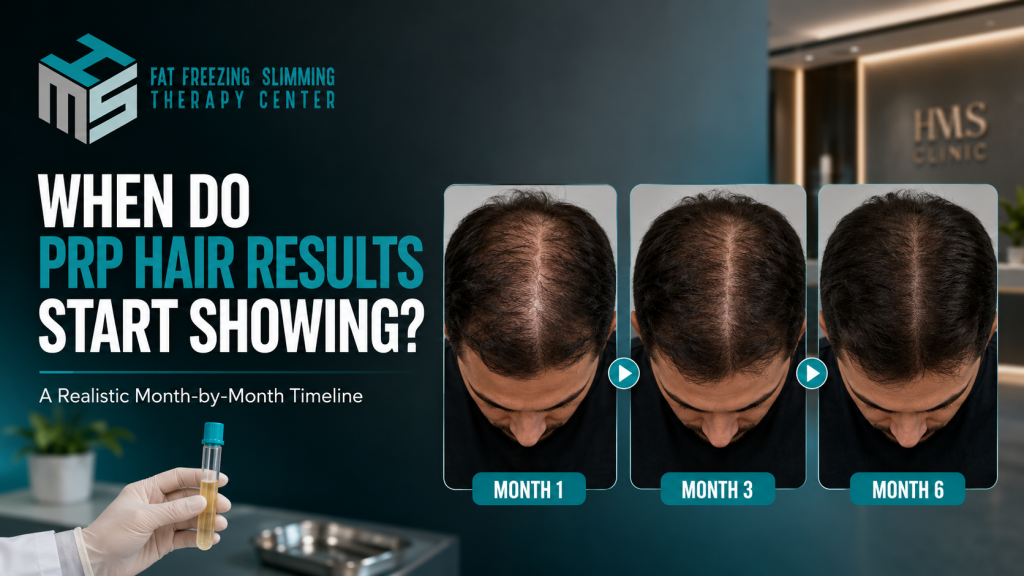
When Do PRP Hair Treatment Results Start Showing?
People considering PRP Hair Treatment usually have one immediate question: “How soon will I see new hair?”
The honest answer is that PRP does not produce an overnight cosmetic transformation. Hair follicles follow a biological growth cycle, so improvement normally appears in stages. Some suitable patients first notice less shedding or better hair texture, while visible changes in density take longer.
A realistic expectation is that early changes may become noticeable within two to three months, while more visible improvement is commonly assessed between three and six months. Some people require a longer observation period. The exact timing depends on the cause of hair loss, follicle health, treatment protocol, age, nutritional status, hormonal factors and consistency with the recommended sessions.
It is also important to distinguish between genuine regrowth and temporary changes caused by styling, lighting or hair length. A responsible provider should explain how progress will be measured instead of promising a dramatic result by a fixed date.
This guide examines the complete PRP Hair Treatment timeline, what happens beneath the scalp before visible growth appears, why results differ and how to determine whether treatment is working.
Contact HMS Fat Freezing for PRP Hair Treatment
Medical note: This article provides general educational information and does not replace a diagnosis or treatment plan from a qualified healthcare professional. Hair loss has many possible causes, and PRP is not appropriate for every person or every type of alopecia.
What Is PRP Hair Treatment?
PRP stands for platelet-rich plasma. During PRP Hair Treatment, a small sample of the patient’s own blood is collected and processed in a centrifuge to separate and concentrate platelet-rich plasma. The prepared plasma is then administered into selected areas of the scalp according to the treatment plan.
Platelets are widely known for their role in clotting, but they also contain growth factors and signalling proteins involved in tissue repair. In hair restoration, the purpose is to support the environment surrounding existing follicles and encourage healthier follicular activity in suitable candidates.
The American Academy of Dermatology notes that studies indicate PRP may be a safe and effective option for certain people experiencing hair loss. However, response varies, repeat treatments are generally required, and PRP is not a guaranteed cure.
Patients looking for service-specific information can review the PRP hair restoration service in Dubai offered by HMS Fat Freezing.
Contact HMS Fat Freezing for PRP Hair Treatment
Why PRP Results Take Time
Hair does not grow continuously at the same rate. Each follicle moves through a cycle consisting of growth, transition, rest and shedding phases.
The main phases are:
- Anagen: The active growth phase
- Catagen: A short transition phase
- Telogen: The resting phase
- Exogen: The stage during which the hair shaft is released
A session cannot instantly turn every resting follicle into visibly long hair. Even if follicular activity begins changing below the scalp, enough time must pass for a new or strengthened hair shaft to emerge and grow to a noticeable length.
This explains why a patient may experience biological activity before seeing a clear difference in the mirror. It also explains why measuring progress too early can create unnecessary disappointment.
Contact HMS Fat Freezing for PRP Hair Treatment
Reduced shedding and new growth are different outcomes
One of the most important distinctions is between stabilization and regrowth.
If a patient was losing 100 or more hairs a day and shedding later decreases, the treatment may be supporting stabilization even though the scalp does not yet look denser. Visible density requires existing hairs to remain in place while new or miniaturized hairs become thicker and longer.
Contact HMS Fat Freezing for PRP Hair Treatment
A credible assessment of PRP Hair Treatment should therefore examine several outcomes:
- Changes in daily shedding
- Hair-shaft thickness
- Hair density in a defined scalp area
- Strength and texture
- Visibility of the scalp under consistent conditions
- Progression or stabilization of thinning
Contact HMS Fat Freezing for PRP Hair Treatment
PRP Hair Treatment Results Timeline
There is no universal calendar that applies to every patient. The following timeline describes reasonable stages that may occur in responsive, properly selected candidates. It should not be treated as a guaranteed schedule.
| Time after starting | What may be happening | What the patient may notice | Best way to assess |
|---|---|---|---|
| First 24–72 hours | Temporary local response after treatment | Mild tenderness, redness or sensitivity | Follow aftercare instructions |
| Weeks 1–4 | Early follicular and tissue response | Usually no visible regrowth | Avoid judging results |
| Months 1–2 | Hair cycle may begin stabilizing | Possible reduction in shedding | Hair-fall diary and standardized photos |
| Months 2–3 | Early growth changes may emerge | Fine new hairs or improved texture in some patients | Close-up comparison photographs |
| Months 3–4 | Strengthening and thickening may become clearer | Less scalp visibility or improved coverage | Clinical review and density assessment |
| Months 4–6 | Cumulative response is easier to evaluate | More noticeable thickness or density in responders | Compare with baseline photographs |
| Months 6–12 | Continued growth and maintenance phase | Better understanding of the final response | Long-term treatment review |
The first month: preparation rather than transformation
During the first month, most patients should not expect a visible change in hair density. The scalp may feel mildly sensitive for a short time after the procedure, but these immediate sensations do not indicate whether treatment will succeed.
This phase is better viewed as the beginning of a biological process. Repeated daily mirror checks are unlikely to show meaningful differences and can make normal variations in styling look like progress or deterioration.
Patients should instead establish a good baseline by taking clear photographs of the hairline, temples, parting, crown and any area of concern.
Contact HMS Fat Freezing for PRP Hair Treatment
Months one to two: possible reduction in hair fall
Some responsive patients report that their hair shedding becomes more manageable during this period. This may appear as fewer hairs on the pillow, in the shower drain or on a hairbrush.
However, shedding fluctuates naturally. Stress, illness, nutrition, hormonal changes and seasonal factors can all influence the number of hairs lost on a particular day. A single low-shedding week is not enough to prove that PRP Hair Treatment is working.
Tracking the average pattern over several weeks gives a more useful picture.
Contact HMS Fat Freezing for PRP Hair Treatment
Months two to three: early signs may appear
Between the second and third months, some patients begin noticing short, fine hairs near the hairline or within previously thin areas. Existing hair may also feel stronger.
These early hairs can be difficult to distinguish from broken strands. New growth usually has a tapered end, while broken hair often has a blunt or frayed appearance. A scalp examination can provide a more dependable assessment than self-inspection.
For many patients, this is still an early stage. A lack of dramatic improvement at three months does not automatically mean that PRP Hair Treatment has failed.
Contact HMS Fat Freezing for PRP Hair Treatment
Months three to six: visible improvement is easier to judge
The three-to-six-month period is often more informative. In suitable responders, existing miniaturized hairs may become stronger, and improved coverage may make the scalp less visible.
The most reliable evidence comes from photographs taken with the same:
- Hairstyle
- Camera angle
- Distance
- Lighting
- Hair condition
- Parting position
- Camera settings where possible
Changes can look exaggerated if the “after” photograph uses dry, styled hair under soft lighting while the baseline photograph shows wet hair beneath a bright overhead light.
Months six to twelve: the longer-term result
By six months, a provider and patient can usually make a better-informed assessment of whether the treatment has delivered meaningful improvement. Some people continue to see gradual changes beyond this point because hair shafts need time to grow in length and contribute to overall coverage.
The long-term plan may include maintenance sessions, supportive treatment or a revised approach if response has been limited. The AAD explains that PRP is not a permanent solution for pattern hair loss and that maintenance may be needed to preserve improvement.
Contact HMS Fat Freezing for PRP Hair Treatment
What Does a Real PRP Result Look Like?
Marketing images often create the impression that treatment changes a severely bald area into dense hair. That is not the most realistic expectation.
In a suitable candidate, meaningful PRP Hair Treatment results may include:
- Slower progression of thinning
- Reduced excessive shedding
- Stronger-feeling hair
- Greater shaft diameter
- Improved density within thinning areas
- Better coverage along the parting or crown
- Less scalp visibility under ordinary lighting
The change may be clinically useful without being visually dramatic. For example, preventing further deterioration over a year can be valuable for a patient with progressive pattern hair loss, even if the hairline does not move forward.
Contact HMS Fat Freezing for PRP Hair Treatment
A practical example
Consider two patients who both begin with a widened central part.
The first patient has active follicles with moderate miniaturization and a confirmed pattern-hair-loss diagnosis. After following the recommended schedule, shedding reduces, the existing hairs become thicker and the part appears narrower at six months.
The second patient has long-standing smooth baldness with extensive follicular loss. The same treatment may offer little visible improvement because PRP is intended to support existing follicles; it cannot reliably recreate follicles that are no longer viable.
This is why accurate diagnosis and candidate selection matter more than choosing treatment based on a social media photograph.
Contact HMS Fat Freezing for PRP Hair Treatment
Factors That Influence How Quickly Results Appear
1. The cause of hair loss
PRP has been studied most often for androgenetic alopecia, commonly called male- or female-pattern hair loss. Research has also examined its use in other forms of alopecia, but evidence and suitability vary.
Sudden shedding may result from illness, childbirth, psychological stress, calorie restriction, iron deficiency, thyroid problems or medication. In these cases, addressing the underlying trigger may be more important than proceeding directly with PRP Hair Treatment.
Scarring alopecia requires medical diagnosis because permanent follicular damage can occur. Patients with sudden patches, pain, burning, redness, scaling or scarring should seek an appropriate clinical evaluation.
Contact HMS Fat Freezing for PRP Hair Treatment
2. The stage of thinning
Earlier intervention may offer a better opportunity to support follicles that are still present but producing finer hairs. Long-standing shiny bald areas generally have a lower likelihood of responding meaningfully.
This does not mean every early case will respond or every advanced case will fail. It means that follicle viability is a major part of treatment planning.
3. The treatment protocol
PRP preparation and administration are not identical across every clinic. Differences may include blood-processing methods, platelet concentration, injection depth, spacing and treatment frequency.
A 2023 systematic review available through PubMed concluded that evidence indicates potential benefit but also highlighted limitations in the quality and consistency of available research. Variability between protocols is one reason results cannot be predicted with absolute certainty.
4. Consistency with the recommended schedule
PRP Hair Treatment is commonly performed as a course rather than as a single isolated appointment. Missing sessions or stopping before the planned assessment point can make it difficult to determine whether the patient is responding.
The appropriate schedule should be decided by a qualified provider according to the patient’s condition, response and medical suitability.
5. Nutrition and general health
Hair production requires adequate protein, iron, zinc, vitamins and energy. Nutrient deficiencies should be investigated rather than assumed. Taking supplements without evidence of a deficiency can be unnecessary and, in some cases, harmful.
Poorly controlled health conditions, major stress, sleep disruption, smoking and restrictive diets can also influence hair quality or shedding. PRP cannot compensate for every unresolved health factor.
6. Hormonal and genetic influences
Pattern hair loss is strongly influenced by genetics and hormonal sensitivity. PRP may support follicular function, but it does not permanently remove the genetic tendency toward progressive miniaturization.
Some patients may require a broader medical plan. Any prescription treatment should be discussed with an appropriately qualified healthcare professional because benefits, contraindications and side effects differ between individuals.
7. Age and follicular activity
Age alone does not determine success. A younger patient with aggressive hair loss may progress quickly, while an older patient with mild, stable thinning may retain viable follicles.
The important factors are diagnosis, duration, activity of hair loss and condition of the follicles not simply the patient’s date of birth.
Contact HMS Fat Freezing for PRP Hair Treatment
How Many Sessions Are Usually Needed?
Patients often ask whether one appointment is enough. In most treatment plans, PRP Hair Treatment involves an initial series of sessions followed by a review. Maintenance may be advised depending on the diagnosis and individual response.
The exact number and spacing should not be copied from another person’s plan. A patient with early diffuse thinning may have different requirements from someone with a receding hairline or postpartum shedding.
Contact HMS Fat Freezing for PRP Hair Treatment
A responsible consultation should explain:
- The proposed number of initial sessions
- The reason for the recommended spacing
- When results will be reviewed
- How progress will be measured
- Whether maintenance may be required
- What will happen if there is little response
Patients researching different regenerative options can also read the HMS guide to professional hair treatments for hair growth.
Contact HMS Fat Freezing for PRP Hair Treatment
How to Track PRP Hair Treatment Progress Correctly
Subjective memory is unreliable. Many people cannot accurately remember how wide their parting was four months earlier. A structured tracking method provides better evidence.
Take standardized photographs
Photograph the same areas before treatment and at agreed intervals. Avoid taking pictures every day; monthly or clinically scheduled comparisons are usually more useful.
Monitor shedding without becoming obsessive
Instead of counting every hair, record a weekly estimate such as low, moderate or high shedding. Note events that could affect hair loss, including fever, major stress, medication changes or dieting.
Assess density, not only hair length
Longer hair can create the appearance of greater volume. The key question is whether the number or thickness of hairs within a consistent scalp area has changed.
Use professional scalp assessment
Where available, magnified scalp imaging or trichoscopic assessment can help evaluate miniaturization, density and shaft variation. Measurements must be repeated in the same location to provide meaningful comparisons.
Review the whole treatment plan
If shedding continues, the provider may need to reconsider diagnosis, investigate contributing factors or refer the patient for medical assessment. Automatically adding more PRP sessions without reviewing the cause is not a sound strategy.
Contact HMS Fat Freezing for PRP Hair Treatment
PRP Hair Treatment Compared with Other Approaches
| Approach | Primary role | When results may be assessed | Important limitation |
|---|---|---|---|
| PRP | Supports existing follicles using autologous platelet-rich plasma | Usually over several months | Response and protocols vary |
| Topical medication | Helps manage certain forms of pattern hair loss | Often requires several months | Continued use may be necessary |
| Oral medication | Targets selected causes of hair loss | Varies by treatment | Requires medical suitability review |
| Low-level light therapy | Uses specific wavelengths to support follicular activity | Usually requires consistent long-term use | Device quality and adherence vary |
| Hair transplant | Relocates follicles to areas of loss | Growth develops over many months | Surgical procedure with donor limitations |
| Nutritional correction | Treats confirmed deficiencies affecting hair | Depends on cause and recovery | Helps only when deficiency or nutrition is relevant |
These approaches are not automatically interchangeable. A person may need one treatment, a combination or a different plan entirely. Cleveland Clinic describes PRP as an option that may help restore some hair and prevent additional loss, while also emphasizing that results are not predictable for everyone.
Contact HMS Fat Freezing for PRP Hair Treatment
Pros and Cons of PRP Hair Treatment
Potential advantages
- Uses components prepared from the patient’s own blood
- Non-surgical treatment with limited interruption to daily activities
- May help reduce shedding in appropriate candidates
- May support hair thickness and density
- Can be incorporated into a broader hair-loss plan
- Does not require removal of donor follicles
Possible disadvantages and limitations
- Results develop gradually
- Multiple sessions may be required
- Maintenance treatment may be recommended
- Some patients experience tenderness, swelling or temporary scalp sensitivity
- Results vary between individuals
- It is not suitable for every cause of hair loss
- It cannot reliably restore follicles that are no longer viable
- Preparation methods and protocols differ
- Financial commitment should be considered before beginning a course
The Cleveland Clinic PRP overview notes that PRP injections generally carry few risks but can cause discomfort, and outcomes cannot be predicted with certainty.
Contact HMS Fat Freezing for PRP Hair Treatment
When Should You Be Concerned About a Lack of Results?
A patient should not assume failure after a few weeks. However, treatment deserves a formal review if there is no measurable stabilization or improvement after the planned evaluation period.
Questions to discuss include:
- Was the hair-loss diagnosis correct?
- Were the target follicles still viable?
- Were all recommended sessions completed?
- Were photographs and measurements standardized?
- Is shedding being driven by a new medical or lifestyle factor?
- Are nutritional, thyroid or hormonal issues suspected?
- Is another therapy more appropriate?
- Should the patient be referred to a dermatologist?
Continued rapid hair loss, scalp pain, inflammation, scarring, sudden bald patches or symptoms elsewhere in the body should not be treated as ordinary slow response. These signs require appropriate medical attention.
Expert Recommendations from HMS Fat Freezing
Begin with diagnosis, not a treatment package
HMS Fat Freezing recommends assessing the pattern, duration and possible causes of hair loss before deciding whether PRP Hair Treatment is appropriate. Patients should disclose medical conditions, medications, supplements and recent health changes during consultation.
Use the same photographs throughout treatment
A baseline photograph is only useful when follow-up images match its lighting, angle and hair position. Consistency prevents patients from mistaking photographic differences for biological improvement.
Measure stabilization as well as regrowth
Reduced shedding or slower progression can be meaningful, especially in pattern hair loss. The result should not be judged only by whether entirely new hair appears in a visibly bald area.
Do not compare your timeline with another patient
Two people of the same age can have different diagnoses, follicle health and rates of progression. Online before-and-after photographs cannot determine how quickly an individual will respond.
Follow aftercare carefully
Patients should follow the specific instructions provided after their session, including guidance about scalp care, exercise, heat exposure, hair products and medication. Generic online aftercare should not override individualized clinical advice.
Support treatment with sensible hair care
Avoid excessive traction, harsh chemical processing and aggressive handling of fragile hair. These practices will not treat genetic hair loss, but they can reduce unnecessary breakage that makes thinning appear worse.
Schedule a formal progress review
A planned review is more valuable than continuing sessions indefinitely. It allows the provider to compare evidence, discuss patient satisfaction and decide whether to maintain, modify or stop the approach.
Those exploring multiple strengthening options may also find the HMS guide to hair-strengthening treatments helpful.
Frequently Asked Questions
1. How soon does PRP Hair Treatment reduce hair fall?
Some patients report reduced shedding within one to three months, but the timing varies. Hair shedding also fluctuates naturally, so improvement should be tracked over several weeks rather than judged after a single wash or brushing session.
2. Can I see PRP hair growth after one session?
Visible growth after one session is not a reliable expectation. PRP is generally performed as a planned course because follicular and hair-cycle changes develop gradually. Any early improvement in appearance may be due to styling, reduced shedding or temporary changes in hair texture.
3. Why have I not seen results after three months?
Three months may still be early, particularly if the main outcome is stabilization rather than dramatic regrowth. Other explanations include advanced follicular loss, an inaccurate diagnosis, inconsistent treatment, ongoing nutritional or medical triggers, or limited individual response. A clinical review is more useful than assuming success or failure.
4. Does PRP make hair grow permanently?
PRP is not considered a permanent cure for genetic hair loss. Benefits may require maintenance, and the underlying tendency toward follicular miniaturization can continue. Long-term management should be based on diagnosis and professional guidance.
5. Can PRP regrow hair on a completely bald scalp?
PRP is more likely to support follicles that are still present. Smooth, long-standing bald areas may have limited viable follicular activity and therefore a lower chance of visible regrowth. A professional scalp assessment is necessary before setting expectations.
6. Is increased shedding normal after PRP?
Shedding can fluctuate for many reasons, and some people may notice temporary changes. Persistent, severe or sudden shedding should be discussed with the treatment provider to identify other possible causes rather than being automatically labelled a normal response.
7. Are PRP results different for men and women?
Both men and women may be considered for PRP, particularly for appropriately diagnosed pattern hair loss. Results depend more on the diagnosis, stage of thinning, follicle viability and treatment consistency than on sex alone.
8. How can I make PRP Hair Treatment work faster?
There is no safe shortcut that can force hair follicles to complete their growth cycle immediately. The best approach is to follow the recommended schedule, address confirmed health or nutritional concerns, avoid damaging hair practices and attend progress reviews.
9. What happens if PRP does not work for me?
The provider should reassess the diagnosis, baseline evidence, treatment course and possible contributing factors. Depending on the findings, options may include medical referral, alternative therapy, combination treatment or stopping PRP.
10. Is PRP suitable for every type of hair loss?
No. Hair loss may be genetic, hormonal, nutritional, inflammatory, autoimmune, scarring, medication-related or triggered by illness. Some causes require specific medical treatment. Suitability should be determined through proper consultation rather than by the appearance of thinning alone.
Conclusion: When Should You Expect a Meaningful Change?
PRP Hair Treatment should be approached as a gradual follicle-support strategy rather than an instant hair-volume procedure. Early changes, such as less shedding, may occur within the first few months. More visible improvement in thickness or density is usually easier to assess between three and six months, with longer-term evaluation continuing beyond that point.
The most valuable insight is that timing alone does not define success. Diagnosis, follicle viability, treatment consistency and objective progress measurements all matter. A patient who achieves stabilization may have gained a worthwhile benefit even if the result does not resemble a dramatic marketing image.
Set expectations before the first session, record a reliable baseline and agree on when the outcome will be reviewed. If progress is limited, the next step should be reassessment not an automatic promise that another session will solve the problem.
For an individual consultation about PRP Hair Treatment and non-surgical hair restoration options in Dubai, contact HMS Fat Freezing.
Contact HMS Fat Freezing
HMS Fat Freezing
Hamsah Building, Offices 407 & 408, Block A
Business Center, beside Ansar Gallery, Dubai
Phone: +971 4 583 2989
Email: info@hmsfatfreezing.com
Website: https://hmsfatfreezing.com/