
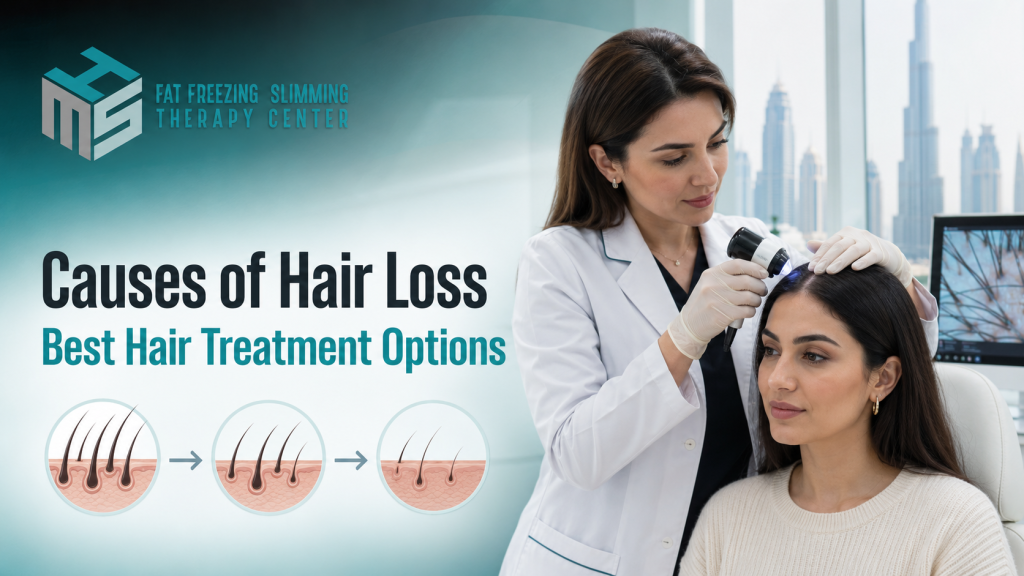
Causes of Hair Loss and the Best Hair Treatment Options
Hair loss rarely has one universal explanation. Two people may notice similar thinning around the crown but have entirely different underlying causes. One may have inherited pattern hair loss, while the other may be experiencing temporary shedding after illness, severe stress, rapid weight loss or iron deficiency.
That distinction matters because the Best Hair Treatment is not determined by which procedure is most popular. It is determined by the diagnosis, the condition of the follicles, the person’s medical history and the realistic objective of treatment.
Some conditions respond to medication. Others require correction of a nutritional or hormonal problem. Selected patients may consider regenerative procedures such as platelet-rich plasma, while advanced permanent loss may require surgical consultation or cosmetic camouflage.
The most useful question is therefore not, “Which treatment grows hair fastest?” It is, “Why is this person losing hair, and are the affected follicles still capable of producing healthy strands?”
This guide explains the major causes of hair loss, how clinicians distinguish them and how appropriate treatment options are selected.
Contact HMS Fat Freezing for Hair Treatment
Understanding the Normal Hair-Growth Cycle
Each scalp hair moves through a repeating biological cycle.
Anagen: Active Growth
During anagen, the follicle actively produces a hair strand. Scalp hair can remain in this stage for years. The length of the growth phase is one reason some people can naturally grow longer hair than others.
Catagen: Transition
Catagen is a short transitional stage during which active growth stops and the follicle begins to shrink.
Telogen: Resting
The follicle remains inactive during the resting phase. Eventually, the older strand is released and a new cycle can begin.
Exogen: Shedding
Exogen describes the release of the hair fibre. A certain amount of daily shedding is normal. Concern arises when the balance changes—more follicles enter the resting phase, new growth becomes weaker or follicles become damaged.
The Best Hair Treatment should address the part of this cycle being disrupted. Stimulating a severely scarred follicle is different from supporting a healthy follicle that has temporarily entered a resting stage.
Contact HMS Fat Freezing for Hair Treatment
Hair Shedding, Thinning and Breakage Are Not the Same
People often use “hair fall” to describe three different problems.
Shedding means complete strands are being released from the follicle. You may notice more hair in the shower, on a brush or across the pillow.
Thinning occurs when hair density decreases or individual strands become progressively finer. The scalp may become more visible around the parting, temples or crown.
Breakage happens when hair shafts snap above the scalp. Heat styling, bleaching, chemical processing, tight hairstyles and friction can contribute.
These problems can occur together, but their management differs. Products applied to the hair shaft may reduce breakage but cannot correct an autoimmune scalp condition or inherited follicle miniaturisation.
The Most Common Causes of Hair Loss
1. Androgenetic Alopecia
Androgenetic alopecia is commonly called male pattern baldness or female pattern hair loss. It is influenced by genetics and hormones.
In men, it often begins with recession at the temples, thinning at the crown or both. In women, it commonly produces gradual thinning across the top of the scalp and widening of the central part, while the frontal hairline may remain relatively preserved.
Affected follicles gradually produce shorter, finer strands. Early assessment is valuable because treatment generally aims to preserve and strengthen active follicles. Completely inactive or extensively miniaturised follicles are harder to restore.
The Best Hair Treatment for pattern loss may involve evidence-based medication, appropriate procedural support or a combination selected by a medical professional.
Contact HMS Fat Freezing for Hair Treatment
2. Telogen Effluvium
Telogen effluvium causes increased shedding when a larger-than-usual number of follicles enter the resting phase. It may begin weeks or months after a trigger such as:
- High fever or significant illness
- Surgery
- Childbirth
- Severe psychological stress
- Rapid weight loss
- Restrictive dieting
- Iron or nutritional deficiency
- Thyroid disturbance
- Starting or stopping certain medications
The delay between the trigger and visible shedding often creates confusion. Someone may recover from an illness and only notice substantial hair fall two or three months later.
Treatment focuses on identifying and addressing the trigger. When the cause is corrected and the follicles remain healthy, recovery may occur gradually, but normal density takes time because hair grows slowly.
3. Alopecia Areata
Alopecia areata is an autoimmune condition in which the immune system attacks hair follicles. It often causes smooth, clearly defined bald patches, although some people experience more extensive loss.
This is not the same as ordinary pattern thinning. A dermatologist may recommend medical therapies based on the patient’s age, severity, disease activity and affected areas.
The American Academy of Dermatology’s guidance on alopecia areata treatment notes that treatment plans vary and that limited patchy loss may sometimes regrow without intervention.
PRP, supplements or salon treatments should not be assumed to be the Best Hair Treatment for autoimmune hair loss without a proper medical diagnosis.
4. Nutritional Deficiencies
Hair production depends on adequate nutrition, but indiscriminate supplementation is not a reliable strategy.
Low iron stores, inadequate protein intake and deficiencies involving certain vitamins or minerals can contribute to shedding in appropriate clinical contexts. However, taking high doses without testing may be unnecessary and can sometimes be harmful.
Contact HMS Fat Freezing for Hair Treatment
Nutritional loss is more likely in people who have experienced:
- Highly restrictive diets
- Rapid weight reduction
- Digestive or absorption disorders
- Heavy menstrual bleeding
- Poor protein intake
- Bariatric surgery
- Prolonged illness
A clinician may recommend blood tests based on symptoms and history. The Best Hair Treatment in this situation begins by correcting a confirmed deficiency rather than purchasing multiple “hair vitamins.”
Contact HMS Fat Freezing for Hair Treatment
5. Thyroid and Hormonal Conditions
Both underactive and overactive thyroid conditions can affect hair growth. Hormonal changes associated with childbirth, menopause or polycystic ovary syndrome may also contribute to shedding or pattern thinning.
Hair symptoms alone cannot confirm a hormonal disorder. Other signs, medical history and appropriate testing should guide the evaluation.
Where an underlying endocrine condition exists, hair procedures should complement—not replace—medical management.
6. Scalp Inflammation and Infection
Dandruff, seborrhoeic dermatitis, psoriasis, fungal infection and other inflammatory scalp conditions may cause itching, scaling, discomfort or increased shedding.
Repeated scratching can worsen breakage and inflammation. Certain infections require prescription treatment and should not be managed with cosmetic scalp procedures alone.
The Best Hair Treatment for an inflamed scalp is often to control the scalp condition before considering growth-focused procedures. HMS Fat Freezing’s guide to scalp treatments for healthy hair growth discusses why scalp health should form part of a broader hair-care plan.
Contact HMS Fat Freezing for Hair Treatment
7. Traction Alopecia
Traction alopecia results from repeated pulling on the hair follicles. Tight ponytails, braids, extensions, buns and certain headwear practices can contribute.
Early traction-related loss may improve when tension is removed. Long-term pulling can cause permanent follicle damage and scarring.
Warning signs include:
- Broken hairs around the hairline
- Scalp tenderness
- Small bumps near tightly pulled areas
- Progressive recession in areas under tension
Changing the hairstyle early is more important than adding another product.
Contact HMS Fat Freezing for Hair Treatment
8. Chemical Damage and Heat-Related Breakage
Bleaching, straightening, colouring, high-temperature styling and frequent chemical treatments weaken the hair shaft. The resulting breakage may make hair appear thinner even when follicle density has not changed substantially.
A strand that snaps cannot be repaired biologically. Conditioners and bonding products can temporarily improve smoothness and reduce further damage, but trimming and gentle care may still be necessary.
In these cases, the Best Hair Treatment may be a hair-care correction plan rather than an injectable or medical growth procedure.
9. Medication-Related Hair Loss
Some medicines can contribute to shedding or changes in hair growth. Examples may include certain cancer treatments, anticoagulants, retinoids and other prescription drugs.
Never stop medication because of suspected hair loss without consulting the prescribing practitioner. The medical reason for the medicine may be far more important than the cosmetic side effect.
A doctor can assess the timing, consider alternative explanations and determine whether a safe substitution is possible.
Contact HMS Fat Freezing for Hair Treatment
10. Scarring Alopecia
Scarring alopecia refers to conditions in which inflammation damages and replaces hair follicles with scar tissue. Symptoms can include burning, tenderness, redness, scaling, pustules or smooth shiny areas where follicular openings are absent.
This category requires prompt medical assessment. Once follicles are permanently destroyed, they cannot produce new hair. The objective is often to control inflammation and prevent progression.
Delay matters. A popular treatment package should never substitute for dermatologist-led assessment when scarring is suspected.
Contact HMS Fat Freezing for Hair Treatment
Comparison of Hair-Loss Patterns and Treatment Directions
| Hair-loss pattern | Common clues | Possible evaluation | Typical treatment direction |
|---|---|---|---|
| Androgenetic alopecia | Gradual crown, parting or temple thinning | Pattern examination, history and scalp assessment | Evidence-based medication, selected procedures and long-term maintenance |
| Telogen effluvium | Diffuse shedding after stress, illness or diet change | Trigger history and targeted blood tests | Correct the trigger, improve nutrition and monitor recovery |
| Alopecia areata | Smooth circular or patchy loss | Dermatological and autoimmune assessment | Condition-specific medical treatment |
| Traction alopecia | Loss near areas under repeated tension | Hairstyle history and scalp examination | Remove tension; early medical support where required |
| Scalp inflammation | Itching, scale, redness or discomfort | Scalp examination and possible testing | Treat inflammation or infection first |
| Hair-shaft breakage | Short broken strands and rough texture | Hair-care and chemical-treatment history | Reduce damage and improve shaft care |
| Scarring alopecia | Pain, burning, redness or smooth scarred areas | Urgent dermatologist assessment, sometimes biopsy | Control inflammation and prevent further permanent loss |
| Advanced permanent loss | Long-standing smooth bald areas | Follicle and donor-area evaluation | Cosmetic camouflage or hair-transplant consultation |
This table shows why the Best Hair Treatment cannot be selected from photographs alone. Several conditions can overlap, and a person may have both pattern thinning and temporary shedding.
Contact HMS Fat Freezing for Hair Treatment
How Hair Loss Should Be Evaluated
A careful consultation should include more than a quick look at the scalp.
Medical and Hair-Loss History
The practitioner should ask:
- When did the problem begin?
- Was the loss sudden or gradual?
- Is it shedding, thinning, breakage or patching?
- Was there a recent illness, operation, pregnancy or stressful event?
- Have weight, diet or medications changed?
- Is there itching, pain, redness or scaling?
- Does hair loss run in the family?
- Which treatments have already been attempted?
Scalp and Hair Examination
The distribution of loss provides valuable clues. Examination may consider the parting, temples, crown, hairline, scalp surface, follicular openings and variation in strand thickness.
Dermatologists may use magnification or dermoscopy to examine the follicles and scalp more closely.
Targeted Laboratory Testing
Blood tests are not required for everyone. When clinically appropriate, a doctor may investigate blood count, iron status, thyroid function or other suspected deficiencies or hormonal factors.
Tests should be selected according to the individual’s history rather than ordered as a universal “hair package.”
Contact HMS Fat Freezing for Hair Treatment
Referral or Biopsy
Persistent inflammation, uncertain diagnosis or suspected scarring may require specialist assessment. In selected cases, a scalp biopsy helps distinguish conditions that appear similar on the surface.
The American Academy of Dermatology explains that diagnosis may involve history, scalp examination, blood tests and occasionally biopsy in its hair-loss diagnosis and treatment guidance.
Treatment Options for Hair Loss
Topical Minoxidil
Topical minoxidil is widely used for male and female pattern hair loss. It may help reduce loss and support regrowth in some patients, but it does not work for everyone.
Important considerations include:
- Consistent application is usually necessary
- Results take time
- Temporary early shedding can occur
- Scalp irritation is possible
- Benefits generally require continued use
- Correct strength and suitability should be discussed with a professional
The NHS identifies minoxidil as one of the principal treatments for pattern hair loss and notes that treatment does not work for everyone and is effective only while it is used. Readers can review the NHS hair-loss overview for further information.
Contact HMS Fat Freezing for Hair Treatment
Minoxidil may be part of the Best Hair Treatment plan for suitable pattern loss, but it is not an automatic answer for infection, scarring or sudden unexplained shedding.
Prescription Medication
Finasteride is a prescription option used for male pattern hair loss in appropriately selected patients. It affects hormone metabolism and can cause side effects, so medical supervision and informed discussion are essential.
It should not be casually recommended to women, particularly during pregnancy or when pregnancy is possible. Patients should discuss sexual, fertility, mood and other relevant health considerations with their prescribing doctor.
The US Food and Drug Administration has also warned that compounded topical finasteride products are not FDA-approved and may carry risks. Its topical finasteride safety communication provides important context.
Other prescription treatments may be considered for specific diagnoses, but they require individual medical evaluation.
Contact HMS Fat Freezing for Hair Treatment
PRP Hair Treatment
Platelet-rich plasma treatment involves collecting a small amount of the patient’s blood, concentrating the platelet-containing plasma and administering it to selected scalp areas.
PRP is used as a non-surgical option for certain people with thinning hair and viable follicles. It should not be described as a guaranteed cure or a method for recreating follicles that have been permanently destroyed.
Potential advantages include:
- Uses material obtained from the patient’s own blood
- Non-surgical treatment
- Relatively limited interruption to normal activities
- May complement other treatments in suitable candidates
- Can be directed towards selected thinning areas
Limitations include:
- Multiple sessions may be recommended
- Results vary
- Temporary discomfort, swelling or bruising may occur
- Maintenance may be required
- Suitability depends on diagnosis and health status
- It is unlikely to restore completely bald scarred areas
HMS Fat Freezing provides a dedicated overview of PRP hair treatment in Dubai and explains the usual consultation, preparation and treatment process.
For suitable early thinning, PRP may form part of the Best Hair Treatment plan, but it should follow an appropriate assessment.
Contact HMS Fat Freezing for Hair Treatment
GFC and Other Concentrate-Based Procedures
Growth Factor Concentrate, commonly called GFC, is another blood-derived approach offered by some clinics. Preparation methods and clinical protocols differ from PRP.
Patients should ask:
- What system is being used?
- Who prepares and administers the treatment?
- What evidence supports its use for the diagnosed condition?
- How many sessions are proposed?
- What side effects and limitations apply?
- How will progress be measured?
- What happens if shedding continues?
Marketing names should never replace a clear explanation of the procedure.
Scalp-Focused Treatments
Professional scalp treatments can help manage buildup, excess oil, dryness or selected cosmetic scalp concerns. Medical dandruff, psoriasis, infection or inflammatory disease may require dermatologist-directed care.
A clean scalp may improve comfort and product application, but scalp cleansing does not reverse genetic hair loss. Claims should remain proportional to what the treatment can realistically achieve.
Contact HMS Fat Freezing for Hair Treatment
Nutritional and Lifestyle Correction
Correcting a genuine nutritional deficiency may reduce associated shedding. More supplements are not necessarily better.
A balanced plan may involve:
- Adequate dietary protein
- Correction of confirmed iron deficiency
- Avoiding crash diets
- Gradual, supervised weight management
- Sufficient sleep
- Management of underlying illness
- Stress-management strategies
- Gentle handling of fragile hair
Lifestyle improvement supports health, but it should not be presented as a cure for every type of alopecia.
Contact HMS Fat Freezing for Hair Treatment
Hair Transplantation
Hair transplantation moves follicles from a donor area to thinning or bald areas. It may be considered for stable pattern loss when donor density is adequate.
It does not stop future loss in untreated non-transplanted hair. Long-term planning is therefore important.
Potential patients should consult a qualified hair-transplant surgeon and ask about:
- Diagnosis and stability of loss
- Donor-area capacity
- Expected density
- Hairline design
- Surgical method
- Scarring
- Recovery
- Long-term preservation of existing hair
For established permanent loss, surgery may offer a more realistic solution than repeated non-surgical sessions.
Contact HMS Fat Freezing for Hair Treatment
Cosmetic Camouflage and Hair Systems
Hair fibres, scalp micropigmentation, wigs, extensions and hair systems can improve appearance without claiming biological regrowth.
They may be particularly useful when:
- Medical treatment is still taking effect
- Loss is extensive
- Treatment is unsuitable
- The person prefers a non-medical option
- Immediate visual coverage is desired
Cosmetic solutions are legitimate choices and should not be treated as treatment failure.
Contact HMS Fat Freezing for Hair Treatment
Pros and Cons of Common Treatment Categories
Medical Treatments
Pros
- Some options have substantial clinical experience
- Can help preserve existing hair in suitable conditions
- May be used at home under professional guidance
- Often form the foundation of pattern-loss management
Cons
- May require continuous use
- Side effects and contraindications are possible
- Results take time
- Not appropriate for every cause
PRP and Regenerative Procedures
Pros
- Non-surgical
- Uses an individual’s own blood-derived material
- Can complement a broader plan
- Limited downtime for many patients
Cons
- Outcomes vary
- Multiple sessions may be needed
- Cost can accumulate
- Not suitable for every patient
- Cannot reliably regenerate destroyed follicles
Hair Transplantation
Pros
- Can redistribute permanent donor follicles
- May provide a lasting cosmetic improvement
- Useful for selected established pattern loss
Cons
- Surgical procedure
- Requires sufficient donor hair
- Recovery and potential scarring must be considered
- Future native-hair loss can continue
- Results depend strongly on surgical planning
Lifestyle and Nutritional Support
Pros
- Supports general health
- Essential when deficiency or severe dieting is involved
- Can reduce preventable triggers
Cons
- Does not reverse every diagnosis
- Supplements without testing may be unnecessary
- Improvement may be slow
- Generic advice may delay medical assessment
The Best Hair Treatment may combine categories, but every component should have a defined purpose.
Contact HMS Fat Freezing for Hair Treatment
Dubai-Specific Factors That May Affect Hair and Scalp Comfort
People frequently blame Dubai’s water or climate for every episode of hair loss. The reality is more nuanced.
Heat, perspiration, frequent air-conditioning, UV exposure, dust and repeated washing can influence scalp comfort and hair-shaft dryness. Hard water or mineral residue may affect the feel and manageability of hair. These factors may increase tangling, dryness or breakage, but they do not explain every case of follicular hair loss.
Dubai residents may also experience:
- Stress after relocation
- Changes in diet
- Irregular working hours
- Indoor-outdoor temperature transitions
- Increased use of swimming pools
- Frequent heat styling
- Rapid weight-loss programmes
A filter, anti-residue shampoo or conditioning routine may improve hair texture, but persistent thinning still requires diagnostic consideration.
HMS Fat Freezing’s article on why hair fall may appear worse in Dubai examines the combined roles of climate, lifestyle and health factors.
A Practical Treatment-Matching Framework
Before choosing the Best Hair Treatment, answer three questions.
1. What Is the Pattern?
Diffuse shedding, gradual crown thinning, smooth patches and broken frontal strands point towards different possibilities.
2. Is the Follicle Active, Miniaturised, Inflamed or Destroyed?
An active follicle affected by temporary shedding has a different outlook from a scarred follicle. This distinction influences whether the objective is regrowth, preservation or camouflage.
3. What Is the Measurable Goal?
A useful goal might be:
- Reduce excessive shedding
- Control scalp inflammation
- Preserve current density
- Improve shaft strength
- Increase coverage in thinning areas
- Restore a stable hairline surgically
- Improve cosmetic appearance
Photographs taken under consistent lighting, angle, hairstyle and camera distance are more useful than daily mirror checking.
Contact HMS Fat Freezing for Hair Treatment
Expert Recommendations from HMS Fat Freezing
The team at HMS Fat Freezing recommends a diagnosis-led and expectation-controlled approach:
- Do not begin with a treatment package. Begin with the pattern, history and likely cause of loss.
- Refer warning signs appropriately. Sudden patches, scalp pain, scarring, inflammation or systemic symptoms require medical evaluation.
- Treat the scalp environment where needed. Active irritation or infection should be controlled before elective procedures.
- Protect viable follicles early. Long-standing miniaturisation may be harder to improve than early thinning.
- Avoid frequent treatment switching. Hair growth is slow, and changing products every few weeks makes results difficult to evaluate.
- Use repeatable progress photography. Compare images under the same conditions rather than relying on memory.
- Review nutrition rationally. Correct confirmed deficiencies instead of taking multiple unverified supplements.
- Combine treatments only for a reason. Each element should address the diagnosis or a specific treatment barrier.
- Maintain realistic expectations. Improvement may mean reduced shedding or better density—not restoration of childhood hair volume.
- Choose qualified providers. Injectable, prescription and surgical treatments require appropriately trained professionals.
Readers considering regenerative care can also review when PRP hair-treatment results may appear and HMS Fat Freezing’s guide to PRP hair treatment for women.
Contact HMS Fat Freezing for Hair Treatment
When Should You See a Dermatologist Quickly?
Arrange medical assessment if hair loss is:
- Sudden or rapidly worsening
- Occurring in smooth patches
- Associated with pain, burning or pus
- Accompanied by significant redness or scaling
- Producing shiny or scarred areas
- Affecting eyebrows or body hair
- Beginning in a child
- Associated with weight change, fatigue or other symptoms
- Occurring during serious illness or medical treatment
- Causing major emotional distress
Early diagnosis can be especially important when inflammation threatens permanent follicle damage.
Frequently Asked Questions
1. What is the best hair treatment for thinning hair?
The answer depends on the cause. Pattern thinning may respond to approved medication and selected supportive procedures, while nutritional or thyroid-related shedding requires management of the underlying condition. A consultation should establish the pattern before treatment begins.
2. Can lost hair grow back naturally?
Temporary shedding may recover after the trigger is corrected. Alopecia areata can sometimes regrow spontaneously. Follicles destroyed by scarring generally cannot produce new strands, making early diagnosis important.
3. Does PRP permanently stop hair loss?
No. PRP does not permanently stop every form of hair loss. Some suitable patients may experience reduced shedding or improved density, but maintenance and additional treatment may be necessary.
4. How long does hair treatment take to show results?
Hair changes are slow. Depending on the diagnosis and therapy, early improvement may take several months. The AAD notes that minoxidil-related regrowth may take approximately six to twelve months for some people.
5. Can Dubai water cause permanent baldness?
Water quality may affect texture, dryness, residue and breakage, but it should not automatically be blamed for genetic, autoimmune, hormonal or scarring hair loss. Persistent thinning deserves proper assessment.
6. Which blood tests are needed for hair loss?
Testing depends on symptoms and history. A doctor may consider blood count, iron status, thyroid function or other targeted investigations. Universal testing panels are not necessary for everyone.
7. Is hair loss after weight loss reversible?
Shedding after rapid weight loss may improve when nutrition, weight stability and the hair cycle recover. Severe restriction can also uncover deficiencies, so medical or nutritional assessment may be appropriate.
8. Can women use the same treatments as men?
Not always. Diagnosis, hormones, pregnancy potential and medication risks differ. Women should receive an individual plan rather than copying a male relative’s or partner’s treatment.
9. How do I know whether my follicles are still alive?
A scalp examination and dermoscopic assessment can show follicular openings, miniaturised hairs and signs of inflammation. Smooth scarred areas may indicate permanent damage, but a dermatologist should confirm the diagnosis.
10. Should I take biotin for hair loss?
Biotin should not be treated as a universal solution. Deficiency is uncommon, and high-dose supplements can interfere with certain laboratory tests. Discuss supplements with a medical professional, particularly before blood testing.
Conclusion
Finding the Best Hair Treatment begins with understanding what is actually happening: shedding, miniaturisation, breakage, inflammation or permanent follicle loss.
Pattern hair loss may require long-term medical management. Telogen effluvium calls for identification of its trigger. Scalp disorders must be controlled, nutritional deficiencies should be confirmed and corrected, and suspected scarring needs timely dermatological attention. PRP may support selected patients with viable follicles, while surgery or cosmetic camouflage may be more appropriate for established permanent loss.
No responsible clinic can guarantee that one procedure will solve every case. A trustworthy plan explains the diagnosis, expected timeline, limitations, possible side effects and method for measuring progress.
The Best Hair Treatment is ultimately the one matched to the correct condition, delivered by an appropriately qualified professional and supported by realistic expectations.
Contact HMS Fat Freezing
Address: HAMSAH BUILDING, Offices 407 & 408, Block A, Business Center, beside Ansar Gallery, Dubai
Phone: +971 4 583 2989
Email: info@hmsfatfreezing.com
Website: https://hmsfatfreezing.com/