
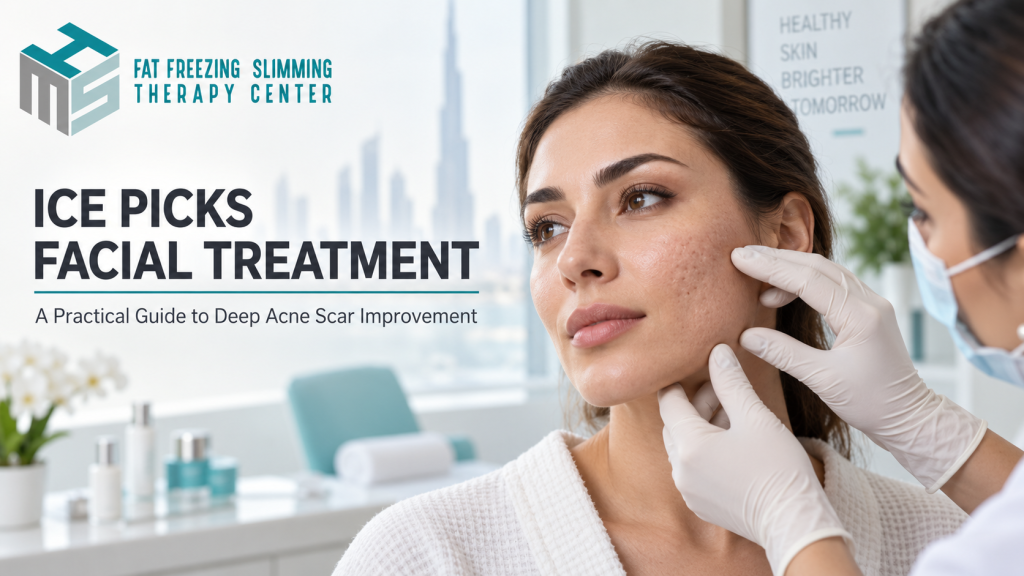
Ice Picks Facial Treatment: A Practical Guide to Deep Acne Scar Improvement
Ice-pick scars are small, but the challenge they create is anything but small. Under direct light, a cheek that seems relatively smooth from the front may show dozens of deep pin-point shadows from the side. Creams can soften dryness and fade some dark marks, yet the pits remain because the problem is not sitting on the surface. It is a structural change extending into the skin.
That is why an effective Ice Picks Facial Treatment begins with correct scar identification rather than a fashionable device or a standard facial package. Some scars respond to focal chemical reconstruction, some are better removed individually, and surrounding texture may need a separate collagen-remodelling procedure. Many people have several scar types at once, so a staged plan usually makes more sense than one aggressive session.
This guide explains professional options, recovery and how to judge a plan realistically. Active acne, medication, skin tone and healing history can all change what is suitable.
Contact HMS Fat Freezing for Ice Picks Facial Treatment
What Are Ice-Pick Acne Scars?
Ice-pick scars are narrow, deep, V-shaped depressions, commonly less than about 2 mm across at the surface. They look as though the skin has been punctured by a fine sharp point. The NHS guide to acne complications distinguishes them from rolling scars, which create wave-like unevenness, and boxcar scars, which are broader round or oval depressions.
They usually develop after deep inflammatory acne damages tissue around a pore. During healing, the body does not replace the lost collagen in an even way. The surface opening may contract while a fibrotic tract remains below it. This “narrow entrance, deep base” shape explains why mild resurfacing may polish the edges without reaching the full scar.
Dark marks are different. Post-inflammatory hyperpigmentation is a colour change; an ice-pick scar is a contour change. A person may have both together, and treating only pigmentation can improve tone while leaving texture unchanged.
Contact HMS Fat Freezing for Ice Picks Facial Treatment
Why a Standard Facial Is Not Enough
A cleansing facial can remove surface build-up, help decongest suitable blackheads and support an acne-prone skincare routine. It cannot mechanically rebuild a deep column of missing dermal tissue. The name Ice Picks Facial Treatment therefore describes a scar-focused professional programme, not simply cleansing, steaming or applying a mask.
Surface treatment may improve brightness, but it is unlikely to correct a deep, narrow tract. The American Academy of Dermatology’s acne-scar guidance notes that scar types require different treatments and clinicians often combine methods.
Active acne should usually be controlled before scar work. HMS Fat Freezing offers an Acne Facial for suitable oily or congested skin, but painful nodules, cysts or persistent acne warrant dermatologist-led assessment.
Contact HMS Fat Freezing for Ice Picks Facial Treatment
The Two-Layer Strategy Behind Better Results
At HMS Fat Freezing, the practical logic behind Ice Picks Facial Treatment is to separate depth from colour and general texture.
Layer 1: Reduce the depth or sharpness of individual scars
Focal techniques target the pit itself. These may include TCA CROSS, punch excision, punch elevation or punch grafting, depending on the scar’s width and depth. The goal is not to sand the whole face aggressively; it is to treat the small structural defects with precision.
Layer 2: Blend the surrounding skin
Once the deepest pits have improved, microneedling, RF microneedling, fractional laser or selected peels may help blend edges, stimulate remodelling and address uneven tone. This sequence prevents a common mistake: repeatedly resurfacing the entire face while the deepest tracts remain largely unchanged.
Contact HMS Fat Freezing for Ice Picks Facial Treatment
Ice-Pick Scar Treatment Options Compared
| Treatment | Best suited to | How it works | Typical recovery pattern | Important limitation |
|---|---|---|---|---|
| TCA CROSS | Multiple narrow, deep pits | High-strength acid is placed precisely inside each scar to trigger local collagen repair | Frosting, redness, then tiny crusts for several days | Must be applied precisely; pigment change and scar widening are possible |
| Punch excision | Very deep, discrete scars | The scar tract is removed and the opening is closed | Small wound and short healing period; a fine line may remain | Treats scars individually and may not suit numerous closely spaced pits |
| Punch elevation | Selected scars with a usable base | The scar base is released and lifted closer to skin level | Local swelling and wound care | More commonly useful for selected boxcar-type defects than very narrow pits |
| Punch grafting | Very deep or larger individual defects | The scar is removed and replaced with a tiny skin graft | Graft-site and donor-site care | Colour or texture mismatch can occur |
| Microneedling | Mixed shallow atrophic scars and surrounding texture | Controlled micro-injury stimulates collagen remodelling | Redness and sensitivity, often for a few days | Alone, it may have limited effect on very deep ice-pick tracts |
| RF microneedling | Mixed texture concerns needing adjustable depth and thermal energy | Needles deliver radiofrequency energy below the surface | Redness, swelling or pinpoint marks | Device, depth and energy selection are critical; serious complications are possible |
| Fractional laser | Broader texture blending and selected atrophic scars | Fractional treatment zones stimulate resurfacing and collagen | Varies from redness to several days of peeling or crusting | Pigment risk and downtime vary by laser type and skin tone |
| Chemical peel | Tone, mild texture and treatment-plan support | Controlled exfoliation and renewal | Redness and peeling depend on strength | A general peel is not the same as focal TCA CROSS and may not reach deep scars |
An Ice Picks Facial Treatment plan should consider whether scars are isolated or crowded, how the skin pigments after inflammation and how much downtime the person can accept.
Contact HMS Fat Freezing for Ice Picks Facial Treatment
How the Main Procedures Work
TCA CROSS for narrow, deep scars
TCA CROSS means chemical reconstruction of skin scars using trichloroacetic acid. Unlike a full-face peel, a trained professional places a tiny amount of high-concentration solution inside each selected depression. A local inflammatory response encourages new collagen formation over time.
DermNet’s TCA CROSS overview notes that several sessions are commonly required and lists possible complications such as irritation, pigment change and joining adjacent scars into a larger defect. It is not a do-it-yourself technique: acid placed outside the scar can burn healthy skin.
TCA CROSS can be a strong component of Ice Picks Facial Treatment when there are many narrow pits, but “stronger acid” does not automatically mean “better outcome.” Concentration, placement, scar spacing, skin preparation and aftercare all matter.
Contact HMS Fat Freezing for Ice Picks Facial Treatment
Punch excision and related punch techniques
Punch excision removes the scar tract using a small circular instrument; the opening is then closed. Punch grafting replaces the removed defect with a tiny graft, while punch elevation releases and raises a scar base. These are minor surgical procedures requiring suitable clinical training, sterile technique and informed consent.
The benefit is directness; the trade-off is a healing site that may leave a fine line or need blending. The NHS overview recognises punch techniques for ice-pick and boxcar scars.
Microneedling and RF microneedling
Microneedling creates controlled microchannels to stimulate collagen and elastin. It can help blended texture and may complement focal treatment, but it should not be marketed as certain removal of every deep pit. Radiofrequency microneedling adds energy below the surface and allows adjustable treatment depth.
HMS Fat Freezing’s RF Microneedling service emphasises assessment, personalised settings and risk information. Excess heat, inappropriate depth or overlapping passes can increase the risk of burns, pigment changes or scarring.
Contact HMS Fat Freezing for Ice Picks Facial Treatment
Fractional laser resurfacing
Fractional lasers treat columns of skin and may soften scar edges or broader texture, particularly after focal correction of deep pits. Ablative and non-ablative systems differ in intensity, recovery and risk.
Laser suitability depends on the device, operator, sun exposure, scarring history and skin tone. The Mayo Clinic acne-scar guide notes that no single treatment is best for everyone and highlights greater laser side-effect risk in some darker skin types or people with a keloid history.
Contact HMS Fat Freezing for Ice Picks Facial Treatment
Chemical peels and pigmentation care
A full-face chemical peel may improve surface roughness, mild scarring or tone, but it is not interchangeable with focal CROSS. See HMS Fat Freezing’s Chemical Peel approach.
Pigmentation should be assessed separately. Fading brown or red marks does not rebuild a scar, while aggressive treatment can trigger fresh discoloration.
Contact HMS Fat Freezing for Ice Picks Facial Treatment
What Happens During an Ice Picks Facial Treatment Journey?
1. Consultation and scar mapping
A useful consultation uses angled light and records scar type, location, depth, active acne, pigmentation and previous treatments. Standardised photographs reveal genuine change better than memory or mismatched lighting.
Disclose skincare, prescriptions, previous procedures, cold sores, keloids, healing problems, pregnancy, immune conditions and recent isotretinoin use. Never stop prescribed medication without advice.
2. A prioritised treatment plan
A sound Ice Picks Facial Treatment plan ranks concerns. For example, a patient with ten very deep pits, widespread shallow boxcar scars and brown marks may first receive focal treatment for the pits, later undergo a texture procedure, and use a pigment-safe home routine throughout. Treating all three concerns aggressively on one day could create unnecessary inflammation.
3. Preparation
Instructions may include pausing exfoliants, avoiding tanning or using clinician-directed preparation. The provider should explain numbing, sensations, wound care and when treatment should be postponed.
4. The procedure
The appointment may involve cleansing, photography, topical anaesthetic and targeted treatment. Duration depends on the number and type of scars. Dramatic redness is not proof of effectiveness.
5. Recovery and review
Temporary redness, swelling, sensitivity, crusting or peeling may occur depending on the procedure. Collagen remodelling takes time; results should be reviewed after healing, not judged the next morning. The next session is planned according to response rather than sold as an inflexible calendar.
A Realistic Example of Combination Planning
Consider Sara, a fictional patient with controlled acne, 25 narrow cheek scars, several rolling scars and a tendency to develop dark marks. A thoughtful Ice Picks Facial Treatment strategy could map deep pits for focal CROSS or selected punch excision, then use conservative collagen remodelling for rolling texture while maintaining pigment control.
Omar, another fictional patient, has four deep scars and little surrounding damage. Individual punch treatment followed by local blending may be more logical than aggressive full-face resurfacing. These examples show why scar geometry matters.
Contact HMS Fat Freezing for Ice Picks Facial Treatment
Benefits and Limitations
Pros
- Targets the actual structure of deep atrophic scars rather than only surface oil or colour.
- Can be personalised scar by scar instead of treating the entire face uniformly.
- Combination plans can address depth, edges, texture and pigmentation in a logical order.
- Gradual collagen remodelling can produce natural-looking improvement.
- Staging allows the provider to learn how the skin heals before increasing intensity.
Cons
- Complete scar removal cannot be guaranteed; improvement is the realistic goal.
- Several sessions or more than one technique may be needed.
- Redness, crusting, swelling and temporary downtime can occur.
- Hyperpigmentation or hypopigmentation is possible, especially after inflammation.
- Poor technique can widen scars, cause burns, infection or additional scarring.
- Surgical or device-based treatment can cost more than surface facials.
Before-and-after photos need consistent lighting, angle, expression and distance; shadows can otherwise exaggerate improvement.
Contact HMS Fat Freezing for Ice Picks Facial Treatment
HMS Fat Freezing Expert Recommendations
Based on the clinic’s scar-treatment framework and the evidence-based principles above, HMS Fat Freezing recommends the following practical approach:
- Control active acne before chasing old scars. Continuing breakouts can create new damage and complicate healing.
- Name every scar type. Ice-pick, rolling and boxcar scars should not be grouped into one vague “texture” diagnosis.
- Treat the deepest defects focally. Ask whether TCA CROSS or a punch technique is more logical than repeated full-face resurfacing.
- Use combination therapy with a reason. Every added procedure should have a defined job—depth correction, edge blending, collagen remodelling or pigment control.
- Respect melanin. Dubai’s intense sun exposure and a patient’s tendency to pigment should influence timing, settings, preparation and aftercare.
- Compare photographs, not promises. Use standardised images and allow enough healing time before judging results.
- Choose gradual improvement over maximal inflammation. More heat, acid or needle depth is not automatically more effective.
- Never attempt high-strength acid treatment at home. Focal scar acids can injure normal skin and sensitive structures when misplaced.
Patients can review HMS Fat Freezing’s dedicated Ice Pick Facial Treatment page before booking an assessment.
Contact HMS Fat Freezing for Ice Picks Facial Treatment
Aftercare: Protecting the Result
Follow procedure-specific instructions. Cleanse gently, keep healing sites clean, use advised products and apply broad-spectrum sunscreen. Do not pick crusts; this can prolong redness, infection risk and pigmentation.
Avoid new acids, scrubs or retinoids unless instructed. Restrictions on heat, exercise, pools, saunas and makeup vary. Contact the clinic for escalating pain, spreading redness, pus, blistering, eye symptoms, fever or an unexpected reaction.
Ice Picks Facial Treatment cannot prevent new scars if inflammatory acne returns, so acne control, non-comedogenic skincare and daily sun protection remain important.
Contact HMS Fat Freezing for Ice Picks Facial Treatment
Frequently Asked Questions
1. Can ice-pick acne scars be removed completely?
Complete disappearance cannot be promised. The realistic aim of Ice Picks Facial Treatment is to reduce depth, sharp edges and shadowing so scars become less noticeable. Outcome depends on scar depth, number, treatment choice, healing response and adherence to aftercare. Several techniques may be needed.
2. What is the best treatment for ice-pick scars?
There is no universal winner. TCA CROSS can suit multiple narrow pits, while punch excision may be considered for very deep, isolated scars. Microneedling or fractional laser may help blend surrounding texture after focal correction. A face with mixed scar types usually benefits from a combination plan.
3. Does microneedling work on deep ice-pick scars?
Microneedling can stimulate collagen and improve general atrophic texture, but very deep, narrow tracts may respond incompletely when microneedling is used alone. In an Ice Picks Facial Treatment programme, it may be more valuable as a blending step after focal treatment.
4. Is TCA CROSS painful?
Patients may feel brief stinging or burning at each treated scar. Comfort varies, and the clinician may use appropriate preparation or numbing depending on the plan. Tiny white “frosted” spots, redness and later crusting are expected features described in professional guidance; severe or worsening symptoms require review.
5. How many sessions are usually needed?
The number depends on scar depth, technique and response. DermNet notes that TCA CROSS is commonly performed over several sessions, often three to six. Surgery may address an individual scar in one procedure but later blending can still be needed. Avoid any clinic that guarantees a fixed result from a fixed session count without assessing you.
6. How long is the downtime?
Downtime ranges from mild redness after selected needling procedures to several days of crusting after focal CROSS, or wound care after punch treatment. Fractional laser recovery varies by technology and intensity. Ask what you will look like on day one, day three and day seven—not simply whether there is “no downtime.”
7. Is Ice Picks Facial Treatment safe for darker skin tones?
Many procedures can be used in darker skin, but parameters and preparation must be chosen carefully because post-inflammatory hyperpigmentation is a significant consideration. Microneedling is generally regarded as suitable across skin tones, while laser type, energy and technique require particular judgement. A history of pigmentation or keloids must be disclosed.
8. Can I do TCA CROSS at home?
No. High-concentration TCA can cause chemical burns, permanent pigment change, eye injury and larger scars if it spreads beyond the target. Online videos do not account for scar diagnosis, acid concentration, neutralisation protocols, sensitive anatomy or emergency management. This part of Ice Picks Facial Treatment belongs in trained professional hands.
9. Can a chemical peel remove ice-pick scars?
A general peel can support tone and mild surface texture, but it is different from placing TCA focally inside individual scars. Deep pits rarely respond sufficiently to a superficial full-face peel alone. The clinician should explain whether the goal is scar reconstruction, texture blending or pigmentation control.
10. When will I see results?
Initial healing may take days, but collagen remodelling develops over weeks to months. Early swelling can temporarily make scars appear smoother, so it should not be mistaken for the final result. Consistent photographs taken after full healing give a more honest view of progress from Ice Picks Facial Treatment.
Conclusion: Precision Beats Intensity
The most useful insight about deep acne scars is simple: a small surface opening does not mean a superficial problem. Successful Ice Picks Facial Treatment depends on diagnosing the scar’s architecture, matching each technique to a clear purpose and allowing the skin time to remodel. The deepest pits may need focal reconstruction or minor surgery; broader unevenness may need controlled collagen stimulation; pigmentation may need its own careful plan.
No responsible provider should promise poreless skin or instant erasure. A better goal is measurable improvement with preserved skin health—fewer hard shadows, softer transitions and a complexion that looks more even in ordinary light. Personalised staging, conservative technique and disciplined aftercare usually matter more than choosing the most dramatic-sounding device.
To discuss a tailored Ice Picks Facial Treatment plan, contact HMS Fat Freezing for an in-person assessment.
Contact HMS Fat Freezing
HMS Fat Freezing
HAMSAH BUILDING, OFFICE 407 & 408, BLOCK-A, Business Center – Beside ANSAR GALLERY – Dubai
Phone: +971 4 583 2989
Email: info@hmsfatfreezing.com
Website: https://hmsfatfreezing.com/
Medical note: This article provides general information only. Acne-scar procedures can cause adverse effects and are not suitable for everyone. An appropriately licensed healthcare professional should assess your skin, medical history, medicines and treatment options before any procedure.