
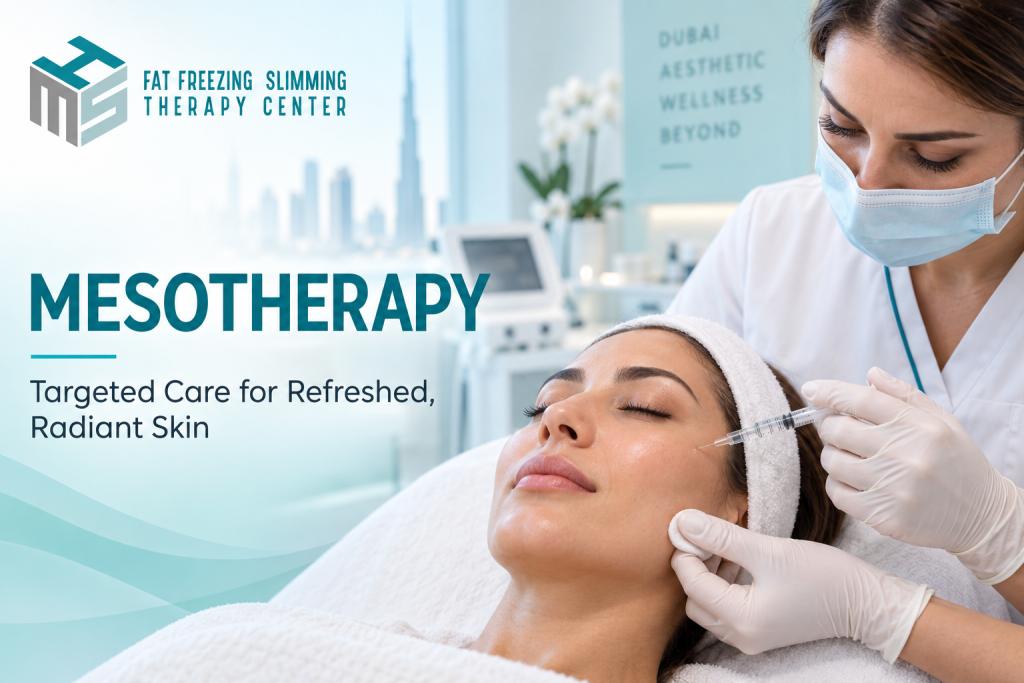
Mesotherapy: Benefits, Procedure, Uses, Results, Safety and Aftercare
People researching injectable skin treatments are often presented with dramatic before-and-after photographs but very little explanation of what was injected, why it was selected or whether the treatment is appropriate for their particular concern. This lack of detail is especially important with Mesotherapy, because it is not one standardised product or a single universal technique.
The term describes a method in which small quantities of a selected formulation are introduced through multiple superficial injections. Depending on the treatment objective, that formulation may contain hyaluronic acid, vitamins, minerals, amino acids or other clinician-selected substances. The ingredients, injection depth, dose and treatment schedule can differ considerably.
For that reason, two treatments advertised under the same name may not be medically or practically equivalent.
A responsible consultation should begin with the condition being treated rather than the popularity of the procedure. Someone concerned about dehydrated skin requires a different assessment from someone experiencing pigmentation, acne scarring or hair loss. The best treatment may involve Mesotherapy, another procedure, a combination plan or no injectable treatment at all.
This guide explains how the procedure works, what it may realistically achieve, where evidence remains limited, what recovery can involve and which questions clients should ask before consenting to treatment.
Medical note: This article provides general educational information and does not replace an examination, diagnosis or personalised advice from a qualified healthcare professional.
What Is Mesotherapy?
Mesotherapy is a minimally invasive technique involving multiple small injections into selected layers of the skin or underlying tissue. The name originates from the concept of delivering substances into the mesoderm, although modern techniques vary in injection depth and clinical purpose.
Dubai Health Authority’s current Standards for Non-Surgical Cosmetic Procedures defines it as a procedure in which multiple tiny injections of pharmaceuticals and/or vitamins are delivered into tissue beneath the skin for purposes that may include skin rejuvenation, hair-loss treatment, cellulite or fat-related concerns.
That broad definition also reveals the treatment’s main complexity: its safety and outcome depend heavily on the product, indication, technique and person administering it.
At HMS Fat Freezing, the dedicated Mesotherapy treatment page describes a customised approach in which the formulation and treatment areas are selected according to the client’s skin condition, medical history and aesthetic goals.
What can a formulation contain?
There is no universal “mesotherapy cocktail.” Depending on the intended use and local regulatory requirements, a formulation might include:
- Non-cross-linked hyaluronic acid
- Selected vitamins or minerals
- Amino acids
- Peptides
- Antioxidant ingredients
- Prescription or regulated substances for a defined indication
- Other approved products suitable for the planned injection route
The complete product name and ingredient list matter. Clients should not accept vague descriptions such as “vitamin cocktail” without knowing exactly what is being administered.
A practitioner should explain the product’s intended use, regulatory status, expected benefit, important risks and available alternatives. A mixture being popular online does not establish that it is suitable, approved or supported by strong clinical evidence.
How Does Mesotherapy Work?
The proposed mechanism depends on what is injected and why.
For a hydration-focused facial treatment, superficial microinjections may distribute a hyaluronic acid-based formulation across selected areas. Hyaluronic acid attracts water, so an appropriate product may support improved hydration and a smoother-looking surface.
For scalp treatment, the intention may be to deliver selected substances near the treatment area. However, results depend on the cause of hair loss, the formulation and the quality of clinical evidence. Hair thinning caused by nutritional deficiency, hormonal illness, autoimmune disease or scarring requires diagnosis rather than a generic injection programme.
The fine needle punctures themselves also produce a limited local response. This should not be confused with conventional microneedling, where controlled mechanical injury across a defined depth is the primary mechanism, or RF microneedling, which additionally delivers thermal radiofrequency energy.
In practical terms, Mesotherapy combines two variables:
- The physical process of multiple small injections
- The pharmacological or cosmetic effect of the injected formulation
A positive outcome cannot automatically be attributed to the injection technique alone. The selected product and the suitability of the patient are equally important.
Common Uses of Mesotherapy
Facial hydration and radiance
One of the most common cosmetic applications is improving the appearance of dull or dehydrated skin. A suitable hydration-oriented formulation may help the skin look fresher, smoother and more luminous.
The procedure is not a substitute for daily sun protection, moisturisation, adequate sleep or medical treatment of an underlying skin disorder. It may be considered an additional treatment for carefully selected clients rather than a replacement for fundamental skin care.
Uneven-looking texture
Some clients consider Mesotherapy for roughness, early fine lines or generally tired-looking skin. Improvements, when achieved, are usually subtle. The treatment should not be marketed as producing surgical lifting or completely removing established wrinkles.
Texture caused by acne scarring may require a different approach. Depending on scar type and skin characteristics, options such as RF microneedling, laser treatment, subcision or chemical reconstruction may be more relevant. Correctly identifying rolling, boxcar and ice-pick scars is more valuable than selecting a treatment based on a social-media trend.
Scalp and hair concerns
Scalp Mesotherapy is promoted for thinning hair and hair quality, but the evidence varies according to the injected substance and diagnosis. A 2023 systematic review indexed by PubMed found potentially positive findings in published studies while also highlighting the need for better-standardised protocols and stronger research.
Hair shedding can have several causes, including androgenetic alopecia, thyroid disease, iron deficiency, recent illness, major stress, certain medicines and inflammatory scalp conditions. A treatment plan should therefore follow appropriate assessment.
Mesotherapy should not delay investigation of sudden, patchy, painful or scarring hair loss. These patterns may require prompt medical evaluation.
Pigmentation and uneven tone
Certain formulations are marketed for pigmentation, but pigmentation is not one diagnosis. Melasma, sun spots, post-inflammatory hyperpigmentation and other colour changes behave differently.
Injecting an unsuitable product or irritating pigment-prone skin can potentially worsen discoloration. In Dubai’s strong year-round ultraviolet exposure, diligent broad-spectrum sunscreen and a realistic maintenance plan are particularly important.
Localised fat and cellulite claims
The term is sometimes used for injection lipolysis or so-called fat-dissolving injections. These applications should not be confused with hydration-focused facial injections.
The US Food and Drug Administration warns that unapproved fat-dissolving injections have been associated with infections, permanent scarring, skin deformities, cysts and painful knots. Its consumer safety information on fat-dissolving injections also explains that regulatory authorisation can be limited to a specific product, treatment area and indication.
Clients should never purchase injectable mixtures online or attempt self-injection. Any body-contouring claim requires separate scrutiny of the exact product, authorised use, provider credentials and available clinical evidence.
Mesotherapy Procedure: What to Expect
1. Consultation and assessment
A professional consultation should cover:
- Your primary concern and desired outcome
- Previous aesthetic procedures
- Medical conditions
- Current medications and supplements
- Allergies and previous reactions
- History of cold sores, keloids or pigmentation
- Pregnancy or breastfeeding status
- Active acne, dermatitis, wounds or infection
- Previous results from injectable treatments
The practitioner should examine the proposed treatment area and determine whether the concern is suitable for Mesotherapy. Standardised photographs may be taken with consent to document the baseline and evaluate change more objectively.
2. Product disclosure and informed consent
Before treatment, you should be told:
- Exact product and manufacturer
- Complete or relevant ingredient information
- Intended purpose
- Injection depth and areas
- Expected number of sessions
- Likely benefits and limitations
- Common and significant risks
- Recovery instructions
- Alternative treatments
- Expected total cost
Dubai Health Authority standards emphasise informed decision-making, appropriate licensing, professional competence, patient education, infection control and treatment within the facility’s permitted scope.
3. Skin preparation
The treatment area is cleansed, and makeup, oil and surface contamination are removed. A topical numbing preparation may be considered when appropriate. If used, it normally needs time to take effect.
The provider should use sterile, single-use needles and follow safe handling procedures. Injection safety is not a cosmetic detail; it is central to preventing infection and other avoidable complications.
4. Microinjections
Small amounts of the formulation are delivered through multiple injections. Depending on the plan, the practitioner may use manual injections or an appropriate delivery device.
Clients commonly describe brief pinching, stinging or pressure. Comfort varies according to the treatment area, needle depth, formulation and personal sensitivity.
5. Immediate aftercare
Small raised bumps, redness, pinpoint marks or mild swelling may be visible immediately afterward. The provider should inspect the skin and explain how to care for it during recovery.
Treatment time varies with the size and number of areas, but the injection stage is often relatively short. The consultation, preparation and post-treatment review should not be rushed simply because the procedure itself is brief.
Mesotherapy Benefits and Realistic Expectations
Potential benefits may include:
- Improved appearance of skin hydration
- Fresher-looking radiance
- Smoother-looking superficial texture
- A customised treatment plan
- Targeted delivery to selected areas
- Relatively limited downtime for many clients
- Gradual, natural-looking improvement
- Ability to complement an appropriate skin programme
These are potential benefits, not guaranteed outcomes. Results depend on the product, treatment indication, technique, baseline condition and individual response.
Mesotherapy generally should not be expected to:
- Replace a facelift
- Remove deep acne scars
- permanently eliminate pigmentation
- Cure every type of hair loss
- Produce major facial volume
- Replace evidence-based treatment of a medical disorder
- Deliver identical results for every client
A useful consultation defines success in observable terms. “Better skin” is vague. “Less visible dehydration lines under consistent lighting” or “improved surface radiance without adding facial volume” creates a more meaningful target.
Mesotherapy Compared with Other Aesthetic Treatments
| Treatment | Main method | Common objective | Typical downtime | Important distinction |
|---|---|---|---|---|
| Mesotherapy | Multiple superficial injections of a selected formulation | Hydration, radiance or another product-specific goal | Usually mild redness, swelling or bruising | Outcome depends greatly on the ingredients |
| Skin booster | Microinjections of a defined injectable product, often hyaluronic acid-based | Hydration and skin quality | Usually mild to moderate | More product-specific than a generic treatment label |
| Microneedling | Controlled mechanical microchannels | Texture and collagen-remodelling support | Redness and sensitivity for several days | Primarily relies on controlled tissue response |
| RF microneedling | Needles plus radiofrequency energy | Texture, scars and skin-remodelling concerns | Variable; often several days | Adds controlled thermal energy |
| PRP facial treatment | Platelet-rich plasma prepared from the client’s blood | Skin-renewal support | Mild swelling, bruising or redness | Uses an autologous blood-derived preparation |
| Chemical peel | Controlled application of a chemical solution | Pigmentation, acne or surface texture | Depends on peel depth | Does not involve multiple injections |
Clients interested in hydration can compare the procedure with a dedicated skin booster treatment. Those looking for an autologous option can learn about PRP face rejuvenation. These procedures are not interchangeable, and suitability must be assessed individually.
Pros and Cons of Mesotherapy
Pros
- Treatment can be tailored to a defined concern.
- Small quantities are delivered to selected areas.
- Many facial protocols involve relatively limited downtime.
- It may improve hydration and radiance when an appropriate formulation is used.
- Gradual change can look natural.
- Treatment plans can be adjusted after evaluating response.
- It may complement an evidence-based skincare routine.
Cons
- There is no single standardised formulation.
- Evidence quality varies between products and indications.
- Multiple injections can cause discomfort.
- Bruising, swelling and visible bumps can occur.
- Several sessions may be recommended.
- Results may be temporary or modest.
- Allergic reactions and infections are possible.
- Product choice and injector competence significantly affect safety.
- It may be unsuitable for certain medical conditions or medications.
The greatest advantage—customisation—is also a potential weakness. Personalisation is valuable only when it is based on assessment, transparent product selection and professional judgment. An unexplained mixture is not meaningful customisation.
Possible Side Effects and Complications
Common short-term reactions may include:
- Redness
- Mild swelling
- Tenderness
- Bruising
- Pinpoint bleeding
- Itching
- Small temporary bumps
- Dryness or sensitivity
Less common but potentially important complications include infection, allergic reaction, persistent nodules, pigment changes, prolonged inflammation, scarring and tissue injury. The risk profile changes according to the formulation and injection depth.
Seek prompt medical advice if you experience increasing pain, spreading redness, significant heat, pus, fever, skin colour changes, blistering, breathing difficulty, facial swelling or any rapidly worsening reaction.
Do not assume every post-treatment symptom is normal simply because injections were expected to cause redness. A reputable clinic should provide clear instructions explaining which reactions can be monitored and which require urgent review.
Who May Not Be a Suitable Candidate?
Suitability must be assessed individually, but treatment may need to be postponed or avoided in people with:
- Active infection, open wounds or inflamed skin
- Known allergy to a proposed ingredient
- Certain bleeding or clotting conditions
- Use of medicines that substantially increase bleeding risk
- Poorly controlled medical conditions
- Some autoimmune or immune-related disorders
- A history of problematic scarring
- Pregnancy or breastfeeding, depending on the product
- Unrealistic expectations
- An undiagnosed skin or hair condition
Never stop prescribed medication to qualify for Mesotherapy without consulting the healthcare professional responsible for that prescription.
Mesotherapy Aftercare
Aftercare instructions should be personalised to the treatment, but common recommendations may include:
- Keep the area clean and avoid unnecessary touching.
- Do not pick, squeeze or massage injection bumps unless instructed.
- Avoid strenuous exercise for the period advised by the provider.
- Temporarily avoid saunas, steam rooms and very hot showers.
- Avoid swimming until the injection sites have settled.
- Pause irritating acids, retinoids or scrubs when advised.
- Use gentle skincare products.
- Apply broad-spectrum sunscreen to exposed areas.
- Avoid applying makeup until permitted.
- Follow instructions for any prescribed or recommended product.
- Contact the clinic if symptoms worsen instead of improve.
Dubai’s heat, intense sunlight and outdoor exposure deserve particular attention. Schedule treatment when you can follow sun-protection instructions and avoid excessive heat during early recovery.
How Many Sessions Are Needed?
There is no responsible universal answer. The number of sessions depends on the formulation, indication, baseline condition and response.
Some plans involve a short initial series followed by reassessment. Others may include maintenance sessions. A clinic should not promise a rigid package before understanding the concern and reviewing relevant medical information.
Response should be evaluated with consistent photographs and defined objectives. If there is no meaningful improvement after a reasonable trial, repeating the same treatment indefinitely may not be appropriate. The diagnosis, product, technique and alternative options should be reconsidered.
When Will Results Become Visible?
Temporary plumping caused by injection-related swelling is not the same as a durable result.
Hydration or radiance changes may become noticeable after the initial redness and swelling settle, but timing varies. Hair-related outcomes generally require longer observation because hair grows in cycles. Texture and pigmentation concerns may also need gradual assessment.
A trustworthy provider will explain what early effects may represent, when genuine improvement can reasonably be assessed and how long the outcome might last.
Expert Recommendations from HMS Fat Freezing
HMS Fat Freezing recommends approaching Mesotherapy as a personalised clinical decision rather than selecting it from a treatment menu without assessment.
Ask what is being injected
Request the exact product name, ingredient information, intended use and expiry details. “Vitamins” or “skin cocktail” is not a sufficiently specific explanation.
Treat the diagnosis, not the trend
Dull skin, melasma, acne scars and hair thinning require different strategies. A popular procedure is not automatically the correct procedure.
Verify professional and facility credentials
DHA standards require professionals to hold an active licence, work within their scope and granted privileges, and provide non-surgical cosmetic care in an appropriately licensed setting. Clients should feel comfortable asking who will administer the treatment and whether that professional is authorised for the procedure.
Avoid unrealistic promises
Be cautious with claims such as permanent pigmentation removal, guaranteed hair regrowth, instant lifting or effortless major fat loss. Ethical treatment planning includes limitations as well as potential benefits.
Plan around recovery
Do not book your first session immediately before a wedding, professional photoshoot or major public event. Bruising and swelling cannot be predicted perfectly, even when technique and aftercare are appropriate.
Protect the skin between sessions
Daily sunscreen, suitable moisturisation and consistent home care can be more influential than adding frequent procedures to an unstable routine. Treatment should support a skin plan, not compensate for the absence of one.
Reassess before continuing
Each session should not happen automatically. The practitioner should evaluate recovery, adverse reactions and visible progress before repeating treatment or modifying the formulation.
Frequently Asked Questions About Mesotherapy
1. Is Mesotherapy good for the face?
It may be considered for selected concerns such as dehydration, dullness or superficial textural changes, depending on the formulation. It is not equally effective for every facial concern. Acne scars, melasma, deep wrinkles and skin laxity may require different or combined approaches.
2. Is Mesotherapy painful?
Most people feel repeated pinching, stinging or pressure. A suitable topical numbing preparation may reduce discomfort, but sensation varies by treatment area, depth and personal pain tolerance. The scalp and areas with thinner skin may feel more sensitive.
3. How long does a Mesotherapy session take?
Timing depends on the area and treatment plan. The injection stage may be relatively brief, but a proper appointment also includes assessment, cleansing, product confirmation, preparation and post-treatment instructions. Safety should not be compromised to shorten the visit.
4. How long is the recovery period?
Many clients return to normal routine relatively quickly, but redness, tenderness, small bumps or bruising may remain for several days. Recovery varies, and visible bruising can sometimes last longer. Follow the instructions provided for your specific formulation.
5. How many Mesotherapy sessions will I need?
The answer depends on the concern, product and response. Some clients are offered an initial series followed by maintenance, while others may not require or benefit from repeated treatment. A schedule should be decided after consultation rather than copied from a standard online package.
6. Can Mesotherapy remove pigmentation permanently?
No responsible provider should guarantee permanent removal. Pigmentation may recur due to sun exposure, hormones, inflammation or an underlying skin tendency. Incorrectly selected or overly irritating treatment may worsen pigment in susceptible skin.
7. Does Mesotherapy regrow hair?
Evidence is still developing and varies by formulation. It may be considered in selected cases, but it is not a universal cure. The cause of hair loss should be assessed first, and established medical options should be discussed when appropriate.
8. Is Mesotherapy the same as a skin booster?
Not exactly. The first term broadly describes a microinjection technique and can involve many formulations. A skin booster usually refers to a defined injectable product designed mainly to improve hydration and skin quality. Always compare the exact products, not only the treatment names.
9. Can I wear makeup after facial Mesotherapy?
You may be advised to avoid makeup for an initial period to reduce irritation and contamination of injection sites. The appropriate timing depends on skin recovery and the products used. Follow the clinic’s specific instructions rather than applying makeup immediately.
10. What should I ask before booking Mesotherapy in Dubai?
Ask for the practitioner’s professional credentials, the facility’s licensing status, the exact injected product, ingredients, intended use, expected outcome, possible complications, alternatives, aftercare plan, total cost and procedure for obtaining help if a reaction occurs.
Conclusion
Mesotherapy is best understood as a delivery technique rather than a single miracle treatment. Its value depends on four things: an accurate assessment, an appropriate formulation, competent administration and realistic expectations.
For selected clients, it may support better-looking hydration, radiance or superficial skin quality with manageable recovery. For other concerns, a skin booster, PRP, RF microneedling, chemical peel, medical hair-loss treatment or a consistent home-care programme may be more appropriate.
The most important question is not simply, “Does Mesotherapy work?” A more useful question is, “Does this exact formulation, administered by this qualified professional, offer a reasonable benefit for my diagnosed concern?”
That question encourages transparent product selection, safer treatment planning and outcomes that can be assessed honestly.
To find out whether Mesotherapy is suitable for your skin or hair concern, schedule a professional consultation with HMS Fat Freezing.
Contact HMS Fat Freezing
Address: Hamsah Building, Office 407 & 408, Block-A, Business Center, beside Ansar Gallery, Dubai, United Arab Emirates
Phone: +971 4 583 2989
Email: info@hmsfatfreezing.com
Website: https://hmsfatfreezing.com/