
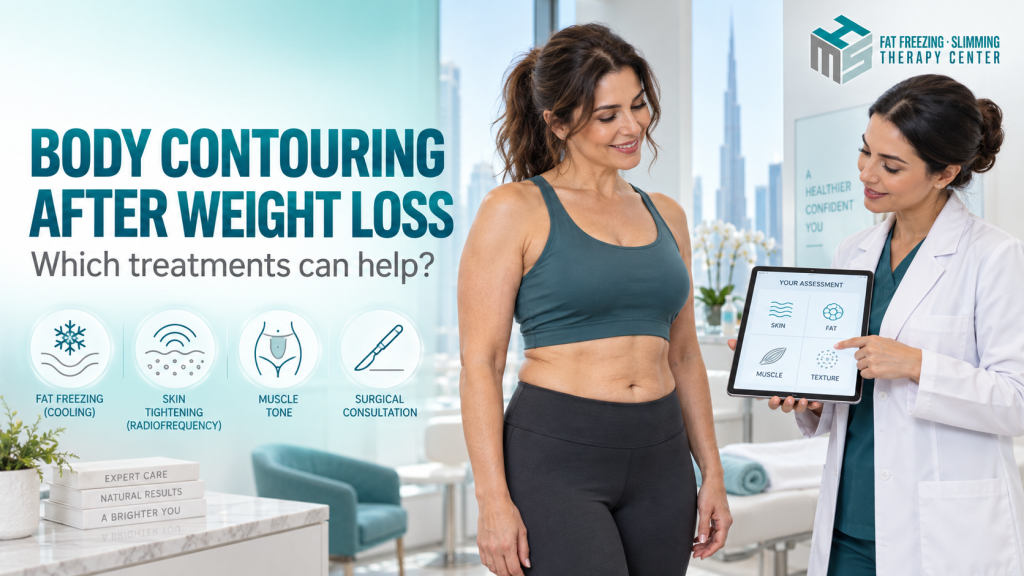
Body Contouring After Weight Loss: Which Treatments Can Help?
Losing a significant amount of weight can improve mobility, health and confidence. Yet the mirror may reveal a result that exercise cannot fully change: loose abdominal skin, folds around the waist, deflated upper arms, stubborn fat pockets or uneven texture. This is where Body Contouring may help—but only when the treatment matches the tissue causing the concern.
That last point is crucial. “Loose skin” is often used to describe four different issues: true excess skin, a remaining layer of subcutaneous fat, reduced muscle definition and cellulite or fluid-related texture. One device cannot correct all four. Successful Body Contouring begins with diagnosis, not a package of sessions.
This guide explains what surgical and non-surgical treatments can realistically do, who may benefit and when to wait.
Medical review note: This educational article does not replace an examination. A qualified healthcare professional should assess your health, weight stability, medications and expectations before treatment.
Why the Body Can Look Different Before Body Contouring
Skin expands during weight gain and may contract after weight loss, but the degree varies. Age, genetics, sun exposure, smoking, pregnancy and the scale and duration of weight change can influence elasticity.
The result may be mild creasing or substantial folds around the abdomen, arms, thighs, chest, back, buttocks or chin. Large folds can trap moisture, complicate hygiene, rub during movement or contribute to rashes. Johns Hopkins Medicine explains that excess tissue can also cause discomfort and interfere with daily activities in its guidance on post-weight-loss surgery.
The four-layer assessment
Before choosing Body Contouring, ask which layer is actually responsible:
- Skin: Is it mildly lax, crepey or hanging in a fold?
- Fat: Is there soft, pinchable fat beneath otherwise serviceable skin?
- Muscle: Is reduced tone or abdominal separation affecting the silhouette?
- Surface texture: Is the concern cellulite, swelling or an irregular contour?
This “skin–fat–muscle–texture” map is more useful than choosing Body Contouring by popularity. A small abdominal fat pocket beneath firm skin may suit non-surgical reduction. A heavy apron of excess skin needs a surgical opinion if removal is the goal. Using the first person’s treatment for the second creates disappointment even when the device performs as intended.
When Should You Consider Body Contouring?
The best timing is usually after weight has stabilised and major weight-loss goals have been reached. Continuing to lose weight after a procedure can create further laxity; regaining weight can stretch tissue and compromise the result. The American Society of Plastic Surgeons lists stable weight, good general health, non-smoking and realistic goals among the characteristics of appropriate Body Contouring candidates.
There is no universal waiting period. Bariatric surgery, GLP-1 medication, nutrition, pregnancy plans, chronic disease and the proposed Body Contouring treatment affect timing. If weight is still changing noticeably, document concerns, optimise nutrition, build strength and arrange medical review rather than rushing.
Seek medical assessment if folds are painful, inflamed, ulcerated or infected. Functional symptoms may change care. Uncontrolled diabetes, bleeding disorders, poor circulation, infection or problematic wound healing also require individual clearance.
Which Body Contouring Treatments Can Help?
1. Cryolipolysis for small, localised fat pockets
Cryolipolysis, commonly called fat freezing, uses controlled cooling to target a selected area of pinchable subcutaneous fat. The body gradually clears affected fat cells over time. It is a contour-refinement procedure—not a method for losing significant weight and not a way to remove hanging skin.
This Body Contouring option may be considered when weight is stable, the concern is a discrete bulge and the skin can follow a smaller contour. Possible areas include the abdomen, flanks, back, thighs, arms or under the chin, depending on the device indication and safe applicator placement.
People exploring this option can review HMS Fat Freezing’s explanation of fat freezing treatment in Dubai. A consultation should still determine whether the visible fullness is fat, loose skin or both.
The US Food and Drug Administration states that non-invasive Body Contouring does not treat obesity or produce the health benefits of weight loss. Its device guidance details contraindications and risks. Redness, bruising, swelling, discomfort or numbness can occur. A rare but serious cryolipolysis complication is paradoxical adipose hyperplasia, in which tissue grows rather than shrinks and may require surgery.
2. Radiofrequency or ultrasound for mild skin laxity
Energy-based Body Contouring uses controlled heat or ultrasound to stimulate tissue responses that may create gradual, modest tightening. It is most relevant when laxity is mild—not when skin hangs in a substantial fold.
The American Academy of Dermatology notes that non-invasive skin-tightening results tend to appear gradually and are generally modest. It also states plainly that people with a large amount of sagging skin may not benefit. Its overview of ways to firm sagging skin is a useful expectation-setting resource.
Ask whether a device targets superficial laxity, deeper tissue, fat or cellulite, because “tightening” is not one mechanism. Settings, operator training, skin type and medical history matter. Heat-based treatments can cause burns, pigment changes, swelling or discomfort.
3. Mechanical or combination treatments for cellulite and texture
Mechanical Body Contouring using vacuum massage, rollers or vibration may temporarily improve cellulite, puffiness or uneven texture. It does not remove a true skin fold and is better suited to surface quality than a large volume of tissue.
HMS Fat Freezing offers Endosphere treatment, which may be discussed when texture and body-shaping goals overlap. A consultation should distinguish temporary visual improvement from permanent tissue removal.
4. Muscle-stimulation treatments for definition
Some Body Contouring devices use electromagnetic energy to cause repeated muscle contractions. They may improve the appearance of muscle firmness, but do not excise skin or replace strength training, fat reduction or surgery.
This may suit a stable-weight person seeking definition beneath mild fat and laxity. A possible hernia or significant muscle separation needs medical evaluation, not device treatment.
5. Liposuction for residual fat—not excess skin
Liposuction-based Body Contouring removes fat through small incisions and can create a larger change than non-surgical reduction. It relies on skin contracting around the new shape; with poor elasticity, removing fat may reveal or worsen laxity.
The UK National Health Service describes liposuction as a procedure for small areas of fat that have not responded to diet and exercise, noting that it works best where skin is firm and elastic. Its liposuction guidance also outlines recovery and risks, including contour irregularity, infection, bleeding and blood clots.
Liposuction belongs in a surgical consultation after major weight loss. A surgeon may use it alone, combine it with skin removal or advise against it when tissue will not retract predictably.
6. Surgical skin removal for significant excess tissue
Surgical Body Contouring remains the only way to remove substantial hanging skin. Procedures may include:
- Abdominoplasty or panniculectomy for the abdomen
- Lower-body lift or belt lipectomy for the abdomen, waist, hips and buttocks
- Brachioplasty for the upper arms
- Thigh lift for the inner or outer thighs
- Breast or chest lift procedures
- Upper-body or back lift for rolls around the torso
These are major procedures involving scars, anaesthesia, recovery and risks such as infection, wound-healing problems, fluid collections, bleeding, altered sensation and blood clots. Some people need staged operations. Planning depends on health, tissue distribution, priorities and safe operating time.
Non-surgical options are limited when the fundamental problem is excess skin. Consult an appropriately licensed, qualified plastic surgeon who regularly performs post-weight-loss Body Contouring and operates in an accredited facility.
Body Contouring Treatment Comparison
| Treatment | Best suited to | Loose-skin effect | Downtime | Main limitation |
|---|---|---|---|---|
| Cryolipolysis | Small, pinchable fat pockets | Little or none | Usually minimal | Does not cause weight loss or remove skin |
| Radiofrequency or ultrasound | Mild laxity and selected contour concerns | Modest, gradual tightening | Usually low; varies by device | Cannot correct substantial hanging tissue |
| Mechanical massage or vibration | Cellulite, puffiness and surface texture | Temporary visual improvement | Minimal | Results may be temporary and require maintenance |
| Muscle stimulation | Selected muscle-tone goals | None | Usually minimal | Does not remove fat or skin |
| Liposuction | Residual fat with reasonable skin elasticity | None; may expose laxity | Days to weeks | Surgical risks and variable skin retraction |
| Surgical lift or skin excision | Moderate to severe excess skin | Removes excess tissue | Several weeks or longer | Scars, anaesthesia and greater recovery |
The table is a starting point, not a prescription. Needs can differ by area: the abdomen may require surgery while a small flank pocket may suit non-surgical Body Contouring later.
A Practical Treatment-Selection Framework
Step 1: Name the problem without naming a device
Instead of saying, “I want fat freezing,” say, “I have a soft lower-abdominal bulge,” or, “The skin on my arms hangs when they are raised.” This prevents the consultation from becoming a sales confirmation for a treatment selected before examination.
Step 2: Grade the change by function and severity
Ask whether the concern is visible only in certain positions, present at rest, or causing rubbing, hygiene problems or restricted movement. Mild cosmetic laxity and function-limiting folds belong on different pathways.
Step 3: Decide how much recovery is acceptable
Non-surgical Body Contouring generally offers less downtime but subtler results. Surgery can create a more substantial change but requires scars and recovery. Neither is automatically “better”; suitability depends on the problem and the person’s priorities.
Step 4: Define success before treatment
Agree on an observable goal: a smoother clothing fit, a smaller measured bulge, less thigh rubbing or removal of an abdominal fold. Avoid promises such as “perfectly tight skin.” Standardised photographs, the same posture and consistent lighting provide a more honest record than day-to-day mirror checks.
Three Practical Examples
Example 1: Stable weight with a small flank bulge
A client has maintained weight for eight months but retains a flank pocket beneath reasonably firm skin. Cryolipolysis may be discussed, with the clear expectation that Body Contouring may reduce the bulge but will not substantially lower body weight.
Example 2: Lower-abdominal fold after major weight loss
Another person has lower-abdominal tissue that overlaps and becomes irritated in hot weather. Fat reduction could leave it emptier without removing the fold. Medical assessment and a plastic-surgery consultation are more appropriate than repeated device sessions.
Example 3: Mild thigh laxity with cellulite
A third person has stable weight, mild laxity and uneven thigh texture but no heavy folds. Strength training, energy-based tightening and a mechanical treatment may be considered. The realistic goal is gradual refinement, not surgical-level tightening.
These examples illustrate why the same weight-loss number does not determine the same Body Contouring plan.
Pros and Cons of Body Contouring After Weight Loss
Potential advantages
- Can refine proportions after weight has stabilised
- May address stubborn fat that does not respond predictably to lifestyle changes
- Surgical removal may reduce rubbing, hygiene difficulty and discomfort from large folds
- Treatment can focus on one area or be planned in stages
- Non-surgical options often allow a faster return to routine
- A well-chosen plan may improve clothing fit and confidence
Potential disadvantages
- Non-surgical results are usually modest and may require multiple sessions
- No procedure guarantees symmetry or a specific aesthetic outcome
- Surgical treatment creates permanent scars and requires meaningful recovery
- Costs can rise when several areas or maintenance sessions are involved
- Temporary side effects can occur, while uncommon complications may be serious
- Further weight change, pregnancy and ageing can alter the result
- Treating fat when the real problem is skin can produce disappointing value
Expert Recommendations From HMS Fat Freezing
HMS Fat Freezing recommends approaching Body Contouring after weight loss as a staged decision rather than booking several technologies at once.
1. Confirm that weight is stable
Stable measurements make Body Contouring planning and progress photography more meaningful. If weight is changing, prioritise weight management and medical follow-up.
2. Separate fat from loose skin
The pinch test is not a diagnosis. Soft fullness may include fat; thin, folding tissue may be predominantly skin. Professional assessment should confirm the target.
3. Treat the highest-impact area first
Choose the area that most affects comfort, clothing or proportion. Reassess after results develop before adding another procedure. This helps prevent unnecessary treatment stacking.
4. Match expectations to the treatment category
Non-surgical Body Contouring is designed for refinement. Surgery is the category that removes substantial excess skin. Honest expectations are part of safe treatment planning, not a lack of ambition.
5. Review health history and contraindications
Disclose medications, supplements, pregnancy or breastfeeding status, implants, scars, hernias, circulation problems, cold sensitivity, skin disease and previous procedures. A seemingly minor detail can change whether a device is suitable.
6. Use lifestyle habits to protect the result
Adequate protein and nutrition, hydration, resistance training, sleep, sun protection and weight stability support appearance and recovery. They do not remove loose skin, but they help preserve the result of an appropriate treatment.
Clients comparing non-surgical choices can explore HMS Fat Freezing’s body-sculpting treatment and broader slimming-treatment options before arranging an individual assessment.
Safety Questions to Ask at a Consultation
Bring a short written list. Useful questions include:
- What tissue is creating my concern: skin, fat, muscle or texture?
- What exact device or procedure do you recommend, and why?
- Is the device authorised for this intended use and body area?
- Who will perform the treatment, and what are their qualifications?
- What result is realistic for a person with my degree of laxity?
- How many sessions are proposed, and when should results be assessed?
- What are the common, uncommon and urgent complications?
- What happens if I do not respond or develop an adverse effect?
- Is surgery more appropriate for the result I want?
- What is the complete expected cost, including maintenance or follow-up?
Be cautious if a consultation guarantees centimetres lost, avoids discussing risks, treats a large skin fold as “fat,” or pressures you to purchase a package immediately. Good Body Contouring advice sometimes concludes that no treatment—or a different specialist—is the right next step.
Frequently Asked Questions
1. Does loose skin go away naturally after weight loss?
Some skin contraction may occur gradually, particularly after modest weight loss and in younger skin with good elasticity. Significant folds are less likely to disappear completely. Give the body time to stabilise, support general health and obtain an examination before assuming a device can remove excess tissue.
2. Can Body Contouring remove loose skin without surgery?
Non-surgical treatments may create modest tightening when laxity is mild. They cannot cut away a large amount of hanging skin. If the desired result requires tissue removal, consult a qualified plastic surgeon about surgical options and their risks.
3. Is fat freezing suitable after major weight loss?
It may suit a stable-weight adult with a small, pinchable fat pocket and acceptable skin elasticity. It is not intended for obesity, significant weight reduction or removal of a skin fold. Cold-sensitivity disorders, poor circulation and certain local conditions may make it unsuitable.
4. What is the best Body Contouring treatment for the stomach?
It depends on anatomy. A small fat pocket may suit non-surgical reduction; mild laxity may suit an energy-based treatment; poor muscle definition needs a different plan; and a large abdominal apron may require surgical removal. Hernias and muscle separation require medical evaluation.
5. How long should I wait after losing weight?
There is no single timeline for everyone. Weight should generally be stable, nutrition adequate and health conditions controlled. People who had bariatric surgery or use weight-loss medication should discuss timing with their treating clinician and the professional performing the proposed procedure.
6. Will Body Contouring help me lose more weight?
No. Body Contouring changes the shape or appearance of selected areas. Non-invasive devices are not obesity treatments, and even surgical contouring is not a substitute for a medically appropriate weight-management plan.
7. Can exercise tighten loose skin after weight loss?
Resistance training can build muscle beneath the skin and improve overall shape, but it cannot remove excess skin. Exercise remains valuable for strength, function, weight maintenance and long-term health even when a procedure is being considered.
8. Are Body Contouring results permanent?
Removed skin does not grow back in the same way, and destroyed or removed fat cells do not simply regenerate; however, remaining fat cells can enlarge, and ageing, pregnancy or weight changes can alter the contour. Some non-surgical texture improvements are temporary and need maintenance.
9. Can several areas be treated at the same time?
Sometimes, but more is not always safer or better. Non-surgical session limits depend on the device and health assessment. Surgical combinations depend on anaesthesia time, blood-loss risk, mobility and recovery. Staging can make recovery safer and outcomes easier to evaluate.
10. How do I choose a Body Contouring clinic in Dubai?
Look for transparent consultations, qualified professionals, appropriate device use, documented contraindication screening, realistic before-and-after examples and clear aftercare. Ask who manages complications and whether a surgical referral will be made when non-surgical treatment cannot meet the goal.
Conclusion: Choose the Treatment That Matches the Tissue
Weight loss changes scale numbers; post-weight-loss contouring addresses what remains. The smartest plan does not begin with a machine. It begins by identifying whether the issue is skin, fat, muscle, texture or a combination—and by deciding how much change and recovery are acceptable.
Non-surgical Body Contouring can be valuable for a modest, well-defined concern. It can reduce a small fat bulge, support mild tightening or improve texture with limited downtime. It should not be sold as a substitute for surgical skin removal. When folds are substantial or functional symptoms are present, an appropriately qualified medical or surgical opinion is the more honest route.
The best outcome is not the most dramatic promise. It is a proportionate plan, a properly screened patient, a qualified provider and a result that was defined realistically before treatment began.
Contact HMS Fat Freezing
Address: HAMSAH BUILDING, OFFICE 407 & 408, BLOCK-A, Business Center, Beside ANSAR GALLERY, Dubai
Phone: +971 4 583 2989
Email: info@hmsfatfreezing.com
Website: https://hmsfatfreezing.com/