
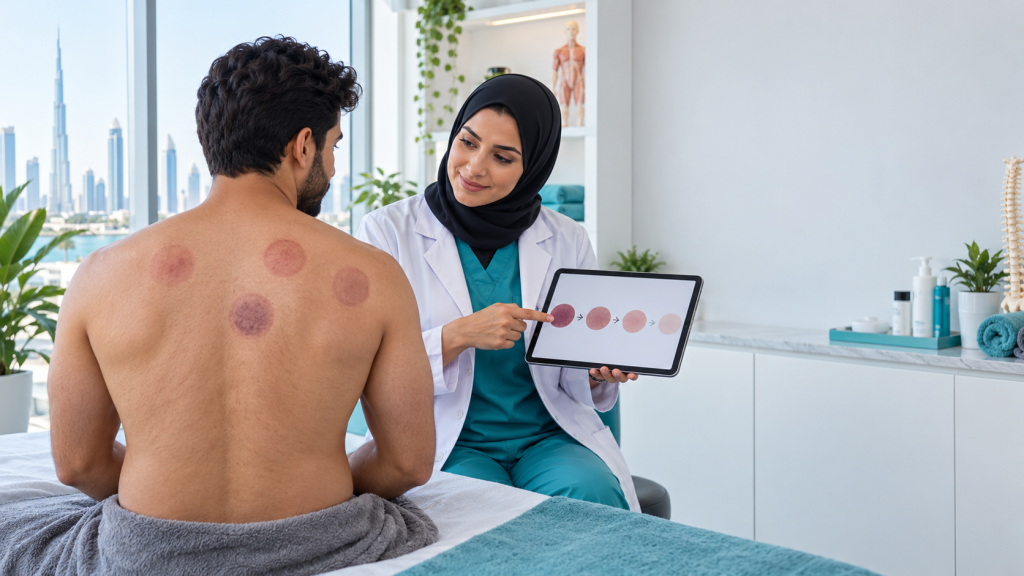
Hijama Marks: Why They Appear and How Long They Last
The first look after a cupping session can be surprising. Circles may appear pink, red, purple or maroon even when the area is not very painful. First-time clients naturally ask whether they are normal, why the shades differ and when they will disappear.
Hijama marks are primarily a visible response to suction on the skin and its tiny superficial blood vessels. In wet cupping, small surface openings may also leave fine dots or short, shallow lines while the skin closes. Most circular discoloration gradually fades, commonly within several days to two weeks, but the exact timeline varies.
This guide explains the mechanism without “detox” claims, what affects colour and duration, and which warning signs deserve attention.
Medical note: This article provides general education, not a diagnosis or personalised medical advice. Cupping should not replace evaluation or treatment for persistent pain, unexplained symptoms or a medical condition. Seek advice from a qualified healthcare professional when your health history or recovery raises concern.
What Are Hijama Marks?
Hijama is commonly used to describe wet cupping. A practitioner creates negative pressure inside cups placed on selected areas. In a wet session, the cups may be removed after initial suction, tiny superficial skin openings are made with sterile single-use instruments, and cups are briefly reapplied.
The round areas come mainly from suction. Negative pressure lifts skin and stresses superficial capillaries. Some tiny vessels may release blood into surrounding tissue, producing a bruise-like circle. Cleveland Clinic says the marks usually fade within one or two weeks and do not represent the deeper muscle-fibre injury of a traumatic contusion. Read its medically reviewed overview of cupping therapy.
Wet cupping can also leave pinpoint spots or tiny superficial scabs. Openings should be shallow; deep cuts and heavy bleeding are not the goal.
Why Do Hijama Marks Appear?
Suction changes the superficial tissues
The local vacuum lifts superficial tissue, shifts fluid and stresses capillaries. Redness or discoloration may remain after removal, while the cup creates the circular shape.
Cup pressure and time matter
Stronger or longer suction generally creates more visible marks, but darker is not better. A controlled Hijama session uses pressure appropriate for the person and body area. Chasing dramatic circles can increase tenderness without proving benefit.
Different body areas respond differently
Skin thickness and local tissue vary. Cups may also seal more strongly at one site, so circles from the same appointment can differ in shade.
Individual biology changes the response
Age, skin tone, capillary fragility, medicines, health conditions and a tendency to bruise influence appearance. Never stop prescribed medication for Hijama; discuss suitability with the prescriber and disclose medicines and supplements.
What Do Different Hijama Mark Colours Mean?
Colour is best understood as a description of the skin response—not a diagnostic chart. A practitioner may record how the tissue responded, but the shade cannot reliably identify a diseased organ, measure “toxins” or prove that a treatment worked.
Pink or light red
A light circle may fade within days. It does not mean the session failed; it may reflect lighter suction, shorter cup time or that area’s response.
Bright or medium red
Red marks are common after cup removal. Mild warmth, tightness or tenderness can occur, but colour and discomfort should lessen rather than spread.
Purple or dark maroon
Darker circles can reflect stronger suction or more visible capillary leakage and may take closer to two weeks to clear. Darkness does not prove “more toxins,” illness or superior treatment.
Yellow, green or brown while fading
As blood pigments clear, discoloration can change shade. Mayo Clinic’s bruise guidance describes similar colour changes in ordinary bruises. Lighter brown or yellow can indicate resolution if pain, heat and swelling are not worsening.
Small dots or superficial lines
Fine spots inside a circle may come from the controlled skin openings used in wet cupping. These are not the same as the broader suction mark. They require clean aftercare because the skin barrier has been opened.
How Long Do Hijama Marks Last?
For many people, Hijama circles become noticeably lighter within three to seven days and are largely gone within one to two weeks. That is a practical range, not a promise. Very light marks may fade sooner; darker marks can remain visible for around 10–14 days. Individual skin and treatment technique can move the timeline in either direction.
| Mark or skin response | Common appearance | Approximate fading pattern | Practical note |
|---|---|---|---|
| Light suction mark | Pink or pale red | Often 2–5 days | May disappear unevenly from the edge inward |
| Moderate mark | Red to purple | Often 5–10 days | Mild tenderness should steadily improve |
| Dark mark | Deep purple or maroon | May take 7–14 days | Darkness does not measure toxins or benefit |
| Wet-cupping points | Tiny dots or shallow lines | Surface closure may occur before colour fully fades | Keep clean and do not pick |
| Concerning reaction | Expanding redness, marked swelling, discharge or increasing pain | Not a normal “wait it out” pattern | Contact a healthcare professional promptly |
Direction matters more than the date. A visible mark improving on day eight is different from a site becoming hotter, swollen and more painful on day three.
What Can Make Hijama Marks Last Longer?
Several factors can extend the visible recovery period:
- Strong suction or cups left in place longer.
- Repeated cupping over an area that had not fully recovered.
- Naturally fragile capillaries or easy bruising.
- Older or thinner skin.
- Medicines or supplements that affect bleeding or platelet function.
- A body area exposed to pressure or friction from tight clothing, bags or exercise equipment.
- Scratching, aggressive exfoliation or picking at wet-cupping points.
- An underlying problem with clotting or healing.
The U.S. National Center for Complementary and Integrative Health lists persistent discoloration, scars, burns and infection as possible adverse effects. It also notes rare anaemia after repeated wet cupping—reasons to favour controlled technique and appropriate intervals.
Normal Recovery or a Warning Sign?
Usually expected after Hijama
Expected short-term effects include circular discoloration, mild tightness, tenderness and superficial wet-cupping points. Brief tiredness or light-headedness may occur. Symptoms should improve, not intensify.
Contact a healthcare professional if you notice
- Redness that expands beyond the treated circle.
- Increasing warmth, swelling or throbbing pain.
- Yellow or foul-smelling discharge.
- Fever, chills or feeling significantly unwell.
- Persistent bleeding from a wet-cupping site.
- Blistering, a burn or severe skin injury.
- Numbness, severe pain or loss of movement.
- Marks that are worsening or not showing improvement after about two weeks.
Urgent care may be needed for severe bleeding, collapse, breathing difficulty or another serious symptom. Do not label every unexpected reaction a “healing crisis.” That phrase can delay appropriate care.
Hijama Marks vs Ordinary Bruises vs Suction Irritation
| Feature | Hijama or cupping mark | Ordinary impact bruise | Skin irritation or possible infection |
|---|---|---|---|
| Typical cause | Controlled suction; superficial openings in wet cupping | A bump, fall or compression injury | Friction, product reaction, excessive technique or microbes entering damaged skin |
| Shape | Often a regular circle | Usually irregular | May follow contact areas or spread beyond them |
| Sensation | Tightness or mild tenderness | Tenderness; sometimes deeper soreness | Itching, burning, increasing heat or worsening pain |
| Colour pattern | Pink, red, purple, then gradual fading | Red/blue/purple with changing shades | Redness may spread; discharge or swelling can appear |
| Expected course | Commonly improves over days and fades within one to two weeks | Often resolves over roughly two weeks, depending on severity | May worsen without appropriate assessment or treatment |
| Key action | Follow aftercare and monitor improvement | Basic bruise care if minor; seek help for severe/unexplained bruising | Seek professional advice, especially after wet cupping |
This comparison is useful, but a photo cannot always identify the cause. If a mark looks unusual or the symptoms do not match a routine recovery, an in-person clinical assessment is more reliable than online colour charts.
Hijama Aftercare That Supports Skin Recovery
Keep wet-cupping sites clean
Follow written instructions, wash hands before touching the area and avoid unnecessary handling. Even tiny openings interrupt the skin barrier.
Avoid picking and harsh skincare
Do not scratch, peel scabs or scrub circles. Avoid fragrance, strong acids, retinoids and exfoliation until the skin settles. Trying to erase a Hijama mark can prolong irritation.
Reduce friction and heat
Choose loose, clean clothing. Follow guidance about exercise, swimming, steam, saunas and hot showers; advice varies with technique and number of sites.
Hydrate normally and rest if needed
Normal hydration and sleep support recovery, but extra water will not wash marks away. Sit safely if light-headed; persistent dizziness or fainting needs attention.
Do not improvise with medicines or creams
Do not stop prescribed medicines or apply antibiotic, steroid or “detox” creams without appropriate professional advice.
People considering treatment can review the clinic’s Hijama cupping therapy service and its step-by-step session guide before booking. Understanding consultation, cup placement, hygiene and aftercare makes it easier to judge a service on process rather than dramatic photographs.
Pros and Cons of Visible Hijama Marks
Marks are not a medical benefit, but their visibility has practical advantages and disadvantages.
Pros
- Predictable sign of suction exposure: A circular response shows where cups were placed and helps the practitioner document skin reaction.
- Useful recovery feedback: Comparing colour and tenderness over several days can confirm that the area is steadily settling.
- Usually temporary: Most marks fade without treatment when technique is appropriate and recovery is uncomplicated.
- Can guide future sessions: A practitioner may adjust pressure, duration or site selection if a client marks heavily or remains tender.
Cons
- Cosmetic visibility: Circles may be noticeable with open-back clothing, swimwear, sports uniforms or formal outfits.
- Variable duration: It is impossible to guarantee that marks will be gone before a specific event.
- Possible discomfort: Mild soreness, tightness or sensitivity can interfere with exercise or sleep position for a short time.
- Risk of misinterpretation: Other people—or even clinicians unaware of recent cupping—may mistake the circles for trauma.
- Complications are possible: Persistent discoloration, burns, scarring and infection are recognised risks, especially with poor technique or inadequate hygiene.
Before a wedding, holiday, athletic event or examination, allow for a possible two-week visibility window. One test site cannot predict every circle.
Who Should Be Especially Cautious?
Wet Hijama is not suitable for everyone. Screening should cover bleeding disorders, anaemia, clotting medicines, skin disease, infection, pregnancy, fainting, impaired healing and chronic conditions. Cleveland Clinic lists several of these as reasons for caution or avoidance.
Wet cupping involves blood. The CDC’s Standard Precautions emphasise hand hygiene, protective equipment, sharps safety and equipment processing. Ask whether skin-opening instruments are sterile and single-use, how cups and surfaces are processed and how contaminated waste is discarded.
Expert Recommendations from HMS Fat Freezing
The following recommendations reflect HMS Fat Freezing’s published emphasis on consultation, personalised cup placement, controlled treatment, sterile single-use materials and aftercare guidance.
1. Plan around the mark, not an exact disappearance date
Allow up to two weeks before an event where circles would concern you. Even if your previous marks faded in four days, a different body area or suction level may behave differently.
2. Ask for a suitability review before the session
Disclose medication, allergies, pregnancy, skin problems, bleeding history, low blood count, recent procedures and previous reactions. A short health conversation can prevent a much longer recovery problem.
3. Choose controlled technique over dramatic colour
The objective should never be the darkest possible circles or the largest amount of blood. Good practice is measured by screening, hygiene, comfort monitoring, appropriate pressure and clear follow-up advice.
4. Photograph only for useful monitoring
If you want to track a Hijama mark, take one photo each day in similar lighting and at the same distance. Constantly checking under different lights can make normal colour variation look like deterioration. The meaningful questions are whether the area is spreading, heating, swelling or becoming more painful.
5. Protect the skin barrier after wet cupping
Keep the area clean, avoid picking and follow the practitioner’s timing for showering, exercise, swimming and heat exposure. Contact the clinic if aftercare instructions are unclear rather than copying a social-media routine.
6. Escalate abnormal symptoms early
Increasing pain, spreading redness, discharge, fever, persistent bleeding or a burn is not evidence that the treatment is “working.” Seek medical advice. HMS Fat Freezing’s broader Hijama guide for Dubai clients also discusses procedure, safety and realistic expectations.
Frequently Asked Questions About Hijama Marks
1. Are Hijama marks normal?
Yes, round pink, red or purple areas are a common result of suction. Wet cupping may also leave tiny superficial points within the circles. Expected marks should gradually lighten and become less tender. Spreading redness, increasing heat, discharge, severe pain or fever is not a routine pattern.
2. How many days do Hijama marks take to disappear?
Many fade noticeably within three to seven days and resolve within one to two weeks. Light circles may clear sooner, while dark marks can last closer to 10–14 days. Technique, skin, body area, medication and individual healing all matter, so no ethical practitioner can guarantee an exact date.
3. Why are my Hijama marks very dark?
Darkness can reflect stronger suction, longer cup time, more visible superficial capillary leakage or the way a particular area responds. It does not prove that you had more toxins or that the session delivered greater benefit. Monitor whether the mark steadily lightens and whether tenderness improves.
4. Do dark Hijama marks mean poor circulation?
Not reliably. Colour alone cannot diagnose poor circulation, organ dysfunction or another disease. If you have cold limbs, swelling, non-healing wounds, numbness, skin colour changes unrelated to cupping or other circulation concerns, seek medical assessment rather than interpreting cup circles.
5. Can I make Hijama marks fade faster?
There is no instant, proven eraser. Protect the area from friction, avoid picking or harsh products and follow aftercare. Normal sleep and hydration support general recovery. Do not use heat, aggressive massage, bleaching products or medication simply to change the colour without professional advice.
6. Can I shower after Hijama?
Follow the instructions provided for your specific session, especially after wet cupping. The skin has been opened superficially, so very hot water, hard scrubbing and fragranced products may irritate it. Ask the practitioner when normal showering, swimming and sauna use can resume.
7. Are Hijama marks painful?
Mild tightness, sensitivity or bruise-like tenderness can occur, but severe or escalating pain is not the target. Pain that worsens, limits movement, comes with marked swelling or accompanies fever should be assessed rather than managed as ordinary aftercare.
8. Can Hijama marks become permanent?
Most fade completely. Persistent discoloration or scarring is possible but is not the expected outcome. Risk may rise with burns, excessive suction, deep skin injury, infection, picking or a tendency to form abnormal scars. Seek dermatological or medical advice if a site is not improving.
9. Is it safe to repeat Hijama before the marks disappear?
Repeatedly treating skin that has not recovered may increase irritation, bruising and cumulative blood loss. There is no universal schedule appropriate for everyone. Let the practitioner assess the skin and your overall health; more frequent treatment is not automatically more effective.
10. When should I worry about marks after Hijama?
Get advice if the site becomes increasingly red, hot, swollen or painful; develops pus or an unpleasant smell; continues bleeding; blisters; or is accompanied by fever or feeling unwell. Also seek assessment if marks worsen or fail to show improvement after about two weeks, particularly if you bruise easily elsewhere.
Conclusion: Read the Recovery, Not Just the Colour
Hijama marks are best viewed as temporary evidence of local suction, not a scorecard for toxicity or treatment quality. Their shape comes from the cup; their shade reflects a mix of pressure, duration, body area and individual response. Most become lighter over several days and fade within one to two weeks.
The most useful observation is not whether a circle is red or purple on day one. It is whether the skin is moving calmly toward normal: colour shrinking, tenderness easing and superficial points closing without spreading redness or discharge. That recovery pattern tells you more than any online colour legend.
A responsible session begins with screening, uses controlled technique and blood-exposure precautions, and ends with clear aftercare. If the response moves in the wrong direction, timely professional advice matters more than waiting for a supposed “detox reaction” to pass.
For consultation, suitability screening or aftercare questions, contact HMS Fat Freezing.
Contact HMS Fat Freezing
HMS Fat Freezing
HAMSAH BUILDING, OFFICE 407 & 408, BLOCK-A, Business Center – beside ANSAR GALLERY – Dubai
Phone: +971 4 583 2989
Email: info@hmsfatfreezing.com
Website: https://hmsfatfreezing.com/