
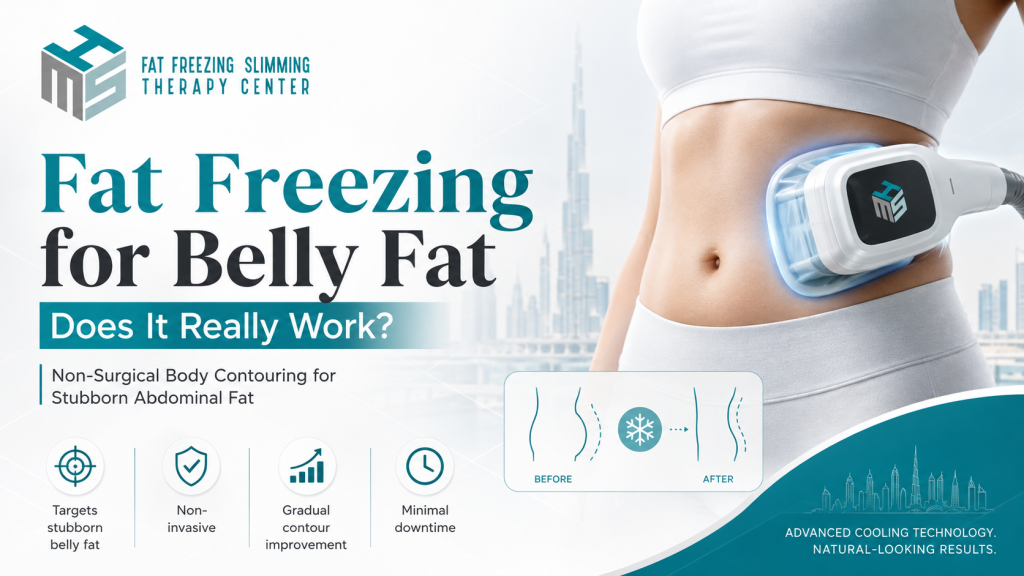
Fat Freezing for Belly Fat: Does It Really Work?
Belly fat is one of the most common reasons people start researching Fat Freezing. Someone may exercise regularly, eat reasonably well and maintain a stable weight yet still notice a lower-abdominal bulge that refuses to change.
That situation often raises a very specific question:
Can Fat Freezing actually reduce belly fat, or is it simply another cosmetic treatment with exaggerated promises?
The accurate answer is more nuanced than a simple yes or no.
Fat Freezing, medically known as cryolipolysis, can reduce selected pockets of subcutaneous abdominal fat in suitable candidates. It is not a treatment for obesity, it does not remove visceral fat surrounding the internal organs, and it should not be marketed as an alternative to meaningful weight loss.
The U.S. Food and Drug Administration describes cryolipolysis as a non-invasive body-contouring technology that uses controlled cold to damage fat cells in selected areas so that visible fat bulges can gradually decrease.
That distinction matters enormously when discussing belly fat.
At HMS Fat Freezing in Dubai, abdominal treatment planning should begin by identifying what type of belly concern a person actually has rather than immediately recommending an applicator.
This guide explains who may benefit, how treatment works, what it cannot do, how many sessions may be needed and what people in Dubai should realistically expect.
What Exactly Is Fat Freezing?
Fat Freezing is a non-surgical body-contouring procedure based on controlled cooling.
During cryolipolysis, an applicator is placed over a suitable pocket of subcutaneous fat. Depending on the device, the tissue may be gently drawn into the applicator and exposed to controlled cold for a defined period.
Fat cells are more vulnerable to controlled cold exposure than many surrounding tissues. The goal is to damage selected fat cells while avoiding surgical removal.
The FDA explains that after cooling damages the fat cells, the body’s immune system gradually clears the affected cells, meaning the contour change develops over time rather than immediately.
This is why a person does not normally walk out of a session with a dramatically flatter stomach.
The biological process is gradual.
Does Fat Freezing Really Work for Belly Fat?
Yes—when the belly fat is the right type and expectations are realistic.
That qualification is important.
Abdominal fat is not all the same.
Subcutaneous Belly Fat
Subcutaneous fat sits between the skin and abdominal muscles.
It is the soft, pinchable layer you can usually grasp with your fingers.
This is the type that Fat Freezing is designed to target.
For example, imagine someone whose body weight has remained stable for a year but who still has a small roll below the navel.
That person may be a more appropriate candidate for cryolipolysis than someone whose abdomen projects outward primarily because of deep visceral fat.
Visceral Belly Fat
Visceral fat sits deeper inside the abdomen around internal organs.
You cannot simply pinch it between your fingers.
Fat Freezing does not target this deeper visceral fat.
Visceral adiposity is a broader health issue associated with metabolic and cardiovascular risk and is better addressed through appropriate medical, nutritional and lifestyle strategies.
This difference is one of the most important things to understand before considering abdominal body contouring.
Fat Freezing vs Different Types of Belly Concerns
| Belly Concern | Will Fat Freezing Help? | Better Approach |
|---|---|---|
| Small pinchable lower-belly pocket | Often suitable | Fat Freezing may help |
| Upper abdominal subcutaneous fat | May be suitable | Assessment needed |
| Love handles/flanks | Common treatment area | Fat Freezing may help |
| Deep visceral abdominal fat | No | Medical weight management |
| Significant obesity | Not primary treatment | Structured weight-loss care |
| Loose abdominal skin | Does not directly tighten significantly | Skin-tightening assessment |
| Abdominal muscle separation | No | Medical/physiotherapy assessment |
| Large excess skin after weight loss | Limited benefit | Surgical consultation may be appropriate |
This table demonstrates why simply asking “Does Fat Freezing work on the stomach?” is not enough.
The correct question is:
What is causing the abdominal shape I want to change?
Who Is a Good Candidate for Belly Fat Freezing?
A suitable candidate is generally someone who has a localized, pinchable fat pocket rather than a need for major weight reduction.
HMS Fat Freezing’s own published guidance similarly notes that cryolipolysis is more appropriate for localized stubborn fat and should not be confused with a significant weight-loss programme.
A stronger candidate may:
- Have reasonably stable body weight
- Have localized abdominal fat
- Be close to a comfortable or target weight
- Want non-surgical contour improvement
- Understand that results develop gradually
- Have realistic expectations
- Be willing to maintain healthy habits afterward
A weaker candidate is someone approaching the treatment expecting to lose 10 or 15 kilograms.
That is not what Fat Freezing is designed to achieve.
A Practical Example: Two People With the Same Waist Size
Consider two clients with a similar waist circumference.
Client A
Client A exercises four times per week, has maintained a stable body weight and has a soft lower-abdominal pocket that can clearly be pinched.
Their concern is primarily local contour.
They may potentially respond well to abdominal Fat Freezing.
Client B
Client B has recently gained 15 kg, has a firm protruding abdomen and wants substantial overall weight reduction.
Even though both people may say, “I want to lose belly fat,” their treatment needs are completely different.
Client B should first address overall weight and metabolic health rather than expecting localized cryolipolysis to solve the problem.
This kind of distinction is more useful than choosing treatment based solely on a before-and-after image.
What Happens During Fat Freezing for the Abdomen?
Step 1: Consultation
A professional consultation should examine:
- The amount of pinchable fat
- Distribution of abdominal fat
- Skin condition
- Previous procedures
- Relevant medical history
- Desired contour
- Whether the expectation is realistic
The practitioner should also determine whether cooling-based treatment is appropriate for the individual.
Step 2: Treatment Mapping
Abdominal fat is rarely perfectly symmetrical.
A good treatment plan may therefore divide the abdomen into separate zones.
For example, someone may have:
- More fullness below the navel
- Mild upper-abdominal fullness
- Stronger fat deposits at the flanks
Treating all of these identically may not produce the most balanced contour.
Step 3: Applicator Placement
The applicator is positioned over the selected fat pocket.
Depending on equipment, clients may feel pulling, pressure and intense cold during the initial stage.
HMS describes temporary cooling, pulling and numbness among sensations that can occur during treatment.
Step 4: Gradual Fat-Cell Clearance
The treated fat cells are not immediately suctioned out as they would be during liposuction.
Instead, the body gradually processes the affected cells over subsequent weeks and months.
That delayed process is why patience matters.
How Long Until You See Belly Fat Freezing Results?
Do not judge a treatment one week later.
The FDA notes that the immune system gradually clears damaged fat cells after cryolipolysis rather than producing an instant result.
Early visible changes may begin after several weeks, while further contour improvement can continue over subsequent months.
HMS also describes Fat Freezing results as gradual rather than immediate.
A practical evaluation might therefore look like:
Week 1: little meaningful visual change expected
Weeks 3–6: some clients may begin noticing contour changes
Weeks 8–12: more useful time to evaluate progress
Later assessment: decide whether additional treatment is appropriate
Individual timing varies.
How Much Belly Fat Can Fat Freezing Remove?
This is where marketing language can become misleading.
There is no responsible universal statement such as:
“Fat Freezing removes exactly 25% of your belly fat.”
Clinical studies have demonstrated measurable reductions in treated subcutaneous fat, but the result relates to the treated fat layer, not total body fat.
It does not mean a person loses one-quarter of their overall abdominal fat or body weight.
The visible result depends on:
- Initial fat thickness
- Applicator coverage
- Number of cycles
- Individual response
- Number of sessions
- Weight stability
- Skin elasticity
- Body proportions
For some clients, even a modest reduction in a localized lower-belly bulge can make trousers or fitted clothing sit differently despite minimal scale change.
That is the correct way to judge Fat Freezing: by contour improvement, not kilograms lost.
How Many Fat Freezing Sessions Are Needed for Belly Fat?
There is no fixed number.
Some localized areas may improve after one treatment cycle, while another person may benefit from additional sessions after a proper reassessment period.
HMS’s published body-contouring guidance notes that the number of sessions depends on treatment area, body composition and desired outcome.
The better question is therefore not:
“How many sessions does everyone need?”
It is:
“How much improvement am I trying to achieve, and what does my starting anatomy allow?”
Why More Sessions Are Not Always Better
Treatment should be based on anatomy and goals, not an automatic package.
Repeatedly treating a small area without considering the surrounding torso can theoretically create imbalance.
For example, substantially reducing lower-abdominal fullness while leaving pronounced love handles may not create the smooth waistline the client expected.
Good body contouring evaluates proportion, not just one isolated patch of fat.
Fat Freezing vs Liposuction vs Weight Loss
| Factor | Fat Freezing | Liposuction | Diet/Medical Weight Management |
|---|---|---|---|
| Main purpose | Local fat contouring | Surgical fat removal | Overall weight reduction |
| Surgery required | No | Yes | No |
| Best for | Small/moderate localized fat | Larger localized fat removal | Excess body weight |
| Downtime | Usually minimal | Significant recovery | None from lifestyle measures |
| Result speed | Gradual | Faster visible volume change after swelling settles | Gradual |
| Effect on scale | Usually small | Variable | Potentially significant |
| Treats visceral fat | No | No | Can reduce visceral fat with overall weight loss |
| Anaesthesia | Generally not needed | Often required | No |
| Contour precision | Moderate | High in appropriate hands | General body reduction |
If substantial abdominal fat removal is required, liposuction may achieve a greater change than cryolipolysis, though it involves surgery, recovery and surgical risk.
If the problem is overall excess weight, neither procedure replaces weight-management care.
HMS provides a broader discussion of these distinctions in its guide to non-surgical slimming treatments versus liposuction.
Can Fat Freezing Get Rid of a Belly Completely?
Usually, that is the wrong expectation.
Fat Freezing is intended to reduce a localized bulge—not produce an entirely flat stomach for every person.
Abdominal appearance is affected by many factors beyond fat:
- Skeletal structure
- Muscle tone
- Visceral fat
- Skin laxity
- Post-pregnancy changes
- Bloating
- Posture
- Abdominal wall separation
- Hormonal and age-related changes
A person may have less subcutaneous fat after treatment and still retain abdominal projection because another factor is responsible.
This is why a thorough consultation is valuable.
What Fat Freezing Cannot Fix
Loose Skin
Cryolipolysis primarily targets fat.
If the main issue is loose abdominal skin after pregnancy or significant weight loss, removing more fat may not solve the concern.
In some cases, a skin-tightening assessment may be more appropriate. HMS discusses this distinction in its guide to treatments for loose skin.
Diastasis Recti
Abdominal muscle separation, commonly discussed after pregnancy, is not a fat problem.
Fat Freezing cannot repair separated abdominal muscles.
Bloating
If abdominal size changes markedly throughout the day, bloating rather than fat may be contributing.
Body-contouring treatment does not treat digestive causes of abdominal distension.
Visceral Fat
As explained earlier, visceral fat is located too deeply for cryolipolysis to target.
Pros and Cons of Fat Freezing for Belly Fat
Pros
- Non-surgical procedure
- No incisions or stitches
- Targets localized subcutaneous fat
- Generally minimal downtime
- Gradual contour change
- Suitable for people who prefer to avoid surgery
- Can target specific areas such as lower abdomen and flanks
- Treatment can often fit around a normal work schedule
Cons
- Does not cause substantial weight loss
- Cannot treat visceral abdominal fat
- Results are not immediate
- More than one session may be needed
- Cannot correct major loose skin
- Not appropriate for everyone
- Results vary from person to person
- Rare but important complications can occur
That final point deserves more attention.
Is Fat Freezing Safe?
Cryolipolysis is a well-established non-invasive body-contouring technology, but non-invasive does not mean risk-free.
The FDA lists potential effects associated with cryolipolysis including:
- Pain or discomfort
- Redness
- Swelling
- Bruising
- Numbness
- Skin sensitivity
- Temporary changes in sensation
The FDA also describes a rare complication known as paradoxical adipose hyperplasia, in which the treated fat area becomes larger rather than smaller and may require surgical treatment.
This is an important EEAT point that should not be hidden from prospective clients.
A professional consultation should discuss both expected side effects and uncommon but meaningful complications.
Who Should Avoid Fat Freezing?
Cooling-based procedures are not appropriate for everyone.
The FDA specifically advises caution or avoidance in people with certain cold-sensitivity disorders and conditions involving abnormal reactions to cold.
Suitability can also be affected by issues in the proposed treatment area or relevant medical history.
HMS’s own slimming-treatment guidance similarly notes that certain cold-sensitivity conditions and local skin or tissue concerns can affect eligibility.
Before Fat Freezing, disclose relevant medical conditions, previous abdominal surgery, medications and any unusual reactions to cold.
Dubai-Specific Considerations
Do Not Plan Around a Last-Minute Event
Dubai residents often seek body treatments before weddings, holidays or beach trips.
Because cryolipolysis results develop gradually, booking one week before an important event is unrealistic.
Plan months rather than days ahead.
Hydration and Lifestyle Still Matter
Dubai’s climate encourages significant time indoors, irregular routines and reduced daytime activity during hotter months.
Although drinking more water does not “flush away fat cells” in some magical way, maintaining sensible hydration, activity and nutrition supports overall wellbeing while your body contour changes.
Weight Stability Matters
A Dubai lifestyle can involve frequent dining out, business lunches and travel.
The fat cells affected by Fat Freezing may be cleared, but remaining fat cells can still enlarge if weight increases.
Cryolipolysis does not make the treated area immune to future weight gain.
Expert Recommendations From HMS Fat Freezing
HMS Fat Freezing recommends approaching abdominal cryolipolysis as contour refinement rather than weight-loss treatment.
The most useful pre-treatment questions are:
1. Is the Fat Pinchable?
If not, the concern may involve visceral fat, muscle structure, skin or another cause.
2. Is Your Weight Stable?
Body contouring is easier to evaluate when body weight is relatively stable.
3. What Does “Success” Mean to You?
“Lose 10 kg” is not an appropriate cryolipolysis goal.
“Reduce this lower-abdominal pocket so my waistline looks smoother” is far more realistic.
4. Are Other Areas Affecting the Overall Shape?
Sometimes the abdomen is only one part of the concern.
Flanks, back fat and skin laxity can all influence the final silhouette.
5. Are You Prepared to Wait for the Result?
Fat Freezing is not instant transformation.
The most appropriate time to judge the change is after the body’s gradual clearance process has occurred.
For a broader understanding of how local body contouring differs from overall weight management, read HMS Fat Freezing’s guide to medical weight loss versus Fat Freezing.
You can also explore HMS’s guide to fast Fat Freezing in Dubai for additional information on procedure planning, treatment areas and recovery.
Evidence-Based Resources Worth Reading
For objective information about cryolipolysis, the U.S. Food and Drug Administration provides a useful overview of non-invasive body-contouring technologies, including how cooling-based devices work, expected effects and potential complications.
Patients should also distinguish cosmetic body contouring from medical weight management. HMS’s current discussion of this difference reflects the same core principle: local fat reduction and whole-body weight reduction solve different problems.
For treatment planning, HMS’s own published material emphasizes personalized assessment based on fat thickness, body composition, skin characteristics and target contour rather than a one-size-fits-all session package.
Authoritative Resources
For readers who want to verify how non-invasive body-contouring technologies are regulated and described, useful sources include:
- U.S. FDA – Non-Invasive Body Contouring Technologies
- FDA CoolSculpting Elite Indications for Use
- FDA Medical Device Classification – Contact Cooling Systems
These sources are useful because they describe cryolipolysis as a body-contouring technology and outline intended uses and known risks from a regulatory perspective.
Frequently Asked Questions
1. Does Fat Freezing actually work on belly fat?
Yes, Fat Freezing can reduce suitable pockets of subcutaneous abdominal fat. It works best on localized, pinchable fat and is not designed for significant overall weight loss or visceral fat reduction.
2. How many Fat Freezing sessions do I need for belly fat?
There is no fixed number. Treatment depends on abdominal fat thickness, distribution, desired change and response to the first session. Some people may need one treatment area addressed once, while others require reassessment and further treatment.
3. Can Fat Freezing give me a flat stomach?
It may improve a localized abdominal bulge, but it cannot guarantee a completely flat stomach. Skin laxity, muscle separation, visceral fat, posture and abdominal anatomy may still affect appearance.
4. Is Fat Freezing better for upper or lower belly fat?
Either may potentially be treated if there is suitable subcutaneous fat that can be safely accommodated by the device applicator. Lower-abdominal pockets are a common cosmetic concern, but individual assessment is required.
5. Will I lose weight after belly Fat Freezing?
Usually not a meaningful amount. Fat Freezing is a body-contouring procedure rather than a weight-loss treatment. The change is better measured by localized contour than by kilograms on the scale.
6. How long does Fat Freezing take to work?
Changes develop gradually as the body processes treated fat cells. Some people may notice early improvement after several weeks, while a more useful assessment often occurs over the following two to three months.
7. Is belly Fat Freezing painful?
During treatment, people may experience pulling, pressure, strong cold and temporary numbness. Afterwards, temporary tenderness, swelling, bruising or altered sensation can occur.
8. Can the belly fat come back after Fat Freezing?
The treated fat cells that are successfully cleared do not simply return as the same cells. However, remaining fat cells can enlarge if weight increases, so maintaining stable weight is important for preserving the contour.
9. Is Fat Freezing safer than liposuction?
It avoids surgery, incisions and general anaesthesia, which gives it a different risk profile from liposuction. However, it also produces more modest changes and has its own potential side effects and rare complications. The best option depends on the desired degree of fat reduction and medical suitability.
10. Who should not get belly Fat Freezing?
People with certain cold-sensitivity disorders, unsuitable tissue conditions or other contraindications may not be candidates. Medical history and the proposed treatment area should be assessed before treatment.
Conclusion: Does Fat Freezing for Belly Fat Really Work?
Fat Freezing can work for belly fat—but only when the problem being treated is actually suitable subcutaneous fat.
That is the most important conclusion.
It can reduce a stubborn lower-belly pocket.
It can improve abdominal contour.
It can help someone who is close to their desired weight refine an area that has not responded as expected to lifestyle efforts.
But it cannot freeze away visceral fat, replace medical weight management, repair loose abdominal muscles or guarantee a completely flat stomach.
The best outcomes begin with accurate diagnosis of the cosmetic concern.
At HMS Fat Freezing, the sensible approach is to assess the fat thickness, distribution, skin quality, body proportions and client’s expectations before recommending sessions.
If the goal is realistic and the fat is suitable, Fat Freezing can be a useful non-surgical tool for abdominal contouring.
If the goal is major weight loss, treatment should start elsewhere.
That distinction protects patients from unrealistic promises and allows cryolipolysis to be used for what it does best: targeted contour refinement rather than dramatic weight reduction.
Contact HMS Fat Freezing
HMS Fat Freezing
HAMSAH BUILDING, OFFICE 407 & 408, BLOCK-A, Business Center – beside ANSAR GALLERY – Dubai
Phone: +971 4 583 2989
Email: info@hmsfatfreezing.com
Website: https://hmsfatfreezing.com/