
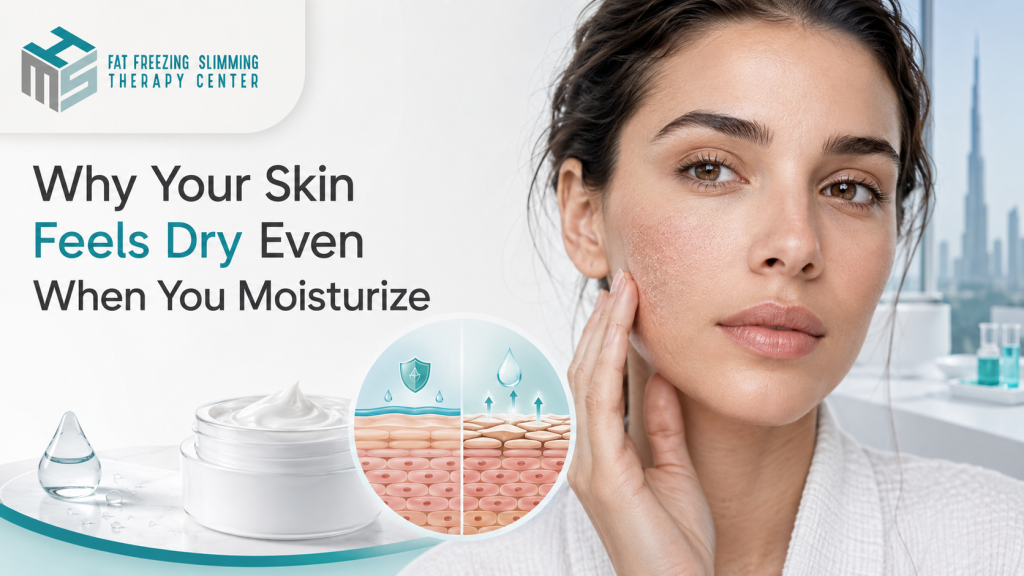
Why Your Skin Feels Dry Even When You Moisturize
You apply moisturizer in the morning, repeat it before bed and may even carry a small tube in your bag. Yet your face still feels tight by midday. Makeup settles into fine lines, the cheeks appear rough, and certain products sting as soon as they touch the skin.
This does not always mean you need a heavier moisturizer.
Persistent dryness can involve the condition of the skin barrier, the ingredients in your routine, the way products are applied, indoor air conditioning, excessive exfoliation or an underlying skin condition. A moisturizer can temporarily soften the surface without correcting the reason moisture is escaping.
An effective Skin Treatment plan begins by identifying whether the skin is genuinely dry, temporarily dehydrated, irritated or affected by a condition that requires medical assessment. Treating every form of tightness with more cream can hide the pattern without solving it.
This guide explains why moisturizer sometimes appears to stop working, how Dubai’s climate can complicate hydration and when professional guidance may be appropriate.
Important: This article provides general educational information and is not a medical diagnosis. Persistent itching, cracking, bleeding, rash, swelling or painful skin should be assessed by a qualified dermatologist or healthcare professional.
Dry Skin and Dehydrated Skin Are Not the Same
“Dry” and “dehydrated” are often used interchangeably, but they describe different concerns.
Dry skin is generally associated with insufficient oil or lipids. It may feel rough, flaky or uncomfortable and can be influenced by genetics, age, medical conditions and environmental exposure.
Dehydrated skin lacks water. It is a temporary condition that can affect dry, normal, combination or oily skin. Someone can therefore have an oily forehead while experiencing tightness, fine dehydration lines and sensitivity on the cheeks.
A suitable Skin Treatment should account for both oil and water balance instead of assuming that every tight-feeling complexion needs a thick occlusive cream.
Dry vs Dehydrated Skin Comparison
| Feature | Dry skin | Dehydrated skin |
|---|---|---|
| Main issue | Insufficient natural oils or barrier lipids | Insufficient water within the upper skin |
| Typical feeling | Rough, flaky, itchy or persistently tight | Tight, dull or temporarily uncomfortable |
| Oil production | Usually low | May be low, normal or high |
| Appearance | Scaling, rough patches or fine cracking | Dullness and more visible fine lines |
| Common triggers | Genetics, ageing, harsh cleansers, skin conditions | Air conditioning, weather, over-exfoliation, unsuitable routines |
| Basic support | Emollients, ceramides and occlusives | Humectants plus barrier-supporting moisturizer |
| Professional approach | Barrier-focused Skin Treatment or medical review | Hydration-focused facial after assessment |
The distinction matters because a water-focused serum may not provide enough lipid support for truly dry skin. Conversely, a heavy balm can seal the surface without supplying sufficient hydration to dehydrated skin.
How the Skin Barrier Controls Moisture
The outermost portion of the epidermis is often described using a “bricks and mortar” comparison. Skin cells act like bricks, while lipids—including ceramides, cholesterol and fatty acids—help form the surrounding mortar.
When this structure is healthy, it limits the amount of water escaping from the skin and helps protect against irritants. When disrupted, transepidermal water loss can increase. The skin may then feel tight shortly after moisturizing because the newly added moisture is not being retained effectively.
A damaged barrier may also cause:
- Burning or stinging
- Increased sensitivity
- Rough texture
- Redness
- Flaking
- Sudden reactions to familiar products
- A shiny yet tight complexion
- Greater discomfort after cleansing
The correct Skin Treatment should therefore focus on barrier recovery rather than repeatedly stripping and resurfacing already vulnerable skin.
1. You Are Applying Moisturizer to Completely Dry Skin
Timing changes how a moisturizer performs.
Moisturizers do not simply “add water.” Many work partly by slowing evaporation and helping retain moisture already present near the skin’s surface. Applying the product immediately after gentle cleansing—while the skin is slightly damp—can help trap some of that moisture.
The American Academy of Dermatology recommends applying moisturizer soon after washing and favoring creams or ointments when skin is very dry.
A practical sequence is:
- Cleanse with lukewarm water.
- Pat the skin gently rather than rubbing it dry.
- Apply any suitable hydrating serum.
- Follow promptly with moisturizer.
- Use sunscreen during the daytime.
Do not leave the skin dripping wet, particularly when using medicated products whose directions require dry skin. Product instructions and professional recommendations should always take priority.
2. Your Moisturizer Does Not Match Your Skin’s Needs
A product labelled “hydrating” may rely primarily on one type of ingredient. Effective moisturizers commonly combine three functional groups.
Humectants
Humectants attract and hold water. Examples include:
- Glycerin
- Hyaluronic acid
- Urea
- Panthenol
- Sodium PCA
Emollients
Emollients smooth spaces between surface cells and improve softness. Examples include:
- Squalane
- Certain plant oils
- Fatty acids
- Shea butter
- Esters
Occlusives
Occlusives create a film that reduces water loss. Examples include:
- Petrolatum
- Mineral oil
- Dimethicone
- Waxes
- Lanolin, when tolerated
A lightweight gel containing humectants may feel refreshing but may not be sufficient for a compromised barrier. A thick occlusive product may reduce water loss but feel uncomfortable on acne-prone skin.
The right Skin Treatment and home routine depend on the person’s skin type, climate exposure, sensitivity and other products. “Heavier” is not always “better.”
3. Your Cleanser Is Removing Too Much Oil
Cleansing should remove sunscreen, makeup, pollution and excess oil without leaving the face feeling stripped.
A squeaky-clean sensation is not evidence of superior cleansing. It can indicate that too much surface lipid has been removed. Strong surfactants, fragranced soaps, repeated cleansing and very hot water may worsen tightness.
Signs that a cleanser may be too harsh include:
- Immediate tightness after rinsing
- Redness around the nose or mouth
- Stinging when moisturizer is applied
- Flaking despite oily areas
- A feeling that moisturizer “disappears” quickly
Try a gentle, fragrance-free cleanser and avoid washing more often than necessary. People wearing water-resistant sunscreen or makeup may benefit from a careful evening double cleanse, but both stages should remain gentle.
A professional Skin Treatment cannot compensate for barrier damage that is recreated at home every morning and evening.
4. You Are Exfoliating More Than Your Skin Can Tolerate
Exfoliation can improve surface smoothness and remove accumulated cells, but frequency matters.
Potentially irritating products include:
- Glycolic acid
- Salicylic acid
- Lactic acid
- Retinoids
- Physical scrubs
- Cleansing brushes
- At-home peeling solutions
- Multiple “brightening” products used together
A common problem is not one unusually strong product but the combined burden of several mild actives. Someone may use an exfoliating cleanser, acid toner, retinol and weekly peel without recognizing that the same barrier is being challenged repeatedly.
If the skin suddenly feels dry, shiny, sensitive and tight, pause non-essential actives and simplify the routine. A gentle cleanser, suitable moisturizer and sunscreen may be enough while the skin settles.
Do not attempt to remove visible flaking with additional scrubbing. Flaking can be a sign that the skin needs less intervention.
5. Your Hyaluronic Acid Serum Is Not a Complete Moisturizer
Hyaluronic acid is a humectant, not a complete barrier-repair strategy.
It can help bind water, but a serum containing hyaluronic acid may need to be followed with an emollient or occlusive moisturizer. Applying the serum alone and allowing it to dry may leave some users feeling tight, especially in heavily air-conditioned environments.
A more balanced routine might include:
- Hydrating serum on slightly damp skin
- Ceramide- or lipid-containing moisturizer
- Sunscreen during the day
- A more protective cream at night if necessary
Hyaluronic acid is not inherently drying, but expectations and product layering matter. The most effective Skin Treatment plan considers the entire routine rather than judging one fashionable ingredient in isolation.
6. Fragrance or Active Ingredients Are Irritating Your Skin
A moisturizer can contain helpful ingredients and still cause irritation.
Possible triggers include fragrance, essential oils, botanical extracts, preservatives or an active ingredient that the individual does not tolerate. Irritant or allergic contact dermatitis can resemble ordinary dryness but may also produce itching, redness, burning or swelling.
A product that stings is not necessarily “working.” Persistent burning should not be treated as proof that an ingredient is penetrating effectively.
The American Academy of Dermatology advises people with very dry skin to avoid fragranced products and notes that ingredients such as retinoids can worsen dryness in some cases.
When introducing a new product:
- Add one product at a time.
- Test it on a small area first.
- Avoid changing the entire routine simultaneously.
- Stop using it if significant irritation develops.
- Seek professional advice if the reaction persists.
This controlled approach helps identify triggers that would otherwise be hidden in a complicated routine.
7. Dubai’s Climate Is Creating a Moisture-Loss Cycle
Dubai presents a distinctive combination of outdoor heat and indoor cooling.
Outside, the skin encounters high temperatures, sunlight, perspiration, dust and rapid evaporation. Indoors, prolonged air-conditioning may expose it to cooler, drier air. Moving repeatedly between these environments can leave the skin feeling unsettled.
Other local factors include:
- Long periods inside air-conditioned offices
- Strong ultraviolet exposure
- Frequent showering after sweating
- Chlorinated swimming pools
- Travel between humid and dry environments
- Dehydration during busy schedules
- Heavy sunscreen and makeup removal
These factors do not mean everyone in Dubai needs the same Skin Treatment. Someone with oily, congested skin may need gentle hydration without a very rich cream, while a person using acne medication may need greater barrier support.
Daily broad-spectrum sunscreen is also essential. Sun exposure can worsen irritation, uneven tone and barrier stress. Choose a texture that you can apply consistently and reapply when appropriate.
8. Your Shower or Washing Habits Are Worsening Dryness
Long, hot showers feel relaxing but can remove protective surface oils. The face may also be exposed indirectly when steam and hot water run over it.
Try:
- Using warm rather than hot water
- Keeping showers reasonably short
- Choosing fragrance-free body cleansers
- Avoiding vigorous towel rubbing
- Moisturizing the face and body soon after washing
- Wearing gloves when handling detergents
The same principle applies to frequent handwashing. Cleansing remains important, but barrier-supporting care should follow repeated exposure to water and soap.
If dryness affects the entire body rather than only the face, review bathing habits, laundry products, occupational exposure and any new medication with an appropriate healthcare professional.
9. Your Skin May Need Ceramides and Lipids, Not More Water
Some people continuously add hydrating toners and serums but never replace the lipids needed to support the barrier.
Ceramide-containing moisturizers may help strengthen the outer layer, particularly when the skin feels sensitive or easily irritated. Other useful ingredients can include glycerin, petrolatum, dimethicone, urea or lactic acid, depending on the location and severity of dryness.
The AAD’s information on dry-skin diagnosis and treatment explains that dermatologists may recommend ingredients such as urea, ceramides, lactic acid or glycerol and may treat an underlying condition when present.
Certain ingredients can sting damaged or cracked skin. Urea and acids, for example, are not automatically appropriate for every face. Seek guidance when choosing a Skin Treatment for highly reactive skin.
10. An Underlying Condition May Be Causing the Dryness
Persistent dryness is sometimes more than a cosmetic concern.
Possible causes can include:
- Atopic dermatitis
- Contact dermatitis
- Psoriasis
- Ichthyosis
- Thyroid disorders
- Diabetes
- Kidney disease
- Hormonal changes
- Nutritional issues
- Medication side effects
This list is not intended for self-diagnosis. Many of these conditions require characteristic symptoms, medical history, examination or testing.
Consult a dermatologist or physician if dryness is severe, widespread, painful, itchy, cracked, bleeding or accompanied by a rash. Also seek advice when symptoms appear suddenly, interfere with sleep or fail to improve after simplifying the routine.
A facial or cosmetic Skin Treatment should not be used as a substitute for medical care when a disease may be present.
Moisturizer Mistakes vs Better Alternatives
| Common mistake | Why it may fail | Better approach |
|---|---|---|
| Applying only after skin is completely dry | Misses the opportunity to retain post-cleansing moisture | Apply promptly to slightly damp skin |
| Choosing by popularity | The formula may not match your barrier or skin type | Select ingredients based on actual needs |
| Using only hyaluronic acid | A serum may not reduce water loss sufficiently | Follow with a suitable moisturizer |
| Exfoliating visible flakes | Can cause further irritation | Reduce actives and support the barrier |
| Using very hot water | Removes protective surface oils | Use lukewarm water |
| Applying more fragranced cream | May intensify irritation | Choose a simple, fragrance-free formula |
| Changing five products at once | Makes reactions difficult to identify | Introduce products individually |
| Booking aggressive procedures | Vulnerable skin may react poorly | Begin with assessment and gentle care |
When Professional Skin Treatment May Help
Professional care can be useful when the skin is dull, mildly congested or dehydrated and home care alone is not producing the desired improvement.
A well-planned Skin Treatment may combine cleansing, gentle exfoliation and hydration while accounting for sensitivity. However, the treatment should be selected after assessing the skin—not simply because a procedure is popular.
HMS Fat Freezing explains the differences between hydration-focused procedures and traditional approaches in its guide to HydraFacial versus classic facial.
HydraFacial-style treatments may be considered for some people because they combine cleansing, exfoliation, extraction and serum delivery. Those interested in the treatment can review the HMS guide to the best HydraFacial in Dubai.
Professional treatment is not suitable for every form of dryness. Active dermatitis, infection, open wounds, severe irritation or unexplained symptoms may require medical clearance.
A Practical Seven-Day Barrier Reset
When dryness appears related to product overload rather than a medical condition, a short simplified routine may help reveal whether irritation is contributing.
Morning
- Rinse gently or use a mild cleanser if needed.
- Apply a fragrance-free moisturizer.
- Use broad-spectrum sunscreen.
Evening
- Remove makeup and sunscreen gently.
- Cleanse with lukewarm water.
- Apply a barrier-supporting moisturizer.
- Use an occlusive product only on appropriate dry areas if tolerated.
Temporarily Pause
- Facial scrubs
- Strong exfoliating acids
- At-home peels
- New retinoids
- Fragranced masks
- Cleansing brushes
- Unnecessary active serums
This is not a medical Skin Treatment plan, and prescription products should not be discontinued without advice from the prescriber. If symptoms worsen or do not improve, obtain professional assessment.
Pros and Cons of Professional Hydrating Treatments
Potential Benefits
- Can provide controlled cleansing and exfoliation
- May improve temporary dehydration and dullness
- Allows treatment selection based on skin assessment
- Can help remove surface buildup gently
- May support a smoother, more refreshed appearance
- Offers professional guidance on home-care routines
Possible Limitations
- Results may be temporary without appropriate home care
- Treatment cannot cure an undiagnosed skin disease
- Over-exfoliation may worsen a damaged barrier
- Some products can trigger sensitivity
- Multiple sessions may be recommended
- Individual results vary
- Medical concerns require a dermatologist rather than a cosmetic facial
The purpose of a hydrating Skin Treatment should be to support the skin—not force it to peel, sting or look inflamed.
Expert Recommendations From HMS Fat Freezing
Start With the Barrier, Not the Trend
At HMS Fat Freezing, we recommend evaluating current sensitivity, recent procedures, active ingredients and lifestyle exposure before choosing a Skin Treatment. A procedure that suits resilient, oily skin may be inappropriate for a dry, reactive complexion.
Bring Your Current Product List
Clients should record or photograph the cleansers, serums, moisturizers, prescription products and sunscreens they use. This often reveals repeated ingredients or an overly complicated routine.
Separate Dryness From Congestion
Dry skin can still develop clogged pores. Aggressive extraction or strong acids are not the only answers. A balanced treatment may address congestion while limiting unnecessary barrier stress.
Readers can explore how treatment selection varies by concern in the HMS guide to the best skin treatments for glowing skin in Dubai.
Do Not Chase Immediate Tightness
Some clients associate a tight post-facial feeling with cleanliness. In reality, excessive tightness may indicate stripping. Comfortable, calm skin is a more useful objective.
Match Frequency to the Skin
Monthly treatment may suit some routines, while others need longer recovery intervals. The HMS guide to monthly facial treatment explains why frequency should depend on skin condition, objectives and procedure intensity.
Refer Medical Concerns Appropriately
Cosmetic professionals should recognize when symptoms fall outside normal aesthetic care. Persistent rash, severe itching, broken skin or suspected dermatitis should be referred to a dermatologist or physician.
Authoritative Resources for Dry-Skin Care
For evidence-based information, readers can consult:
- American Academy of Dermatology: Tips for relieving dry skin
- American Academy of Dermatology: Dry-skin diagnosis and treatment
- Mayo Clinic: Dry-skin diagnosis and treatment
- DermNet: Dry skin
- National Eczema Association: Moisturizing guidance
These sources provide general information. A personal diagnosis still requires an appropriate clinical assessment.
Frequently Asked Questions
1. Why does my skin feel dry immediately after moisturizing?
The formula may be too light, it may lack sufficient emollient or occlusive ingredients, or your barrier may be losing water rapidly. Harsh cleansing and over-exfoliation can also make moisturizer feel ineffective.
2. Can oily skin be dehydrated?
Yes. Oil and water are different components. Oily skin may still feel tight, look dull or show dehydration lines. A lightweight, non-comedogenic Skin Treatment or moisturizer may be more appropriate than trying to remove all surface oil.
3. How can I tell whether my skin barrier is damaged?
Possible signs include burning, redness, roughness, flaking and increased sensitivity to familiar products. These signs are not specific to barrier damage, so persistent symptoms should be professionally assessed.
4. Should moisturizer be applied to wet or dry skin?
For ordinary moisturizers, application to slightly damp skin can help retain moisture. Do not apply products to dripping-wet skin, and follow specific instructions for prescription treatments or potentially irritating active ingredients.
5. Is hyaluronic acid enough for very dry skin?
Usually not by itself. Hyaluronic acid is a humectant and may need to be followed by a moisturizer containing emollient, barrier-supporting or occlusive ingredients.
6. How long does a damaged skin barrier take to recover?
Minor irritation may improve within days after removing the trigger, while more significant damage can take several weeks. Continued exposure, dermatitis or medical conditions can extend recovery. Seek advice if symptoms persist.
7. Can drinking more water cure dry skin?
Adequate hydration supports general health, but drinking extra water does not automatically repair a disrupted skin barrier. Topical care, environmental exposure and underlying causes must also be considered.
8. Which professional Skin Treatment is best for dehydrated skin?
There is no single treatment for everyone. A hydrating facial or HydraFacial may suit some clients, but sensitivity, active conditions, medication and recent procedures must be assessed first.
9. Why does my moisturizer sting?
Stinging can occur when the barrier is damaged or when the formula contains an irritating ingredient. Stop products that cause significant or persistent burning and consult a dermatologist if the reaction continues.
10. When should I see a dermatologist about dry skin?
Seek medical assessment when dryness is severe, painful, widespread, cracked, bleeding, intensely itchy or associated with rash or swelling. You should also seek help if appropriate home care does not improve it.
Conclusion
When moisturizer does not relieve dryness, the answer is rarely to apply unlimited layers of the same product.
The skin may be losing water because its protective barrier has been disrupted. Your cleanser may be too harsh, your exfoliation schedule may be too aggressive, or your moisturizer may not provide the balance of humectants, emollients and occlusives your skin needs. Dubai’s combination of outdoor heat and indoor air conditioning can add another layer of stress.
Begin by simplifying the routine and observing when tightness appears. Apply moisturizer correctly, reduce avoidable irritants and select products according to the skin’s condition rather than social-media popularity.
Professional Skin Treatment can support hydration, texture and overall appearance when it is selected thoughtfully. It should complement good home care and never replace medical evaluation for persistent or severe symptoms.
Comfortable skin is not created by using the greatest number of products. It is created by understanding what the barrier needs, removing what is repeatedly damaging it and allowing enough time for recovery.
Contact HMS Fat Freezing
HMS Fat Freezing
Address: HAMSAH BUILDING, OFFICE 407 & 408, BLOCK-A, Business Center – beside Ansar Gallery – Dubai
Phone: +971 4 583 2989
Email: info@hmsfatfreezing.com
Website: https://hmsfatfreezing.com/
Contact HMS Fat Freezing to arrange a professional consultation and discuss a suitable Skin Treatment for your concerns.